Featured series


Science & Tech
When the sea steals homes and jobs
Makoko, a fishing community and informal settlement on a lagoon in Lagos, Nigeria, is built on stilts, allowing residents to live with the rising and falling water.
Photos and video by David Trilling
Along West Africa’s Gulf of Guinea, Salata Institute research is helping communities and governments weigh excruciating choices about what to protect, how to adapt, and when to retreat
One night about two years ago, the sea came and swallowed Josephine Domevenu’s shop, a kiosk where she sold clothing and packaged snacks: “It happened so fast, I didn’t have time to get anything out.”
Her house, set a few blocks from the water in Keta, a narrow strip of land in eastern Ghana, was still safe. But within a year, the Atlantic lapped at her door. Then came another storm. The sea tore through several rooms and overturned her grandparents’ graves in the garden, filling the cinderblock tombs with sand — a baleful omen for Domevenu and her three children.
“The sea is angry with us,” she said.
Keta is perched uneasily between the Atlantic and a flood-prone lagoon. The beaches have always shifted here; an eastward-racing current both erodes and replenishes the sand. But in recent decades, across West Africa’s Gulf of Guinea, ports, dams, and coastal construction have disrupted that balance.
Now climate change is making storms more violent and rains harder, deadlier, and less predictable. The sea is taking more land. Some stretches of the West African coast are losing more than 30 feet a year.
How these communities can adapt was the focus of a three-year project led by Harvard’s Salata Institute that examined what interventions remain possible as growing coastal populations in resource-constrained countries face a rapidly advancing sea.
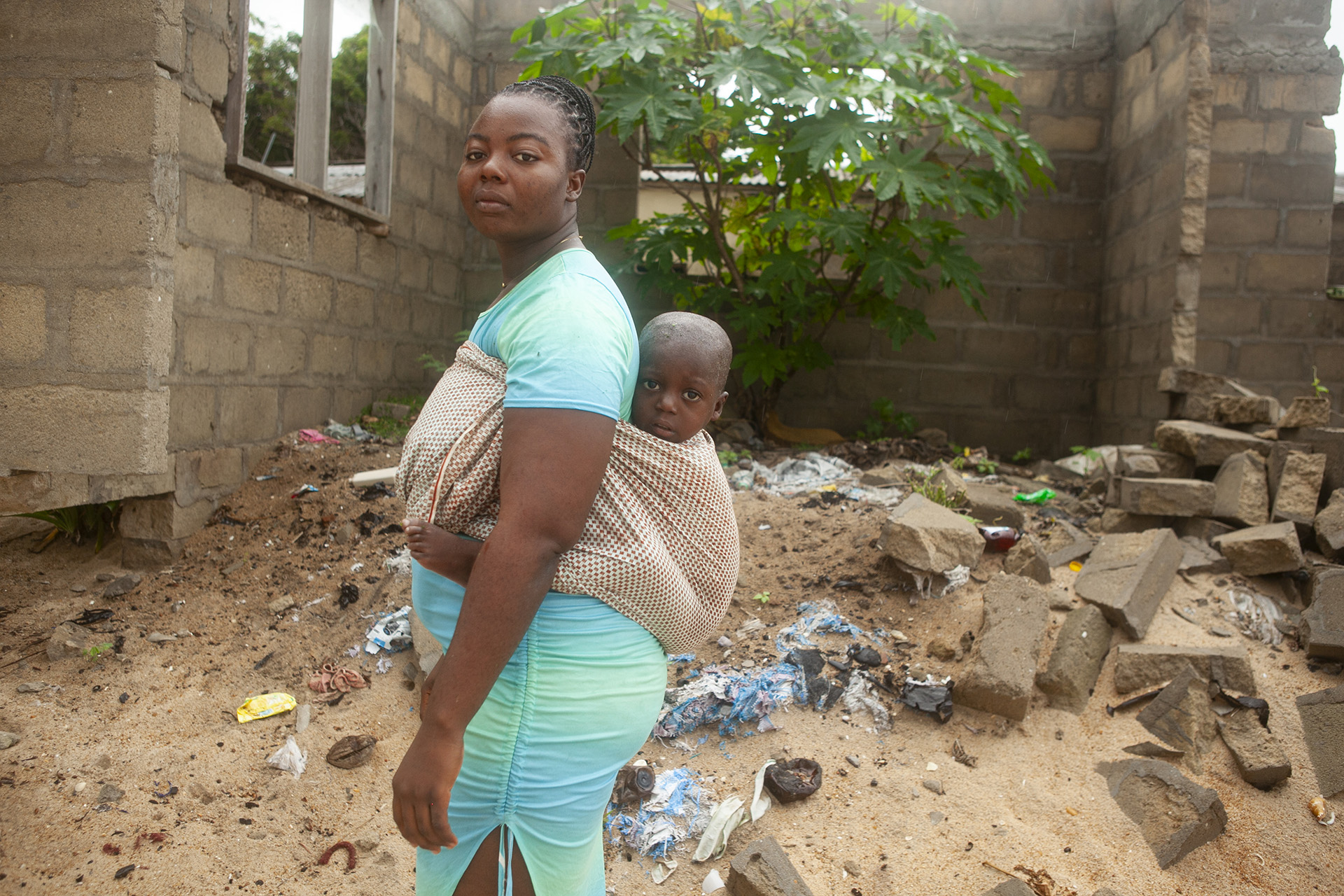
Josephine Domevenu, 25, with one of her three children. Her Keta, Ghana, home, seen here in the background, has been repeatedly damaged by the sea over the last two years. Previously she lost her shop, where she sold food and clothing, and all her merchandise. Her grandparents’ graves, outside her home, were also washed away. “It’s really painful.”
David Trilling
Working with universities in Ghana, Côte d’Ivoire, and Nigeria, the research team modeled future sea-level rise, flood exposure, and erosion; assessed the costs and benefits of managed retreat; and looked beyond the shoreline, suggesting financing options and ways to adapt to the collapse of fisheries that have long provided West African nations with a stable source of protein. The goal was not just to produce research, but to strengthen local capacity and put solutions on the table.
“We did not arrive with science and tell people, in many elaborate ways, that they are in trouble,” said Emmanuel Akyeampong, the principal investigator and the Ellen Gurney Professor of History and Professor of African and African American Studies. “Our project instead asked what can be done with the resources actually available. Communities are eager to feel that they are not helpless.”
‘Shifting the problem’
There is one room left at Domevenu’s home and, for now, a reprieve. This year, Ghana’s government has built several dozen groynes — stone barriers set at right angles to the coast — about 700 feet apart to hold the beach in place.
They are working, but at a cost. By interrupting the natural flow of sand, typically both carried away and redeposited by the currents, the groynes starve beaches downdrift.
Not far, beyond the last groyne, Kwashiwor Dansa is watching the sea close in. For more than 30 years, she has made her living smoking anchovies, mackerel, and sardines over sugarcane husks, buying fresh from fishermen who land their catch outside her home in flat-bottomed canoes painted with names like “Hope in God” and “Who Knows Tomorrow.”
“The sea is getting closer now,” Dansa said, explaining that erosion on her stretch of beach started this spring with the arrival of the groynes. “I’m afraid. If the builders are not in a hurry to put one here, the sea will take our house in weeks. They’d better hurry.”
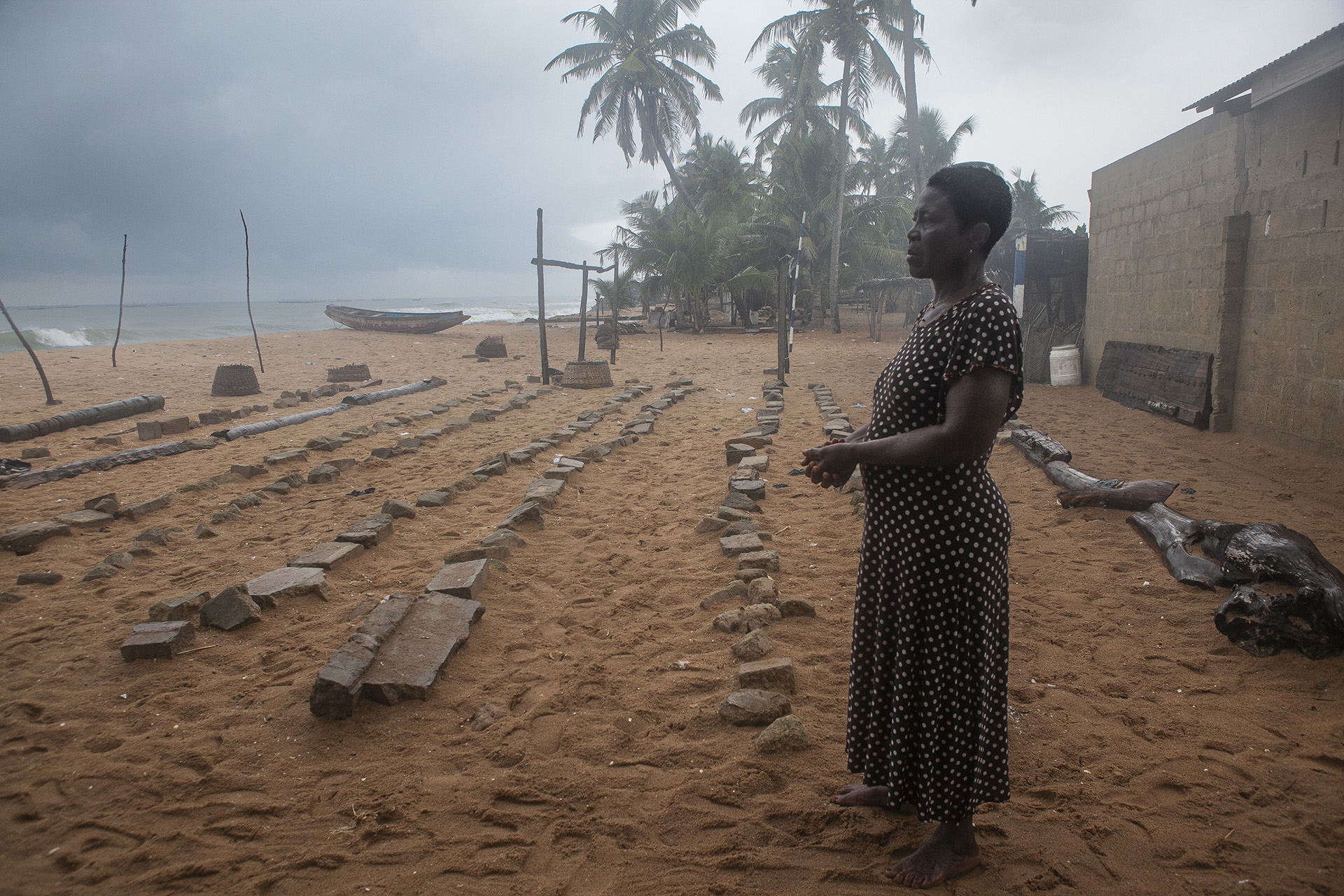
Because of new groynes nearby, Kwashiwor Dansa, 62, of Keta sees erosion outside her home bringing the sea closer and closer.
David Trilling
Though the groynes may provide a fix, they require constant, costly upkeep.
“They are a temporary fix,” said Kwasi Appeaning Addo, a coastal morphologist at the University of Ghana. “People are upset, so they shout at politicians and politicians dump boulders. But it just shifts the problem downdrift. We are not managing erosion; we are fighting erosion, and it’s a fight we cannot win.”
Addo points to nearby Benin as a model for nature-based protection. There, crews rebuilt beaches with sand dredged from the ocean and planted mangroves to hold it in place.
Equipping governments with useful findings
In June, Akyeampong and his co-investigators led a series of policy dialogues in Ghana, Côte d’Ivoire, and Nigeria, bringing researchers, planners, and government agencies together to confront the difficult choices facing coastal communities. The meetings put the project’s data, models, and planning tools in the hands of officials who could act on them.
Political scientist Robert Paarlberg, an associate at the Weatherhead Center, described how climate and demographic pressures are converging. “Not only are climate risks increasing, but population growth on these coasts is surging and putting more people at risk,” he said. “There is a demographic challenge as well as an atmospheric challenge, and the collision between these two is what’s creating the difficult policy choices these governments face today.”
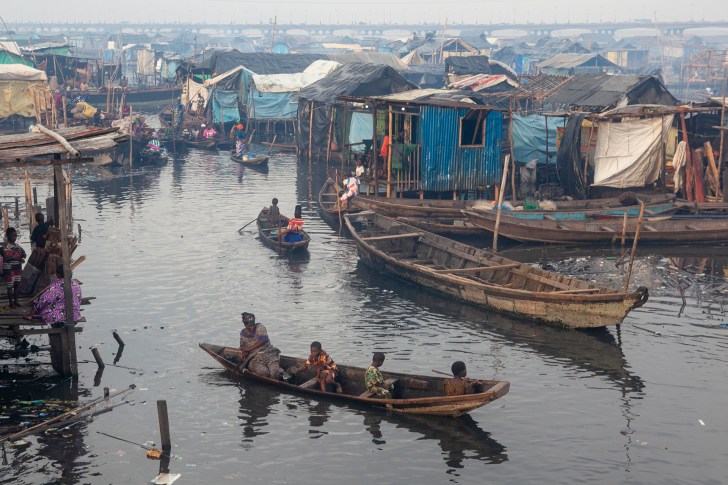
One place emblematic of that collision is Makoko, a fishing community in Lagos, Nigeria, built by its residents on stilts above a lagoon. Encircled by the megacity, thousands of people live in makeshift shelters, some with tarps for walls. They punt to their homes in canoes, the lack of sanitation masked by the smell and haze of smoking fish.
Residents describe their lives there as far from ideal. But Makoko, having adapted to the water’s rise and fall, offers lessons for governments that cannot engineer their way out of sea-level rise, said Mokolade Johnson, a landscape architect at the University of Lagos. “We must borrow ideas from the people of Makoko. We are not going to relocate to the Sahara Desert.”
The policy dialogues also tackled bread-and-butter concerns as traditional economic systems crumble. One approach is to seek adaptation in the blue economy: restoring marine ecosystems, sustaining ports and tourism, and vocational training to help fishing communities find new work as overfishing exhausts stocks and ocean warming drives fish farther from shore. That does not mean seawalls and other engineered defenses should be dismissed, Paarlberg said. But governments should weigh them against nature-based solutions, managed physical retreat from the shore, and “economic retreat” to alternative livelihoods.
The foundation of a home destroyed by coastal flooding in Okun Alfa.
A woman smoking fish at the shore in Accra, Ghana.
Planning with hope
In Lagos, a shortage of land makes relocation especially difficult for the poorest and most vulnerable.
At least once a week, high tide carries the Atlantic over the beach, past a mound of sand and cinderblocks that residents have piled at the top of Baale Street, and over the sandbags protecting Kudirat Abdulateef’s shop and home.
Abdulateef, who sells red pepper, cheese balls, and plastic bags, expects to be displaced — again.
“The sea is destroying my shop, my home. It is punishing my efforts to stop the water. But I have nowhere else to go,” she said. “I dream about the water. Things were not like this before.”
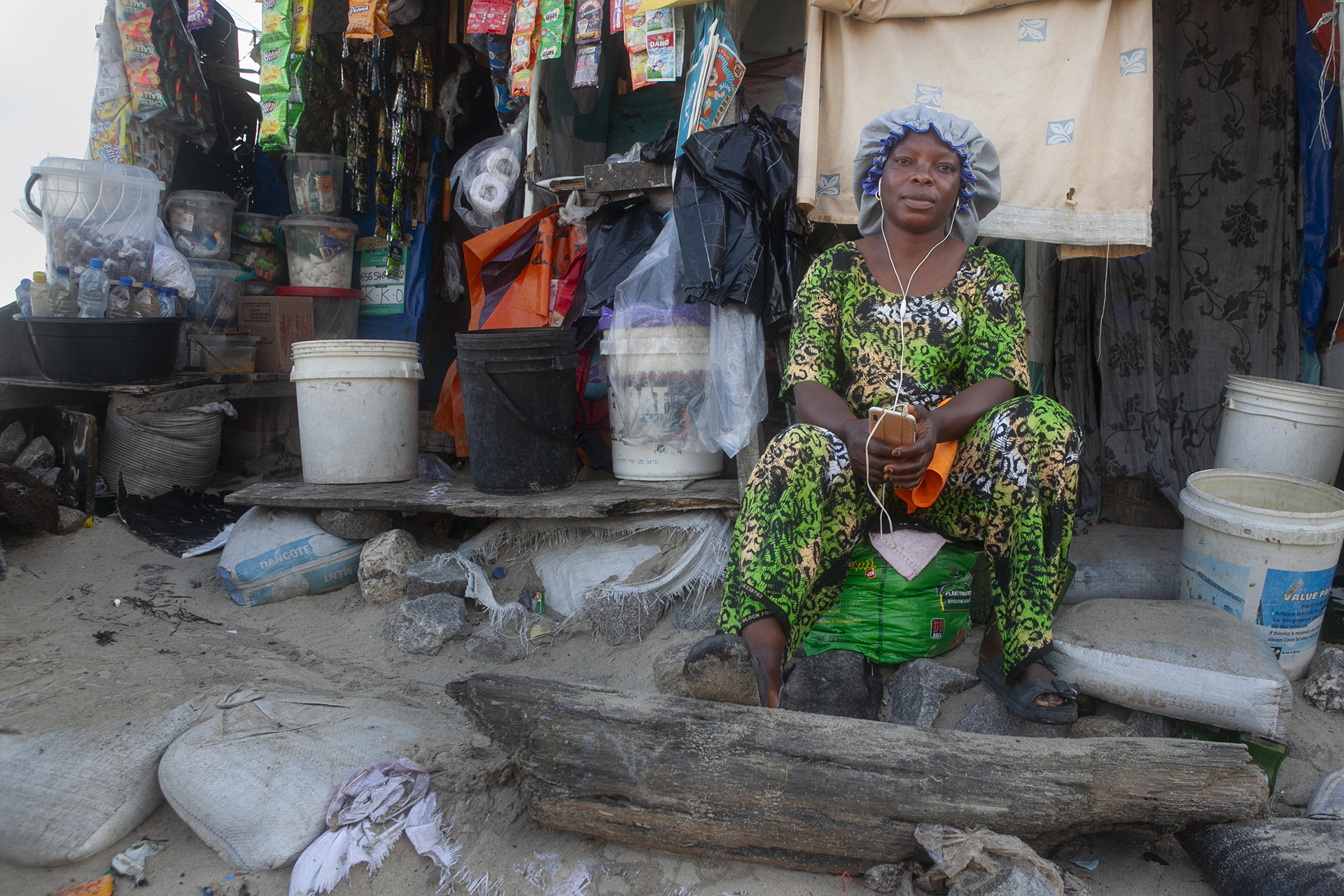
Her home sits between two groynes in Okun Alfa, a Lagos district where the sea has advanced about half a mile inland since the 1990s. Researchers say a luxury development built on an artificial island several miles to the west has worsened the erosion.
At the last groyne, the current curls back toward the land, scouring away a neighborhood in less than a decade.
As the sun set on a recent Saturday, Joseph, who has fished these waters for 54 years, stood thigh-deep in the riptide casting a net for sardines. His net once came back heaving. This time, when he emptied it onto the beach, it held mostly trash.
Okun Alfa is one of six communities featured in a portable “booxhibition” created by the research team for people experiencing coastal loss. Unfolding from a book-like box, the exhibition can be strung up quickly, showing maps, historical data, and illustrations of how the coastlines have changed and what they could look like in the decades ahead.
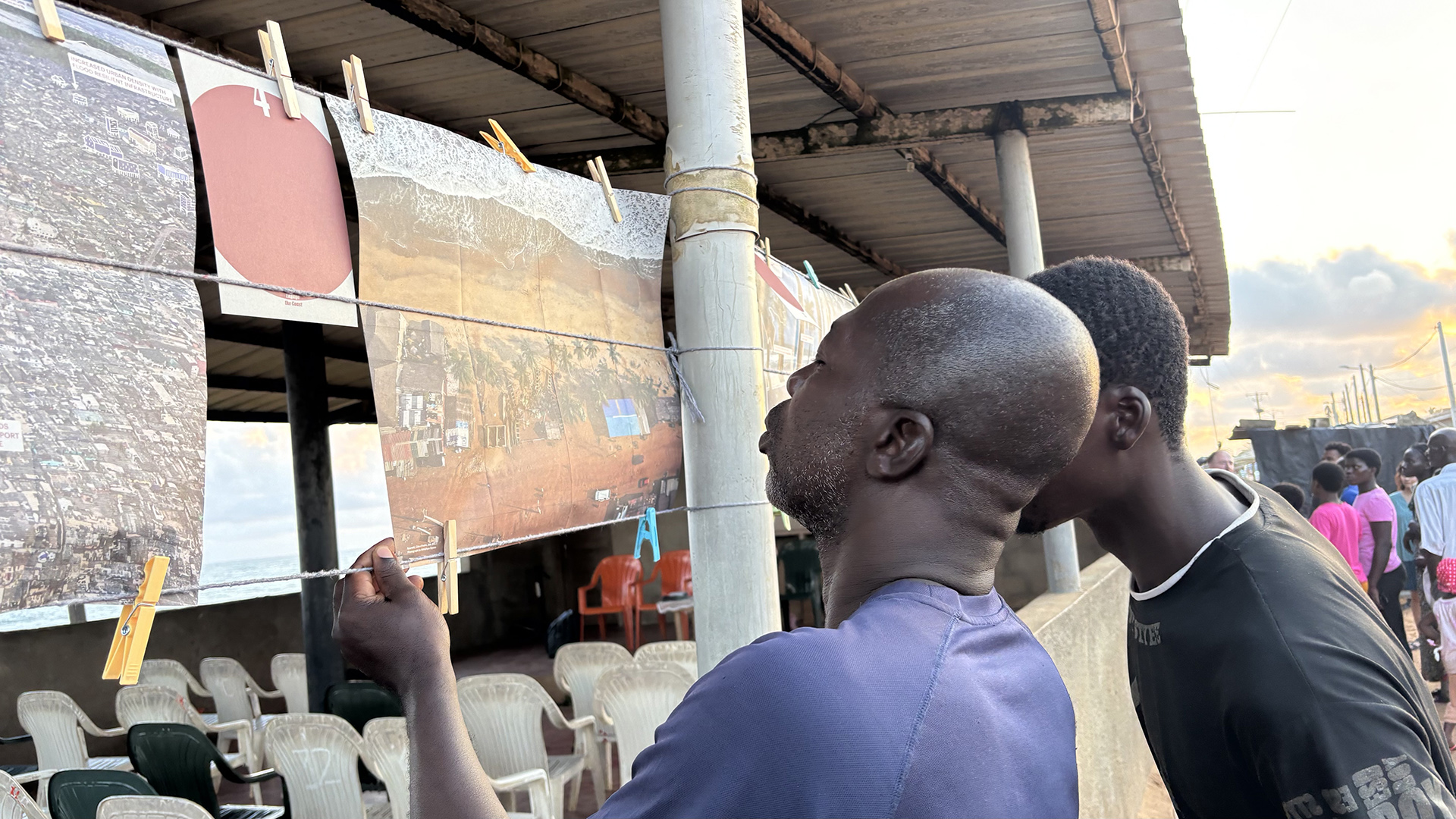
Akyeampong calls it a “visual rendering of the science” — a way to make sea-level projections, erosion models, and adaptation choices legible to the people most affected.
For Supriya Ambwani, a research associate at the Critical Landscapes Design Lab, the goal is not to prescribe a single solution, but to help communities imagine alternatives.
“It feels like a hopeless situation,” she said. “But once you start thinking of solutions, it creates something to work toward. Even if you don’t agree with all the ideas, it prompts people to engage differently.”
“If we don’t imagine what the future could look like,” Ambwani said, “we’re going to struggle to get there.”