Featured series


Science & Tech
Curios and curiouser
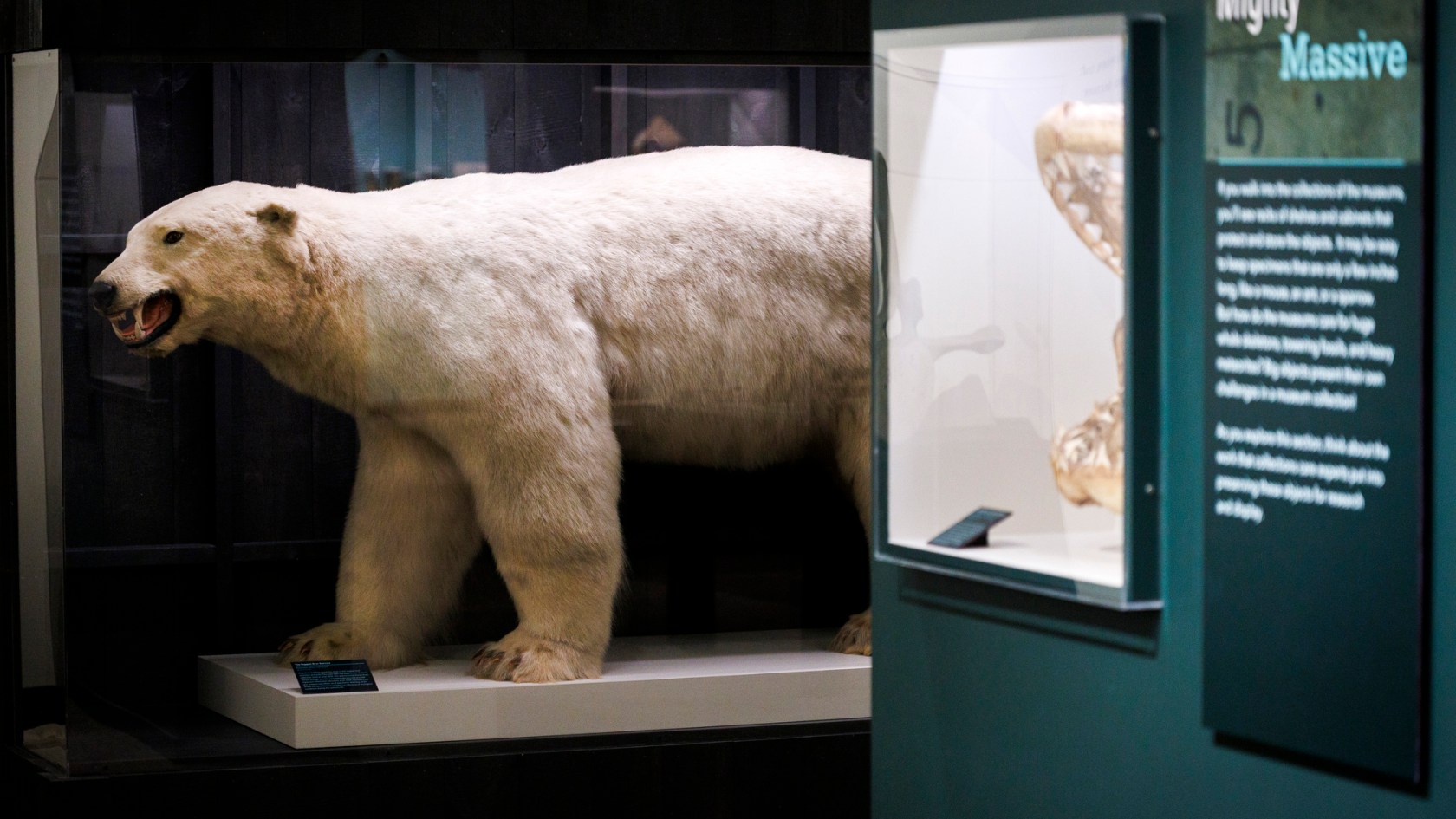
Polar bear from 1878.
Stephanie Mitchell/Harvard Staff Photographer
With exhibits including a dodo, fish mummified in pearl, and a ‘King Kong’-connected Komodo, ‘discovering the stories is one of the best jobs’
You’ve probably already marveled at the astonishingly realistic glass flowers on display at the Harvard Museum of Natural History as well as the whale skeletons suspended from the rafters in its Great Mammal Hall. But have you seen its dodo bird specimen or the Komodo dragon skull?
Both are showcased in the new exhibit “Collecting Wonders: Tomorrow’s Discoveries,” which has unearthed some of the rarest, oldest, biggest, and most beautiful treasures from the museum’s collection of more than 26 million individual objects. The show runs through the end of April in the main gallery space.
Gone, but not forgotten
Several specimens in the exhibit are no longer seen in the natural world.
One of the most famous examples of extinction — the flightless dodo, whose last widely accepted sighting was in 1662 — can be seen by visitors as a whole articulated skeleton. Wiped out by hunting, invasive species, and habitat loss, the dodo is a rare sighting for modern humans. The last time Harvard’s dodo was on display, nearly 20 years ago, it was shown alongside a model complete with feathers and simulated beak and feet.
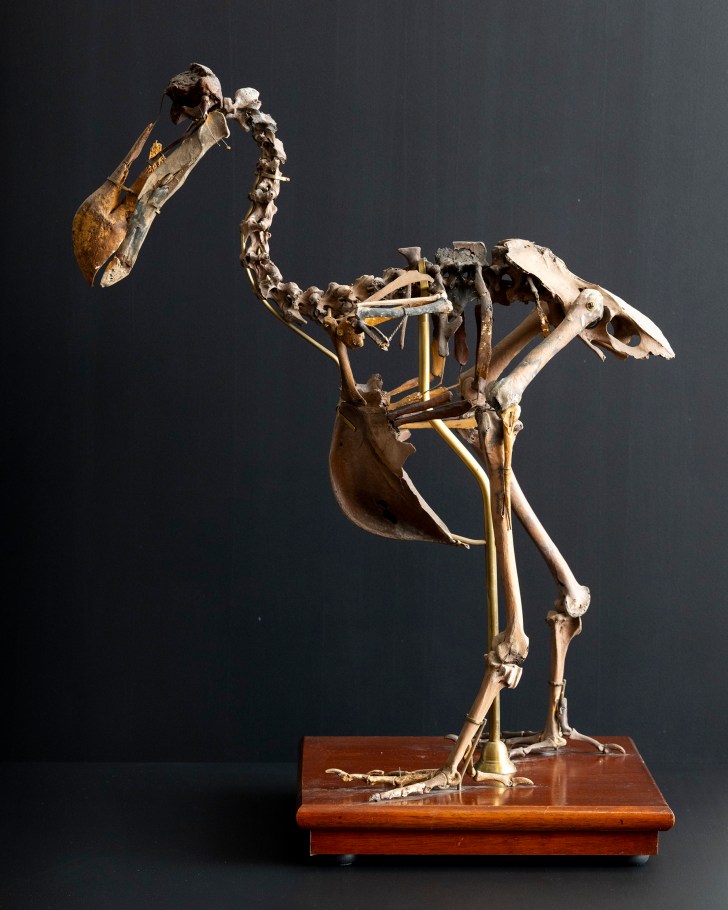
Dodo bird.
Photo by Tony Rinaldo
Visitors can also examine an extinct golden toad that once thrived in the Monteverde Cloud Forest Preserve of Costa Rica. Discovered in 1964 and declared extinct in 2004, the species is widely considered the “poster child” for extinct amphibians.
“The specimens provide a snapshot in time about a species and where it occurred,” said Jeremiah Trimble, curatorial associate and collection manager of ornithology. “People can use them to look at how genetics have changed within a species over time.”
A 300-million-year-old fern tells the story of a rapidly depleting resource. As ferns and other prehistoric plants decayed, they were buried under more and more plant matter, and over millions of years the pressure turned these plants into coal that fueled the Industrial Revolution.
“Dead plants and their data tell a surprising number of stories when you look closely, and discovering the stories is one of the best jobs,” said Michaela Schmull, director of collections and curator of ferns at the Harvard University Herbaria.
Cabinet of curiosities
Several items brought out for “Collecting Wonders” are of the more unique variety, including a Komodo dragon skull said to be from the hunt that inspired “King Kong.” In the 1933 movie, collectors travel to a distant island to trap a “monster,” and according to exhibit curators, the screenwriter was inspired by a real expedition to the island of Komodo in 1926 that brought back Komodo dragon specimens — including Harvard’s.
The exhibit also shows off an oyster circa 1856, in which a pearlfish — a species known for hiding inside the mollusks for protection — is mummified inside layers of mother of pearl.
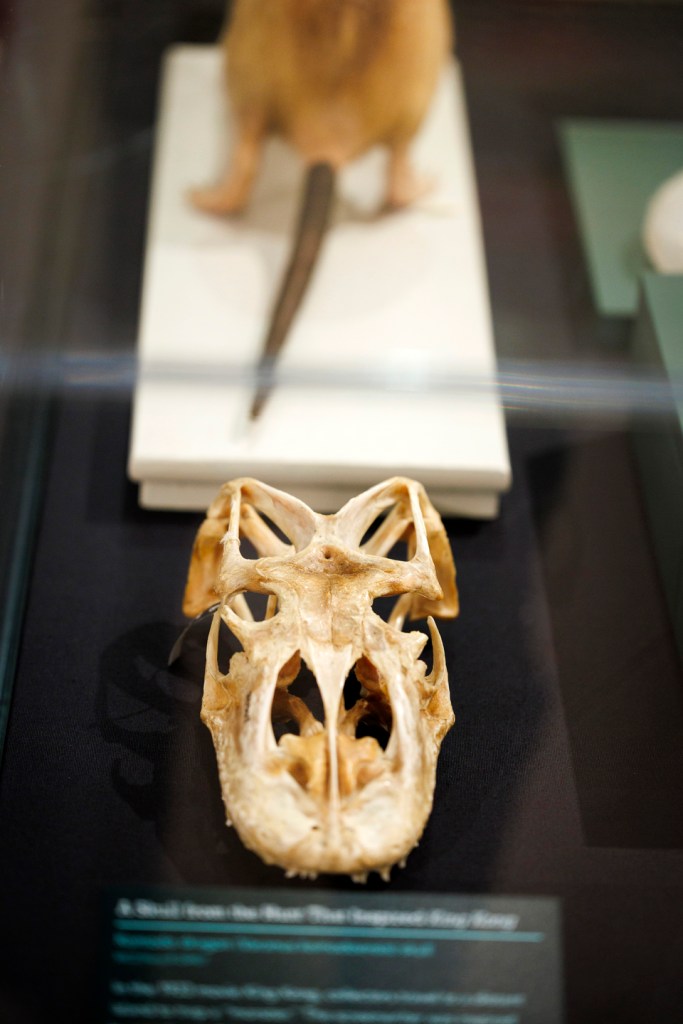
Komodo dragon skull.
Stephanie Mitchell/Harvard Staff Photographer
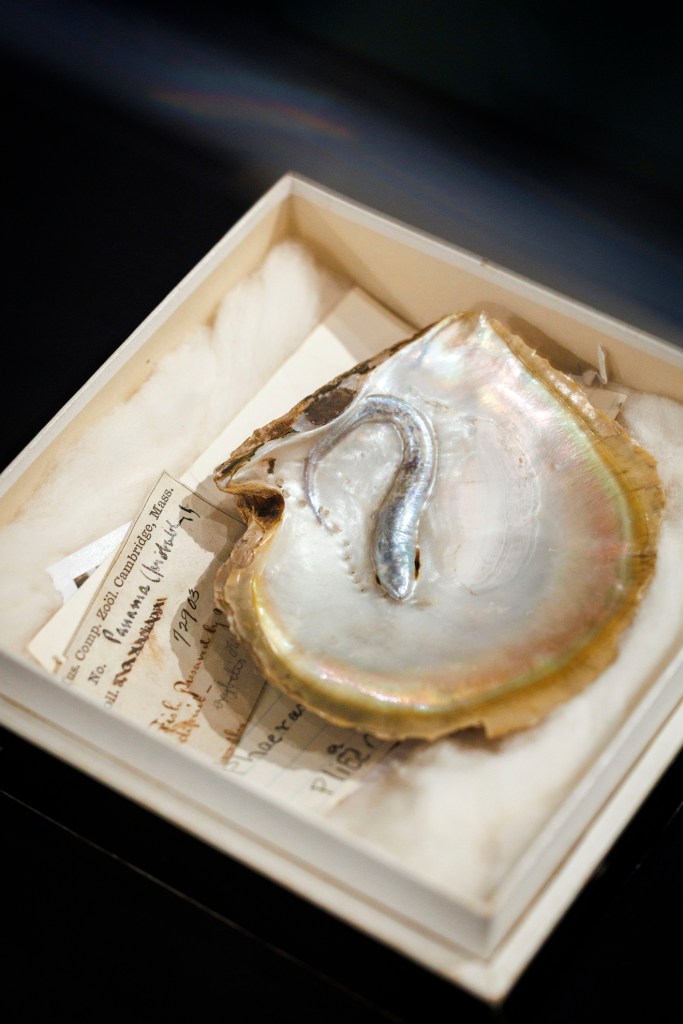
Pearl oyster with pearlfish.
Stephanie Mitchell/Harvard Staff Photographer
“Like a gruesome, fish-shaped pearl,” the exhibit reads.
And what may look like an ordinary blue morpho butterfly — striking in any form — is a specimen displaying bilateral gynandromorphism, meaning it has both female and male markings. One wing shows the male markings, while the other shows the female.
“That’s probably one of my favorites,” said museum spokesperson Bethany Carland-Adams. “It occurs in only one in 10,000 butterflies.”
Natural beauty
The exhibit brings together beautiful objects from several areas of study — precious gems and crystals glinting from behind glass cases next to fossils shined so smooth they almost look like granite.
In its raw form, a chunk of crystalline gold looks like a metallic piece of coral. The shape, caused by rapid growth, is exceedingly rare — displayed in less than 1 percent of the world’s gold.
In another case, a rough ruby alongside a cut ruby and a synthetic ruby showcase human innovation, and the powerful pairing of science and aesthetics.
“The beauty of this exhibit is what Harvard has been and Harvard is really about, which is this immense amount of knowledge that is spread in so many different ways,” said Raquel Alonso-Perez, curator of Harvard Mineralogical and Geological Museum. “It gives you a good glimpse of what all the collections at the Natural History Museum are.”
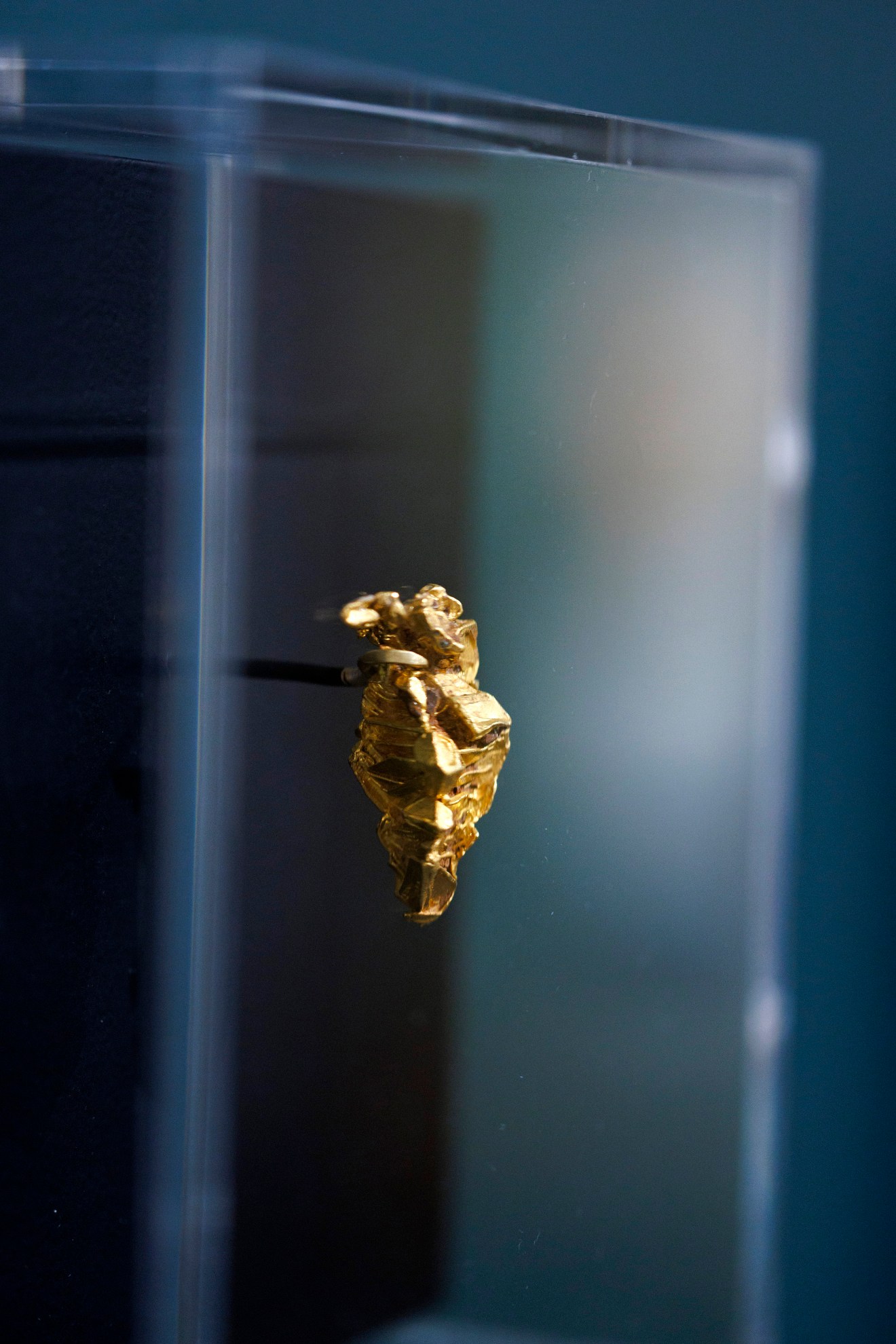
Crystalline gold.
Stephanie Mitchell/Harvard Staff Photographer
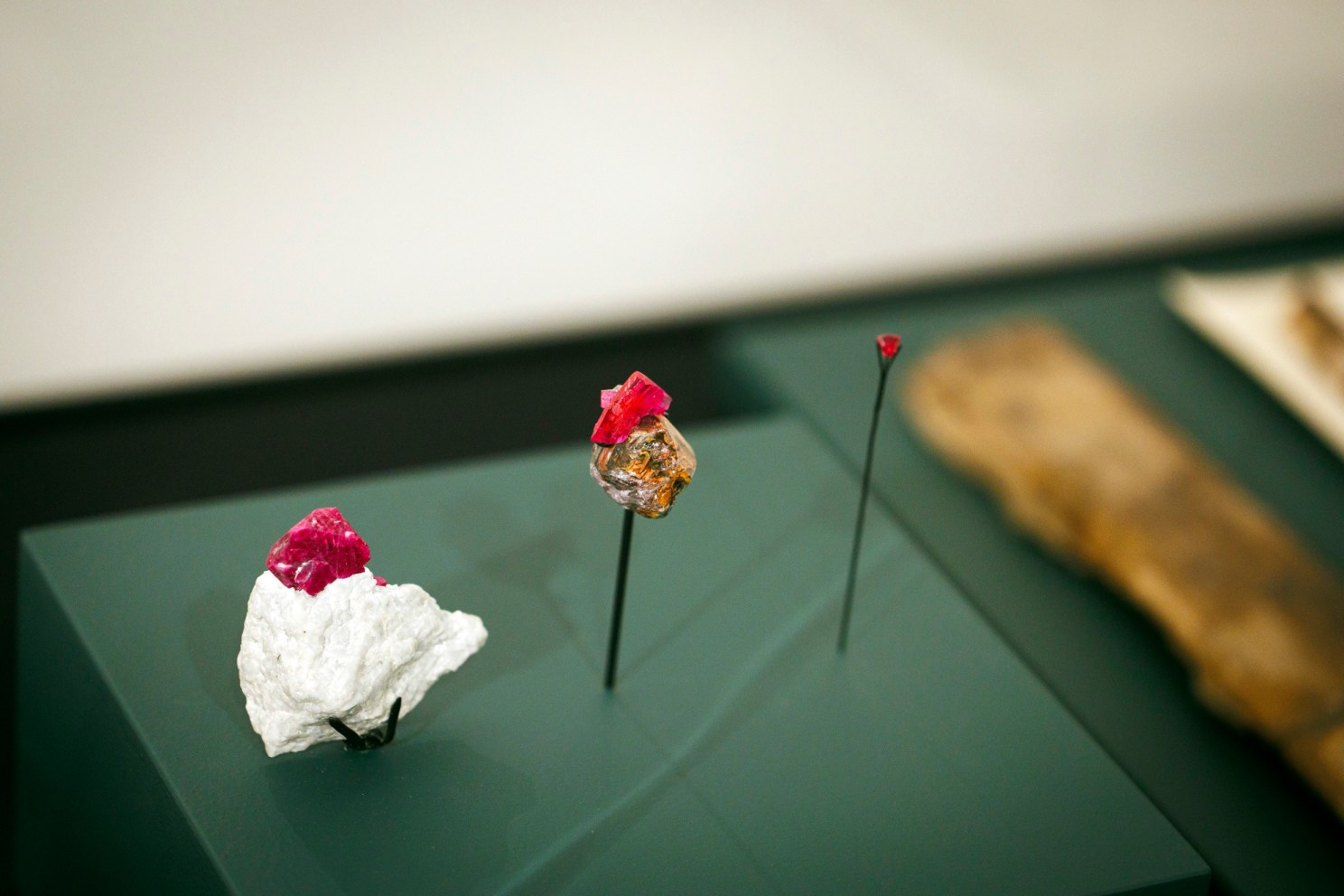
Rough ruby, cut ruby, and synthetic ruby.
Stephanie Mitchell/Harvard Staff Photographer
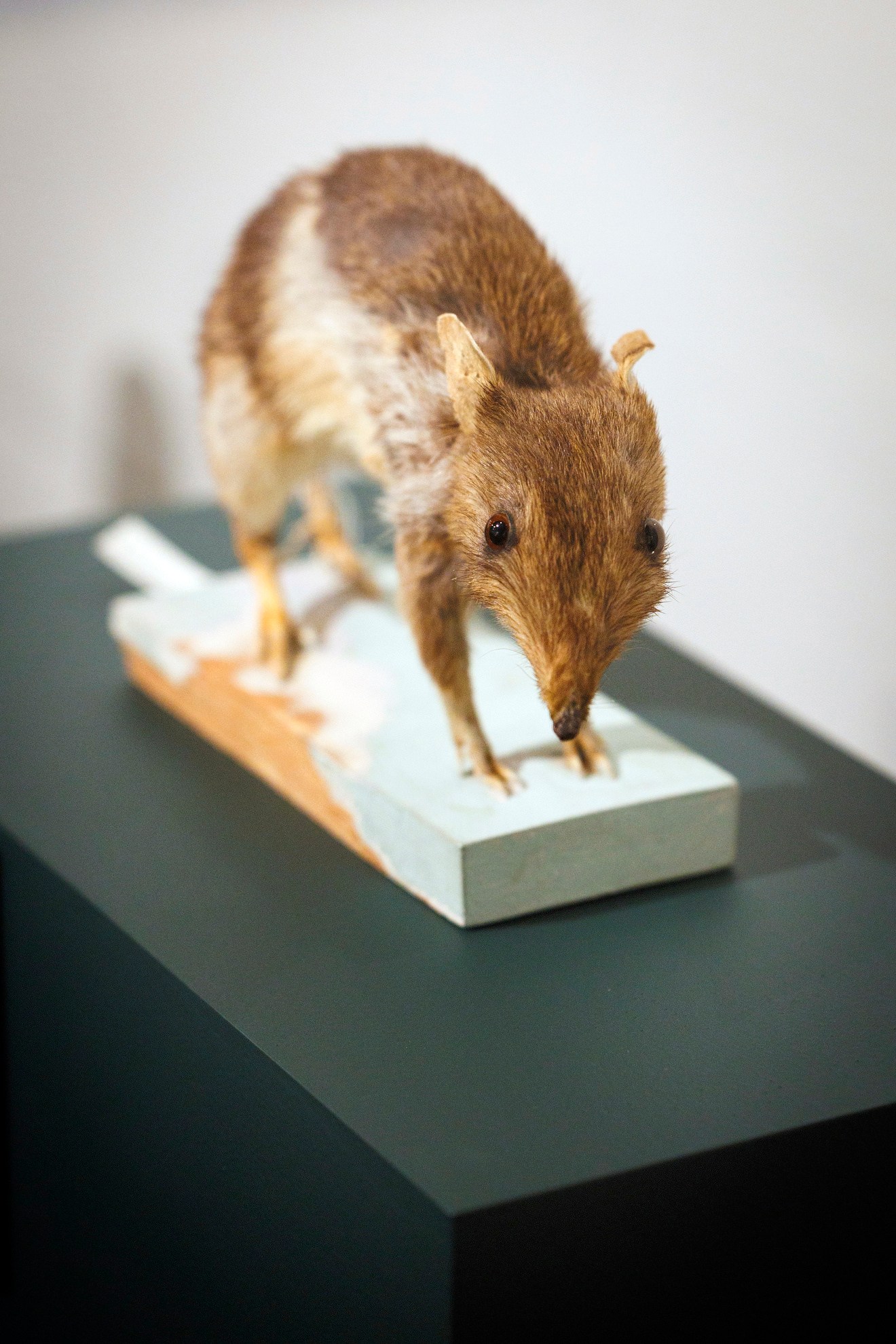
Western barred bandicoot.
Stephanie Mitchell/Harvard Staff Photographer
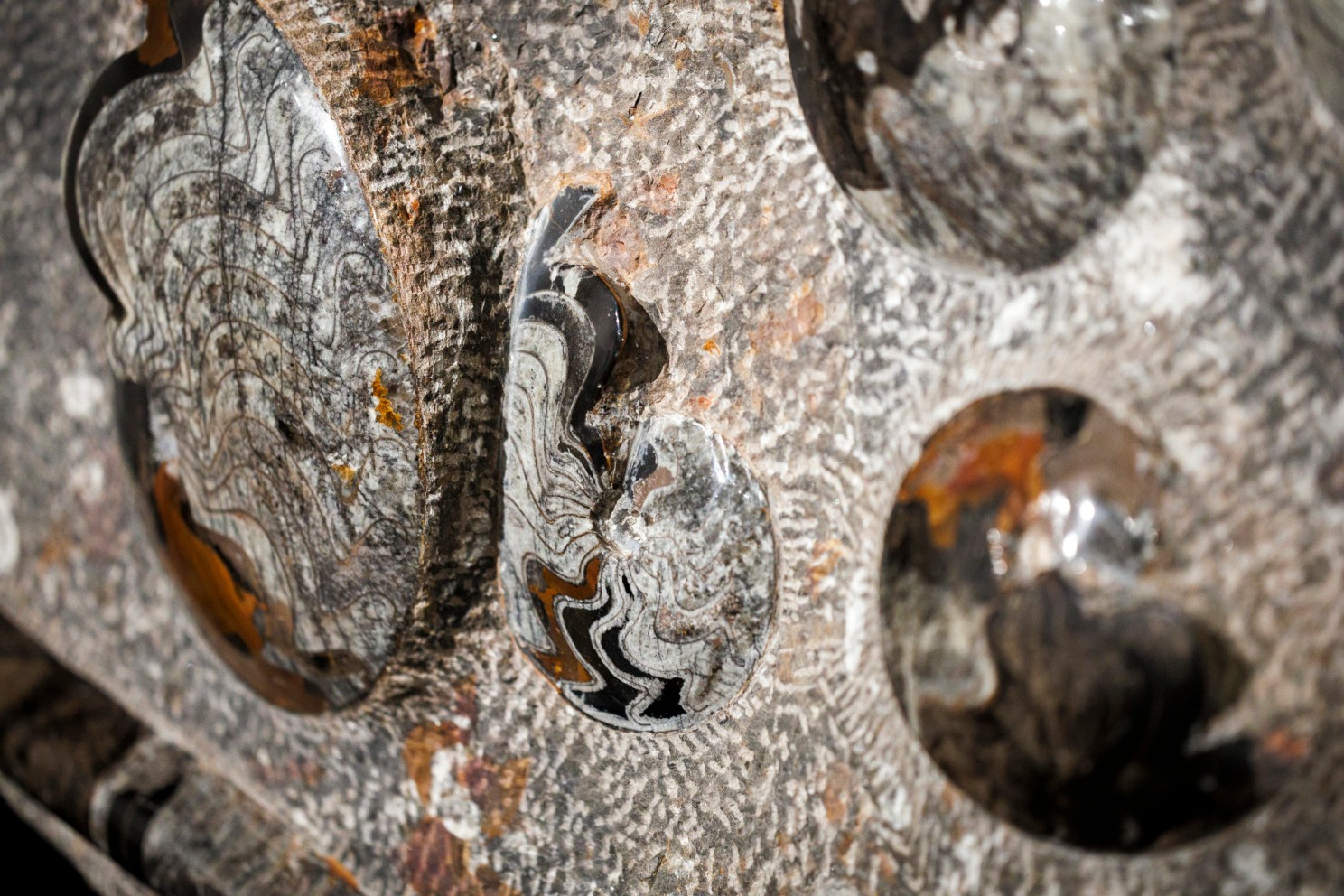
Fossil slab with cephalopods.
Stephanie Mitchell/Harvard Staff Photographer
A striking fossil slab shows that beauty takes time. Cephalopods that swam in a shallow sea around 370 million years ago created multidimensional swirl patterns in the rock from the Atlas Mountains in Morocco.
“They almost become like gems,” said Carland-Adams. “There’s kind of like a Fibonacci sequence aspect to it.”
Creatures great and small
Viewers’ attention might be drawn to a case of preserved, jewel-colored beetles and weevils, in an array of hues and patterns. The structure of crystalline scales on their exoskeletons, the exhibit reveals, gives these beetles a metallic shine that society women of the mid-1800s used like sequins.
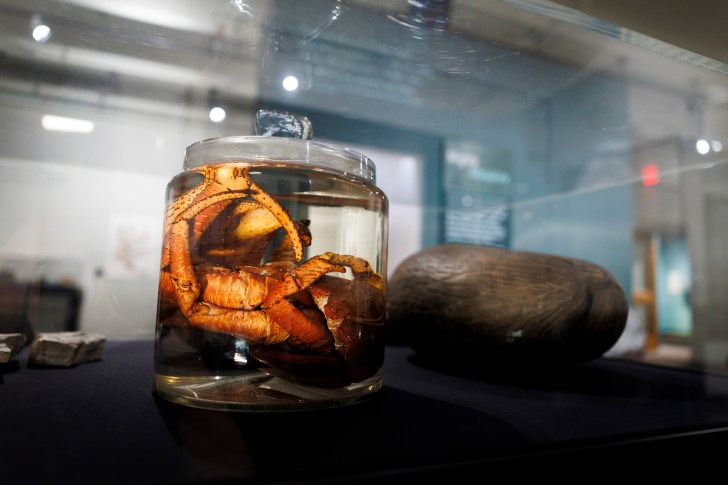
Coconut crab.
Stephanie Mitchell/Harvard Staff Photographer
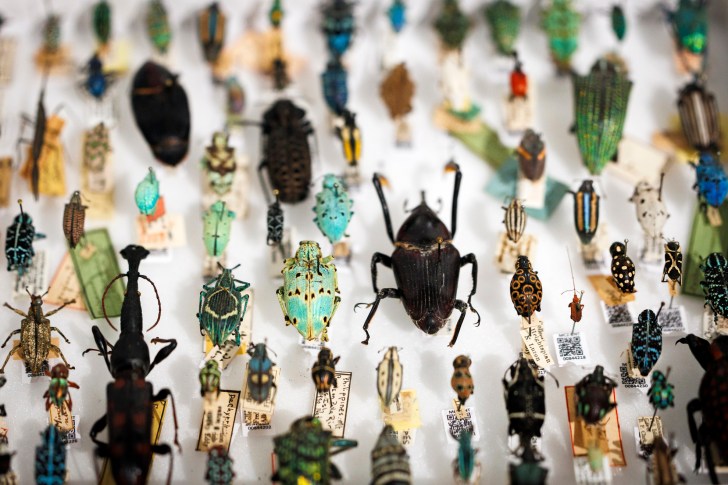
Jewel-like beetles and weevils.
Stephanie Mitchell/Harvard Staff Photographer
The exhibit also features a preserved coconut crab, the largest land arthropod. The crustaceans, which can live up to 60 years, climb palm trees with their pointy legs, and unlike other hermit crab species, don’t carry their shells with them but instead develop tough exoskeletons.
Viewers may also come face to face with an example of the biggest bear species, which stands preserved behind glass at the back of the exhibit. A fully articulated polar bear, which has been in the museum collection since at least 1878, is still in use as a research tool as the species faces threats from climate change. DNA obtained from skin samples informs scientists about population diversity, while stable isotopes from fur samples contain important information about ecological conditions during this animal’s life.
“Collecting Wonders” runs daily from 9 a.m. to 5 p.m. through April.