Featured series


Science & Tech
The why behind sex
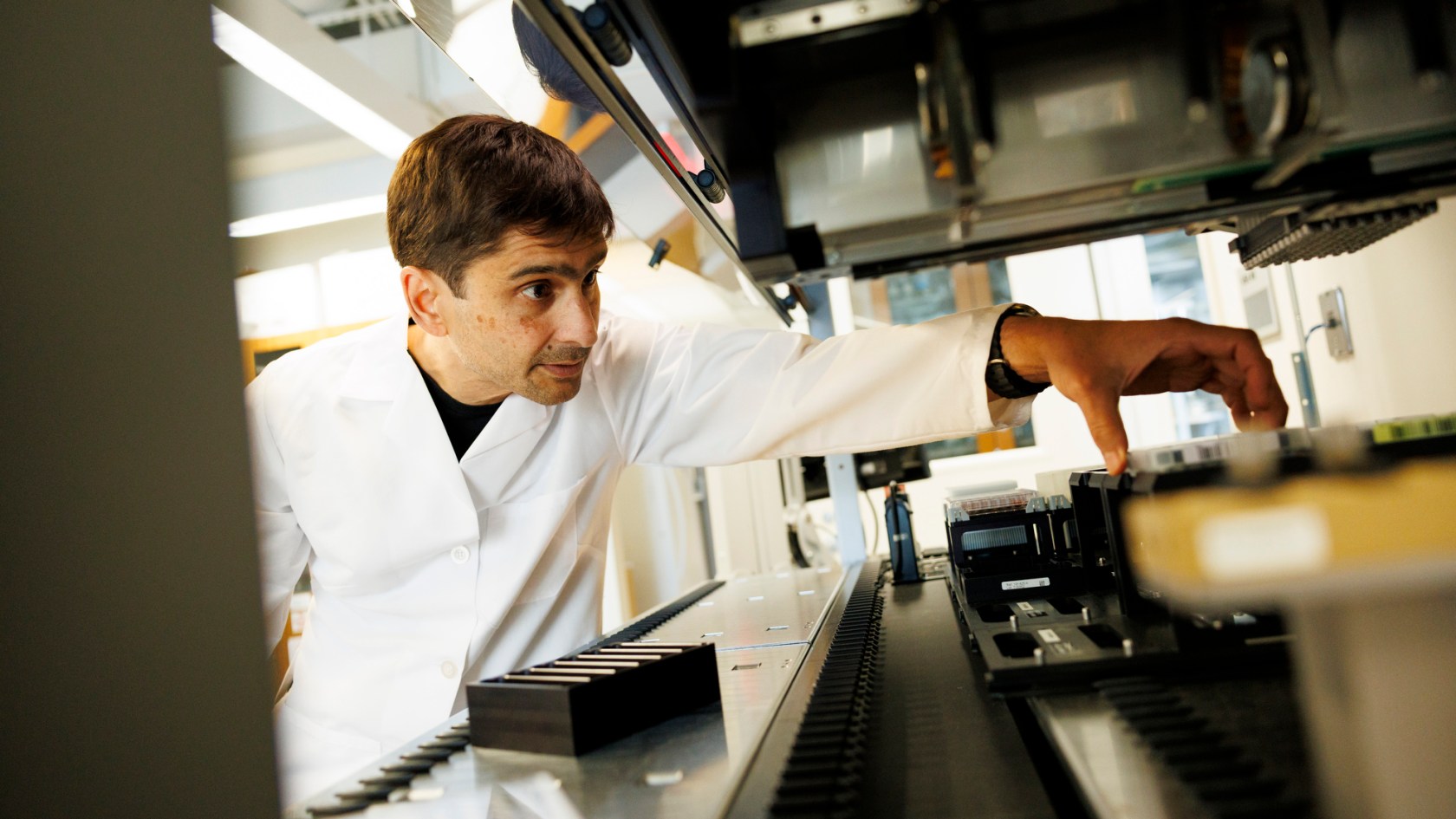
Michael M. Desai.
Niles Singer/Harvard Staff Photographer
Research details answer to a question that’s more complex than it seems
Why is there sex — or, more precisely, sexual reproduction? If you’re an evolutionary biologist, the answer isn’t obvious.
Sexual reproduction is biologically costly, requiring not only competition for mates, but also the creation of entire populations in which only half the individuals can give birth. That reality has led scientists to wonder why it arose in the first place. After all, in asexual reproduction — as occurs when bacteria divide — not only can you skip the wooing and its costs, but every individual is a potential mother.
New research from a group of Harvard biologists dives into the benefits that come with sexual reproduction, particularly in changing environments.
The work was conducted in the lab of Fisher Professor of the Natural Sciences Michael Desai and led by Ph.D. student Shreyas Pai and Parris Humphrey, then a postdoctoral fellow. The team used a strain of yeast as a model organism. The yeast, commonly used in bread baking and beer brewing, has the scientific advantage of being able to reproduce either asexually or sexually.
Another advantage is that yeast produce new generations in only 90 minutes, taking the guesswork out of experiments on evolution, which is generally understood to promote slow change over long stretches of time. With a new generation every hour and half, Desai’s team was able to observe changes after 960 generations in just four months, something that would take hundreds to thousands of years in large mammals.
The research, published in the journal Science in April and supported by the National Science Foundation, the National Institutes of Health, and the National Institute of General Medical Sciences, began with a dozen identical populations of yeast growing in ideal conditions. All initially reproduced asexually, but every 100 generations, designated lines were induced to reproduce sexually for a single generation.
The scientists first confirmed earlier work showing that in a constant, favorable environment, sexually reproducing populations gain more fitness than asexually reproducing populations. Over those nearly 1,000 generations, the fitness of sexually reproducing populations increased 8 percent over the ancestral population, compared with a 5.7 percent increase for asexual populations.
Next, the researchers tested evolution in different environments — one saltier, one hotter, another with decreased acidity, and one with lower phosphate. In these altered conditions, researchers found that sexually reproducing populations had fitness advantages of between 2 percent and 5.6 percent over asexual populations.
While those numbers may not seem large enough to matter, Desai said that over long periods of time, an advantage of even a fraction of a percentage point can allow a particular population to dominate.
“Selective differences of fractions of a percent in large populations can drive total shifts in population composition.”
Michael M. Desai
“Selective differences of fractions of a percent in large populations can drive total shifts in population composition,” said Desai, the paper’s senior author. “A several percent effect in a microbe is large. It might take 50 to 100 generations to take over.”
Desai said that the work also probed the mechanism by which sexual reproduction is advantageous in a shifting environment. Some genes are “pleiotropic,” meaning that they affect the expression of several traits, some of which can be adaptive, some harmful. Harmful traits that affect an individual’s ability to survive or reproduce are reduced or removed from the population naturally. But traits that are neutral or only mildly harmful can survive as what scientists call “hitchhiking load,” particularly if other traits of the same gene provide an adaptive advantage.
When the environment changes for the worse, as it did for the experimental yeast, some of those previously neutral or mildly disadvantageous mutations may threaten survival. That is where sexual reproduction gets its edge.
Asexual populations have no way to eliminate the threat because their offspring are clones and genetically identical. Sexually reproducing populations, on the other hand, produce offspring with a mix of their parents’ genes, some of which may not carry the harmful “hitchhikers.” Over time, that reduces or eliminates the harmful effects of those genes.
“We showed that, without sex, it’s not just that the populations are accumulating deleterious baggage, they’re accumulating baggage that maybe is not so bad in the environment they’re evolving in, but would hurt you elsewhere,” Desai said. “In contrast, when you have sex, you purge that hitchhiking pleiotropic cost and prevent yourself from specializing quite as much just to the environment that you’re in. That can be a big advantage when the environment shifts or fluctuates.”
While Desai and colleagues worked with microbes, he said that the effects extend into more complex organisms where asexual reproduction, while rarer, is still represented. In the plant kingdom, for example, cuttings can grow into fully mature plants that are genetically identical to the parent. Among animals, certain species of lizard can undergo parthenogenesis, in which their eggs are self-fertilized, producing offspring that are clones of their parents.
“We believe that this general mechanism by which sex speeds adaptation and purges hitchhiking deleterious load should be a general advantage of sex across all sorts of organisms,” Desai said. “I think it’s great that we can learn so much about how evolution acts and how the ways in which we reproduce, copy, and re-sort our genomes makes sense all the way across these enormous differences in organisms’ complexity and scale.”