Featured series



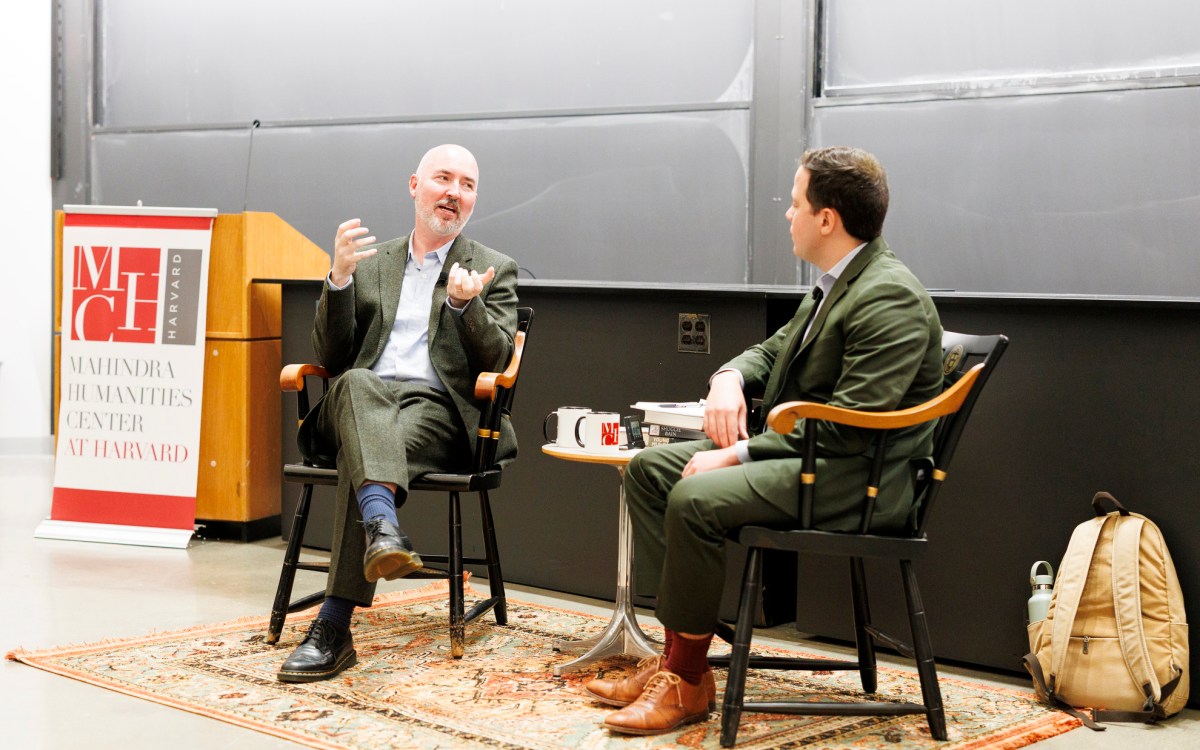
Catherine Lacey (right) in conversation with Laura van den Berg.
Veasey Conway/Harvard Staff Photographer
Arts & Culture
When a fictional character becomes too real
Why Catherine Lacey can’t avoid ‘terrifying’ disclosures on the page and every story feels like her last
For Catherine Lacey, fiction is a vehicle for discovering personal truths.
“When I start trying to make choices about what to reveal or conceal, it just doesn’t work,” the author said in a recent “Writers Speak” event hosted by Harvard’s Mahindra Humanities Center. “When I try to keep [the personal] out, it gets in anyway, or the book will refuse to be written.”
Lacey’s critically acclaimed debut novel “Nobody Is Ever Missing” provides an early example of the writer putting herself in her prose, even subconsciously. In the story, the main character loses her adopted sister to suicide. Between her finishing the book and its publication, Lacey’s stepsister died as a result of substance use — something the author couldn’t have predicted but nonetheless grappled with on the page, she said.
“I didn’t have an adopted sister, I didn’t know anybody that had killed themselves, but my stepsister died by suicide — is the simplest way to describe it — after I had finished the book, and it was something that had been present in my life for about five years before,” she said. “It was present in the family and something everybody knew that they didn’t want to know. And I think those are the kinds of things that come out in fiction when a voice starts to feel like — ‘This is me, but it’s not me’ — and it does feel authentic, but I don’t know where it’s coming from.”
Especially as a young writer, Lacey noted, it wasn’t easy to bring a narrator to life. Now, she said, she knows that when her writing strikes an emotional chord, she’s doing something right.
“It’s terrifying for something to possess a voice,” she said. “It’s terrifying to have disclosures on a page. That even though they’re through a fictional character, it somehow reflects something about you that maybe you don’t even want to expose.”
Even still, Lacey said, she sometimes isn’t cognizant of how much of herself she reveals through her characters.
“I don’t tend to know what the book is about until it’s about to come out, and then a couple months before I realize it’s generally way more personal than I would have thought,” she said. “And if I had been the person in charge of making decisions about what we’re going to write about, what parts of ourselves are going to go in this book, I wouldn’t have put any of them in.”
The short story, in Lacey’s view, is the purest means of letting a narrative come together organically. Her first collection of stories, “Certain American States,” was released in 2018, and “My Stalkers” is forthcoming in 2027.
“When I hear poets talk about writing poems, this is like when you hear flowers talk about being flowers or something … it’s like something happens to them,” Lacey said. “And I think the story is the closest I can get to something happening to me.”
When the characters in a story or the scenes click for Lacey, it’s a quick process from start to finish: “It’s all I can think about for a week or two or three weeks, or however long it takes.”
The characters in “Rate Your Happiness,” published earlier this month in The New Yorker, were bouncing around in her brain for years, she said, waiting for the right threads to connect them. When the scene came to her, all the pieces fell into place.
“There’s just something about suddenly being like, ‘Oh, that’s the thing that I needed,’ that once that was in, I knew that was going to be part of the story — it just spawns everything else,” she said.
But the rush of seeing a story come to life never lasts for long,
“Every time I finish a story, I’ve been like, ‘That might be the last one I ever have,’ because it never really feels like anything else is going to feel like that,” she said. “It’s the magic that helps me not feel like I have a job.”