Featured series
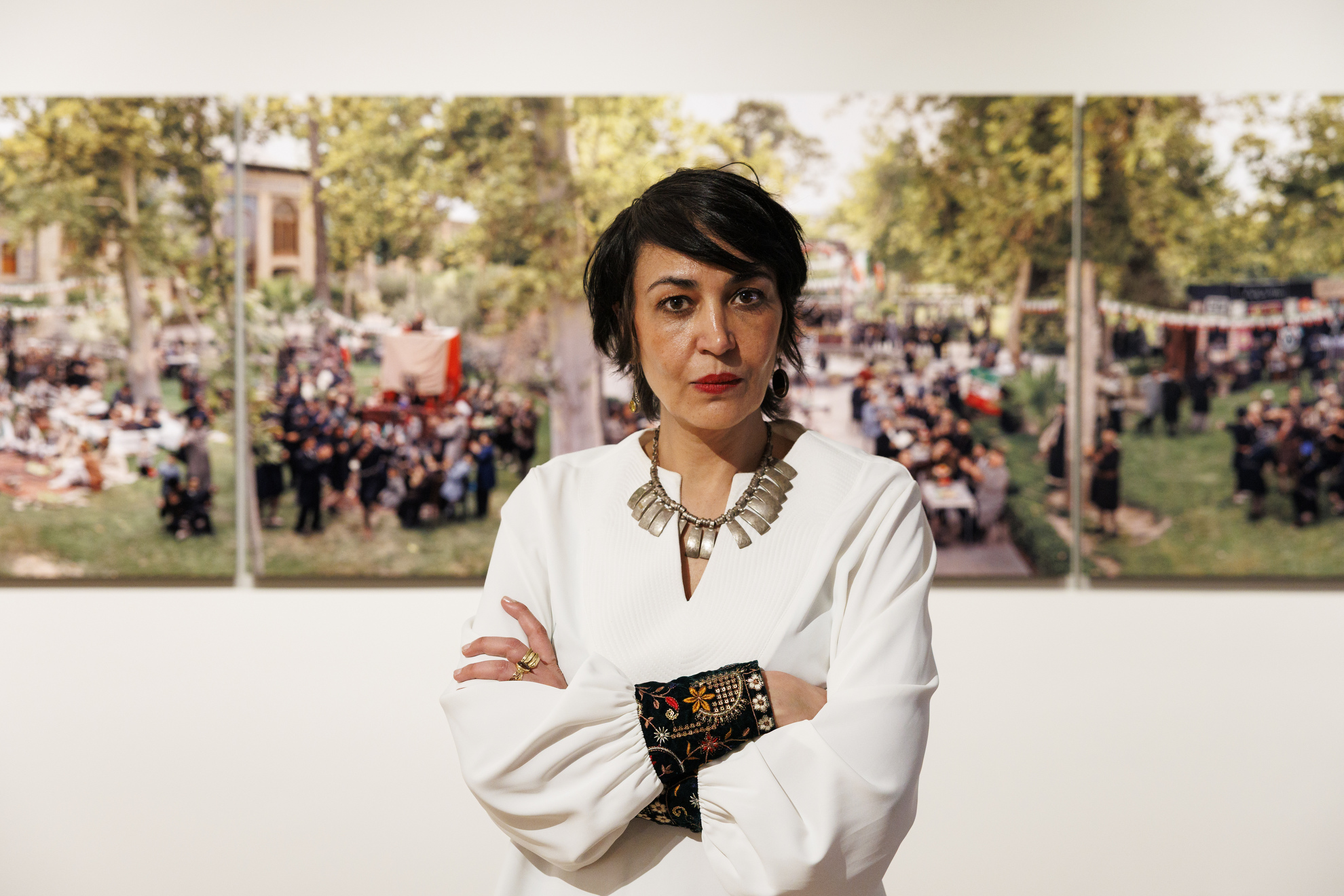
Azadeh Akhlaghi.
Niles Singer/Harvard Staff Photographer
Arts & Culture
Iranian history in tableaux
Photographer brings 11 key scenes from 20th century to life in Peabody exhibit
When visual artist Azadeh Akhlaghi began staging photographs of pivotal moments in Iranian history, she thought that with enough research, she could uncover the truth of each moment.
By the end, she wasn’t so sure.
“I found so many contradictions in the records. In interviews, people censor themselves. There are historical documents from the secret police of the Shah that even now the government wouldn’t give me,” Akhlaghi said. “You can never really find the truth.”
An exhibit of Akhlaghi’s work, “From Iran: A Visual Testimony,” opened early this month at the Peabody Museum of Archaeology & Ethnology and runs through March 21.
The staged photographs cover a period from 1908, when the Russian-led Cossack Brigade bombarded Iran’s parliament during the Constitutional Revolution, to the Islamic Revolution of 1979. Drawing from archival research, interviews, and her background in cinema, Akhlaghi recreated 11 incidents from Iranian’s tumultuous 20th-century history at a panoramic scale — the largest of the images spans 3 feet by 15 feet.
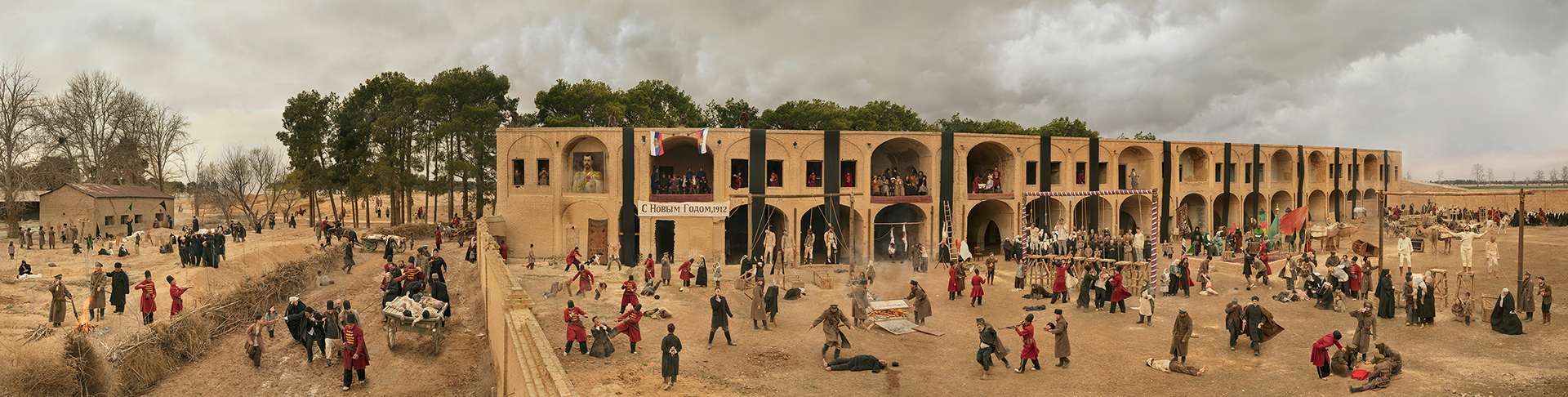
“The Mother of Tabriz” depicts Russian troops’ invasion and occupation of Tabriz, Iran, from 1911 to 1917.
© Azadeh Akhlaghi
Akhlaghi was the 2019 recipient of the Peabody Museum’s Robert Gardner Fellowship in Photography, which supports an established photographic practitioner producing a major project “on the human condition anywhere in the world.” Born in Shiraz, Iran, she studied computer science in Australia before returning to Iran to work in the film industry. She later turned to staged photography. Her 2012 work, “By an Eyewitness,” has been exhibited internationally.
In this interview, edited for length and clarity, Akhlaghi shared her inspiration for the work and how it feels to launch the exhibit amid the U.S.-Israel war with Iran.
What was your inspiration for this body of work?
This came after my previous project, “By an Eyewitness.” That project started in 2009 after the Green Movement in Iran, when there were these big demonstrations in Tehran. People died in the streets, and among those was a girl, Neda Agha-Soltan, whose death was captured by a video.
After I saw that video, I thought about all these people who had died in a similar manner, but there was no camera to capture the moments of their deaths.
“By an Eyewitness” contained 17 images, each reconstructing the moment of the death of an Iranian freedom fighter, writer, or journalist who died in a suspicious or tragic way, and where there was no camera available to capture the moment of their death. I reconstructed those moments based on documents and interviews.
This new project depicts some of the turning points in Iranian history between the Constitutional Revolution of 1906 and the Islamic Revolution of 1979. In each image, I reconstruct some of the repeating themes we experienced in this time: military coups, national resistance, suppression, and moments of victory that then led to a new cycle of suppression and tyranny. I really wanted to focus on this vicious cycle. And I wanted to focus on the unknowns, the people who are only a line in the history books.
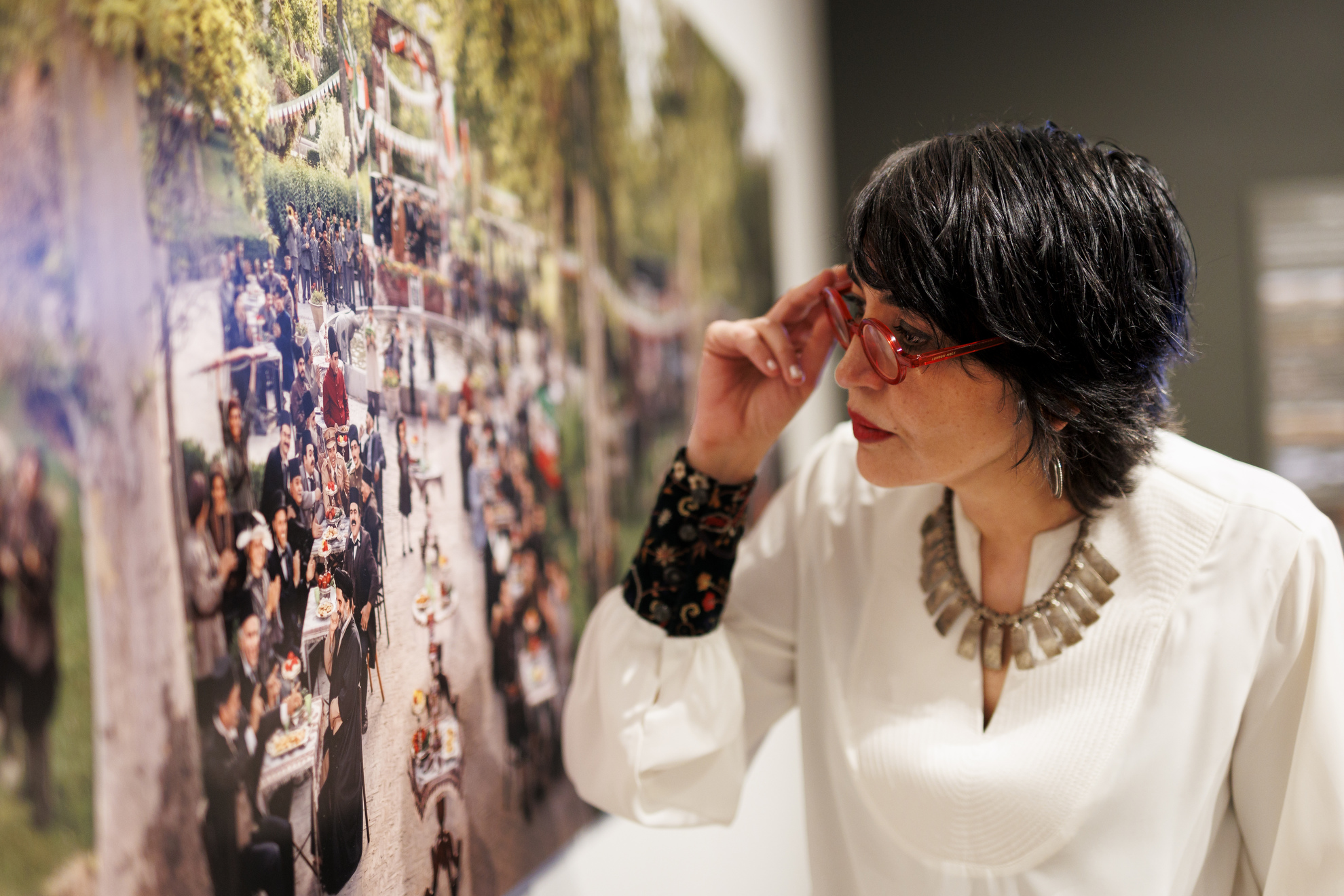
“I wanted them to feel like the huge history paintings like you might see in the Louvre,” Akhlaghi said of her photographs.
Niles Singer/Harvard Staff Photographer
Can you talk about one image in more detail?
In the 1910s, Iran had a very strong women’s movement alongside movements in the U.S. and Britain. My image “The First Iranian Women’s Movement” was inspired by just a couple of lines in a book called “The Strangling of Persia” (1912) by W. Morgan Shuster, an American who was invited to be the treasurer-general of Iran and was later forced out by the Russians. He wrote that he witnessed 300 women with guns come to Parliament, warning that if Iran capitulated to Russian demands, they would kill their husbands, their sons, and the members of Parliament — basically threatening to take over Parliament.
I wanted to know more about that moment. Who were those women? How did they organize such a thing? I found out that they had organized through six or seven societies that met in secret to talk about their demands. They published a newspaper, Danesh, which means “knowledge.” The woman who ran the paper was also Iran’s first female ophthalmologist, and the paper was run out of her clinic. You can find her at the center of the image, as well as other figures, like the first Iranian singer to perform without a hijab in front of men.
My piece imagines the Danesh offices, moments before these women march on Parliament.
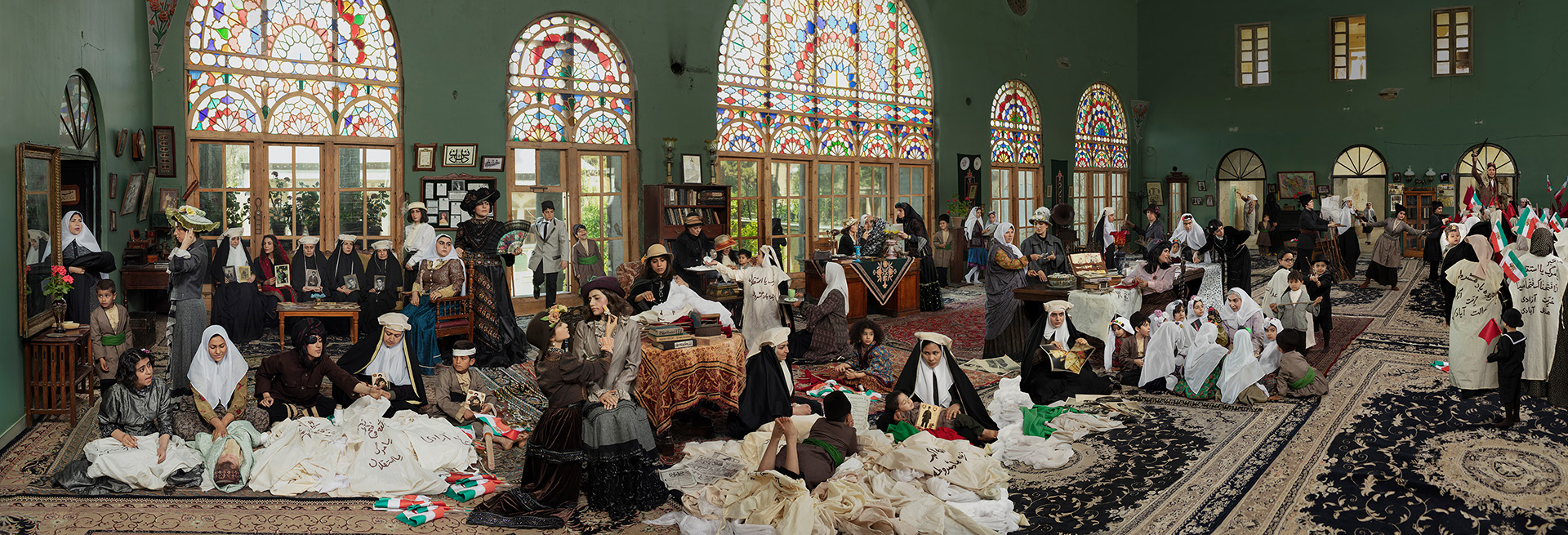
“The First Iranian Women’s Movement” stages an account of armed women protesters preparing to march on parliament in 1911.
© Azadeh Akhlaghi
A close look at “The First Iranian Women’s Movement.”
© Azadeh Akhlaghi
How does your work play with the notion of truth in photos that are staged recreations of moments both deeply researched and imagined?
When I started this project, I thought I could figure out what really happened in the past and depict it. But now I’m not sure that’s ever possible. I found so many contradictions in the record. In interviews, people censor themselves. There are historical documents from the secret police of the Shah that even now the government wouldn’t give me. You can never really find the truth.
That’s why I always put myself somewhere in these images, in a red scarf, to say that this is my imagination of what happened — and it’s why I wanted to make the images as big as possible. I wanted to fit in so many stories and people. I wanted them to feel like the huge history paintings like you might see in the Louvre. These are not photojournalistic images: They’re not real. They’re art.
Why did you choose the time period you did?
I focused on events between 1906 and 1979 because I was interested in moments that shaped contemporary Iran. Yet history often echoes itself. Even when an image refers to an earlier historical moment, viewers sometimes recognize connections across different periods and bring their own interpretations to it.
You began this project long before the current war. But I’m curious what it means to you to have this exhibit launching at this heightened political moment.
I’m really honored to have received the Robert Gardner Fellowship and to have the first exhibit of this work be at the Peabody Museum. But I’m also sad, because I wanted to have my first show in Tehran — I worked on this project for 14 years; I had many actors, a big team there. But that’s impossible now. Even my father, who lives in Iran, can’t see my images because they don’t have internet. I’m very worried about the future.
But I hope people take away this idea of the vicious cycle of Iranian history. Iran has just been repeating the same thing since the Constitutional Revolution, and it’s getting worse. And I hope people can see that even though my work is about Iranian people, it’s really about all people. A mourning mother is the same everywhere.