Featured series

Nation & World
What it will take to turn things around
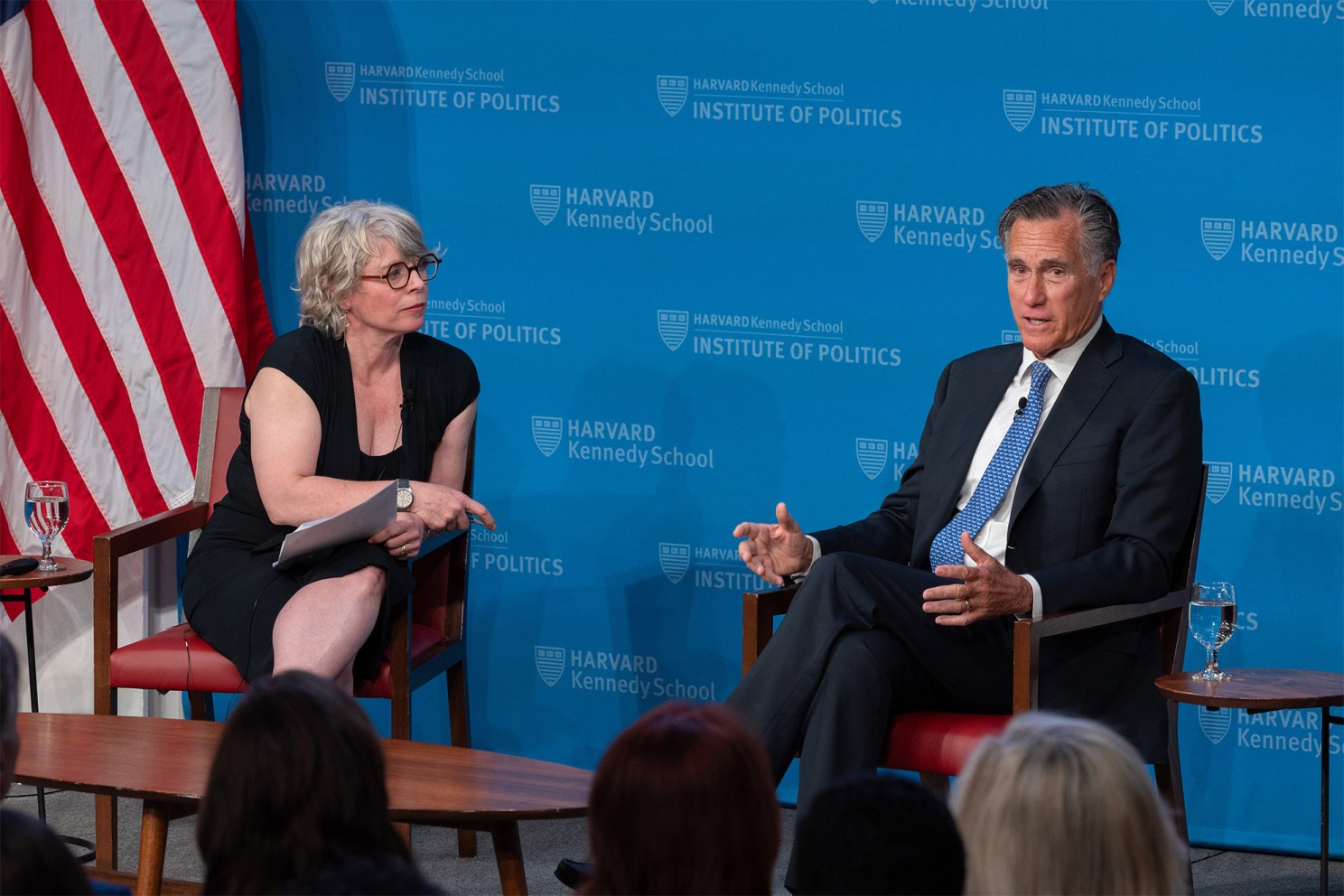
Jill Lepore and Mitt Romney.
Photo by Martha Stewart
Mitt Romney offers critique on nation’s divisiveness, foreign policy, value of hard, thankless work of governing
What the country needs right now is the emergence of a great unifying leader, a government with all three branches doing their jobs, and friends who stand by us, said Mitt Romney, a former U.S. senator and Republican presidential nominee.
During a wide-ranging campus discussion Monday with Jill Lepore, David Woods Kemper Professor of American History, Romney, J.D./M.B.A. ’75, reflected on the divisiveness of American politics over the last decade, current foreign policy that appears to be turning its back on historical allies, and what it will take to turn things around.
Romney put disillusionment from the effects of income inequality high on his list of the causes for our political polarization.
“A lot of people feel that the American dream is not real for them,” that the country is not delivering what they want or need, said Romney.
“It’s the college kids that are saying, ‘I took out a loan and I’m coming out of college, and I can’t get a job. This is simply not right. This is not fair.’”
Other major factors include the rise of social media and news curation, which has undermined a shared agreement by voters on basic facts; multibillionaires bankrolling and influencing political campaigns; and a party nominating process that often bestows outsize sway on more extreme candidates and ideas, he said.
Romney said adding to the dysfunction is the fact that in recent decades legislators of both parties have largely surrendered their independence, in turn, to line up behind their president in partisan fashion.
He also noted that there is the perception of a more partisan swing in the judiciary. He blames that on the parties switching to a simple majority vote in the Senate to confirm judges, abandoning the tougher 60-vote threshold.
So now, he said, when a court decision appears to go against one party or the other, more people assume it was politically motivated, undermining trust in the judicial system.
Romney was a longtime Trump critic who spoke out against him during the 2016 Republican primary and later during his time as a senator, until he left in 2025.
On Monday, Romney made it clear that he approved of some of the things President Trump has done in his second term, such as securing the U.S. border to illegal immigration, while other moves, like getting Europe to contribute more to its own defense, were positions he understood while disagreeing with the president’s approach.
A third set of actions, however, “don’t make any sense,” like starting a beef with Canada, the largest importer of U.S. goods, or alienating European allies over threats to Greenland, he said.
With China and the U.S. battling for global dominance, the country should take advantage of its historically strong relationships with other nations, said Romney.
“I think you want more friends, more collaboration, more coordination,” he said. “I want to be able to say to China, ‘Unless you play by these economic rules, none of us are going to allow your goods to come into our country. Not just America; none of us.’”
Romney, who was governor of heavily Democratic Massachusetts from 2003-2007, said economic issues are important, but perhaps even more decisive for voters are cultural ones.
He critiqued Democrats, saying they have made some mistakes that cost them support in recent years, like the party’s “open border” immigration policy and vocal support for trans athletes.
“My advice is 1) get people who can speak to working-class Americans and 2) make sure that you’re attuned to the cultural issues, not just the ‘Here’s how much more money you’re going to get if you vote for my party,’” he said.
As for the future, Romney said he is “optimistic” and has “faith in America. I’m convinced that our best days are ahead, but we’re going to face some challenges to get there.”
Addressing those challenges effectively will require either the emergence of a great leader, a crisis that jolts the country into unified action, or a new generation that rises up to say enough, he said.
“The reason I come and speak at a place like this is because you guys have the capacity to make a difference and to tell people the truth and to get involved in politics because you want to do something, as opposed to you just want to be there.”
Romney waved off politicians today who seem more interested in podcasting or making viral TikTok videos than in the tough and unglamorous work of governing.
“We don’t need more performers in Washington. If you want to be a performer, go into pro wrestling,” he said. “But if you want to do something, come on in, the water’s fine.”