Featured series

Health
Call it his personal Everest
Experienced mountaineer, researcher fell short of summiting, but his work has helped make climbers safer
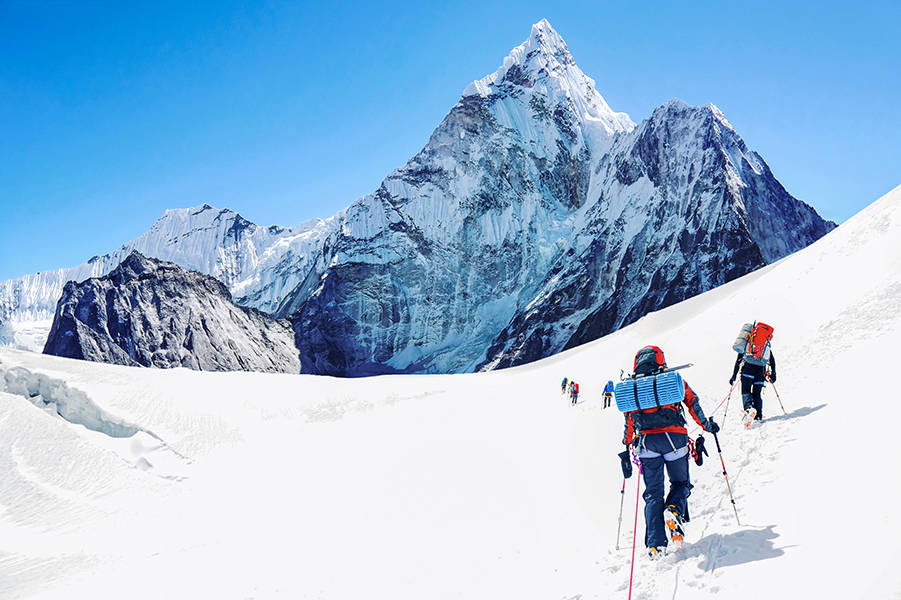
Climbing Mount Everest is getting safer, a new study shows, though the world’s highest peak remains dangerous enough that almost one in 100 who try it don’t make it home.
The work, led by Paul Firth, an experienced mountaineer and associate professor of anesthesia at Harvard Medical School and Massachusetts General Hospital, builds upon his earlier research into high-altitude deaths on the mountain since the first recorded summit attempt, George Mallory’s expedition of 1921.
Firth and colleagues want to better understand what happens to the human body at high elevations to guide efforts to make climbing safer. That initial research, published in 2009, found that cerebral edema likely played a role in many more high-altitude deaths than was previously understood.
The condition develops in regions of low oxygen like Everest’s “death zone” above 26,200 feet, or five miles up. Fluid leaks into the brain, causing headaches, extreme fatigue, coordination problems, and impaired judgment, any one of which presents a hazard in conditions where a single mistake can cost your life.
“Contrary to perceptions and media reports, things are actually safer now, but still very dangerous,” Firth said.
“Contrary to perceptions and media reports, things are actually safer now, but still very dangerous.”
The current research, published in The Journal of Physiology in late April, showed that death rates during climbing expeditions fell by half between the initial period — 1921 to 2006 — and more recent years, 2007 to 2024, with the mortality rate falling from 1.4 percent to 0.7 percent.
Firth and colleagues credited a number of changes in recent years with lowering the death rate.
Most attempts today occur along known, standard routes, which feature fixed ropes. In addition, weather forecasting has improved greatly, as have communication systems, allowing much freer flow of information about what awaits higher up on the mountain.
And advances in logistics, clothing, nutrition, hydration, and oxygen delivery systems have each lowered the risk to climbers from cold, hunger, thirst, and thin air.
“The data are that fewer people are involved in falls, and fewer people are getting isolated, left behind, and dying alone,” Firth said. “We speculate that teamwork has improved and that everything being roped the whole way has helped markedly, but there are many other things that could have contributed which we weren’t able to measure.”
Climbing Everest has always been a life-threatening endeavor.
The first recorded summit was by Tenzing Norgay and Edmund Hillary in 1953. Other parties had not been so successful.
Two died on the first expedition in 1921, though their deaths were en route to the mountain. An avalanche claimed the lives of seven porters on the second expedition in 1922.
Four died in the third attempt, in 1924, including George Mallory and Andrew Irvine, who disappeared on the first known attempt to reach the summit and whose remains were only found in recent decades.
A total of 426 have died in Everest expeditions as of 2024.
According to the current work, a portion of which was funded by the MGH Anesthesia Department, just over half of the deaths occurred in the “death zone.” The air at the summit holds just a third of the oxygen at sea level.
Firth said that most deaths now occur on good-weather days due to lack of oxygen and the extreme cold at that altitude. Improved forecasting has reduced losses directly related to bad weather.
The new work highlights the increased popularity of climbing in recent decades, with 1,921 summits through the 85 years up to 2006, and 9,823 summits in the 18 years since.
Though the mortality rate has fallen, climbers still die almost yearly on the mountain, and many years have seen multiple lives lost.
One such year was 2004, when seven people died on Everest, several during a day when Firth himself was leading a small expedition to the top.
Luckily, Firth’s interest in the physiological effects of high-altitude climbing had primed him to recognize warning signs after his oxygen equipment malfunctioned. He started to fall behind, so he called a halt and brought the group together.
He sent one climber up with adequate oxygen while Firth and the others continued down.
There were no deaths among his team and the climber sent on the second push made it to the top without incident — the first Norwegian woman to summit Everest.
The study highlighted disparities between deaths of climbers and the native sherpas who provide professional porter and guide services.
Three-quarters of deaths among climbers occur high on the mountain, on “summit day” — the last push to the top — or on the way down. The vast majority of sherpa deaths, by contrast, happen lower on the mountain, as they prepare the route for their clients.
Firth was disappointed at not having summited, but he has no doubt now that turning around was the right decision, one reinforced by the deaths on the mountain that day and by his research since.
He’s also content that his two studies of Everest deaths have contributed significantly to the climbing community.
“To me, actually doing the study gave me more of a sense of achievement than climbing Everest,” Firth said. “This was my, ‘Hey, I didn’t climb Everest, but I did the study instead.’ It’s my personal Everest in research.”