Featured series


Arts & Culture
A lost archive of Black history
25 years after landmark photography book, Deborah Willis is still scouring albums, attics, cabinets, cards to fill in the record
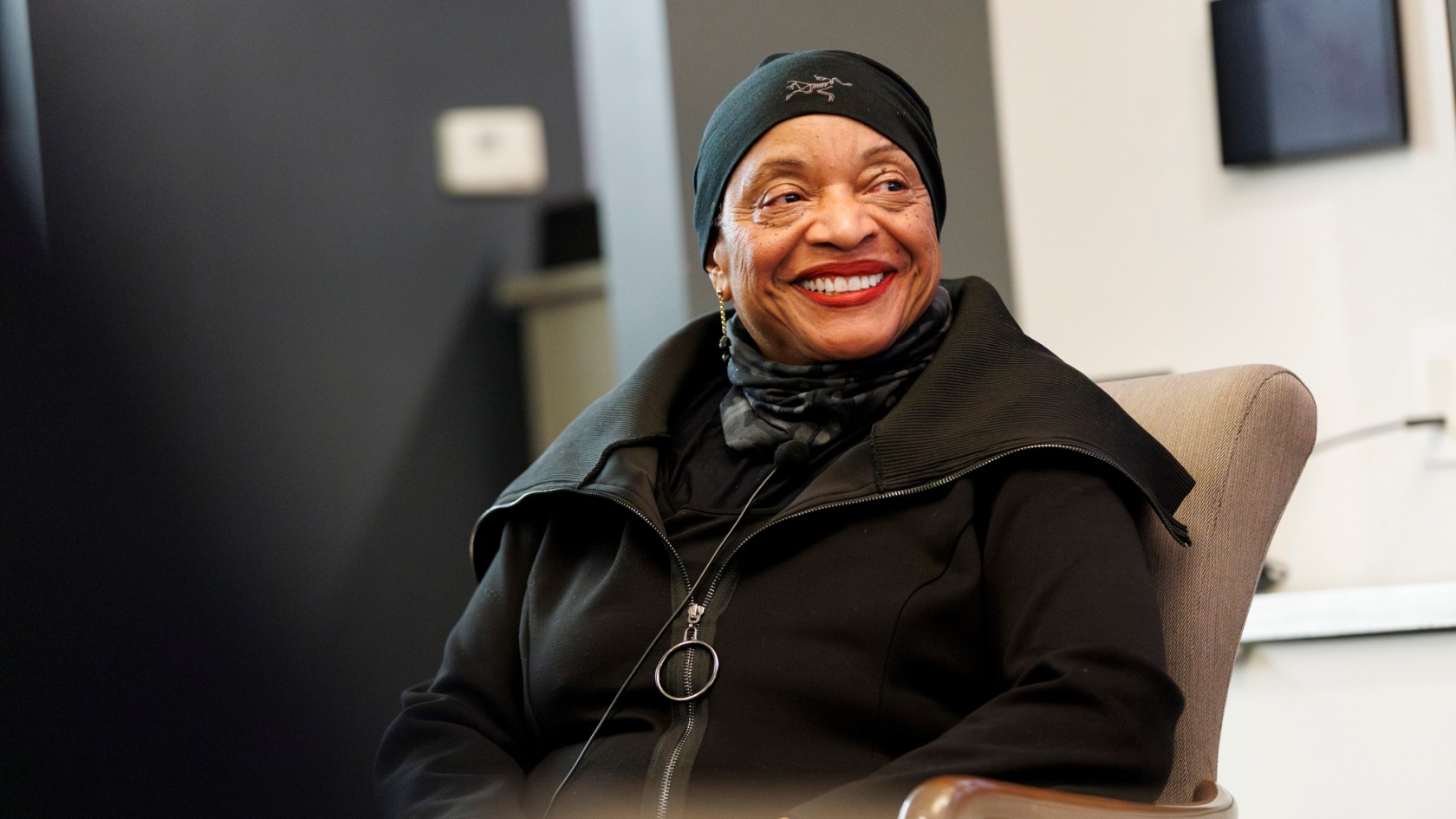
Deborah Willis.
Photos by Niles Singer/Harvard Staff Photographer
Deborah Willis’ career as a photographer, curator, and historian began with a question she had as a college student: Where are the Black photographers?
While enrolled at the Philadelphia College of Art, Willis found that Black photographers were rarely included in history books. Black people, too, were under-represented in images — often included only when the photos displayed their struggle or subjugation.
“I knew there was a lot missing,” Willis said at a recent ArtsThursday event at the Hutchins Center for African & African American Research. “I was encouraged by [curator and professor] Anne Tucker to continue thinking about it and continue working.”
“I knew there was a lot missing.”
Deborah Willis
Willis, the University Professor of Photography & Imaging and Social & Cultural Analysis at NYU, attempted to fill that gap in her 2000 book “Reflections in Black,” a landmark collection of photography celebrating a wide spectrum of African American life from 1840 through the 20th century.
Twenty-five years later, Willis discussed the anniversary edition of the collection before a Harvard audience, delving into her personal history and that of Black photography in the U.S.
One theme of Willis’ talk was the painstaking process of collecting and archiving photographs. Many photos included in Willis’ original and updated book had been hidden or undeveloped before her efforts. Some were held by the relatives of photographers who had passed away. Others emerged unexpectedly from archives, where they had been lost.
She began by showing a picture that a friend had noticed at a memorial service. It showed a large crowd at the funeral of pianist and composer Duke Ellington. In the front, holding a camera, was a young Willis. No one had noticed for decades.
Willis described her experience at the event, held at St. John’s Cathedral in New York City. “Of course, I lost my camera and the negative, so I have no record,” Willis said. “This is why it means so much to see this here.”
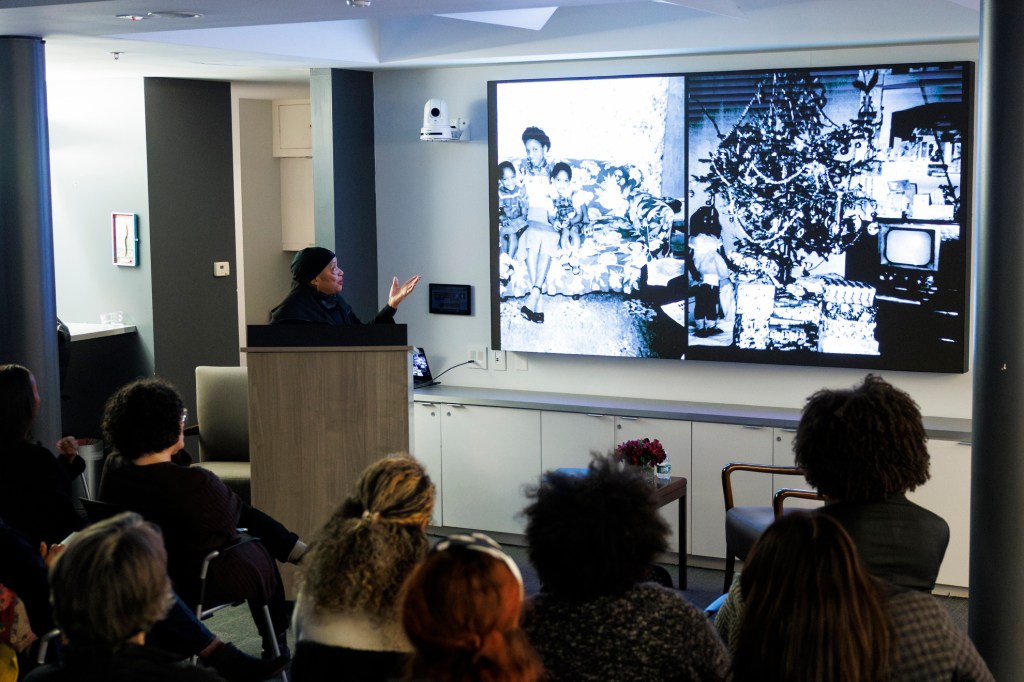
Showing off pictures of her childhood home, Willis described her upbringing in North Philadelphia. She spent countless hours in her mother’s beauty shop, where women from the neighborhood gathered to talk. “They shared moments of disappointment in their lives, but they also shared moments of love,” she said. “Mom’s place was a secure, safe place for them.”
Her father was a policeman, tailor, interior decorator, amateur photographer, and a World War II veteran who used the GI Bill to study “everything that he could to create a life for his family.”
Willis showed one of the first photographs that she ever took — a Christmas scene that featured her doll, Susie. Later she presented one of her early undergraduate photos — depicting couples, grandmothers, and mothers looking out the windows of an apartment building. “I have been photographing homes for a long time,” Willis said, “and I’m really connecting to the idea of what it meant for us to acknowledge our communities.”
The photographs Willis showed, many of which feature in her collection, often reflected similar themes: love, the family, home — sentiments that she hoped to represent in African American visual history.
Unearthing them was often difficult. She recalled hearing about one notable exhibition whose photos seemed to have been lost. When she visited the Library of Congress to search for them, she was told that there was no information available. She continued the research anyway, until, one day, a librarian called and said she had found 350 photographs of Black communities produced by African American photographer Thomas Askew of Atlanta.
In another instance, the daughter of photographer Richard Roberts, who took pictures of South Carolina’s Black middle class, told Willis how the family had saved glass plate negatives of her father’s work in the crawl space of the house for many years.
Other photos Willis showed, like one of a few young girls outside an ice cream parlor, provided an alternative vision of African American life in the 1960s, typically dominated by photos of strife and protest. “We had an opportunity to see that young girls were part of the marches,” said Willis, “but they’re also having this casual afternoon, eating ice cream and sharing their moments with their stockings on after church.”
After the presentation, Sarah Lewis, John L. Loeb Associate Professor of the Humanities and associate professor of African and African American Studies, lauded Willis for demonstrating the “importance of collaboration for the entire field.”
“You have created the world in which I teach from, that we are living in,” Lewis said. “It just moves me so much.”
As for Willis, she says her work uncovering lost history continues.
Just recently, she found new photos of aviator Bessie Coleman from the Hooks Brothers commercial photography studio in Memphis.
“So we can imagine that there are all of these photographs in somebody’s cabinet, and in cards, and in family albums. The families who are holding on to these images will unpack more and more each time.”