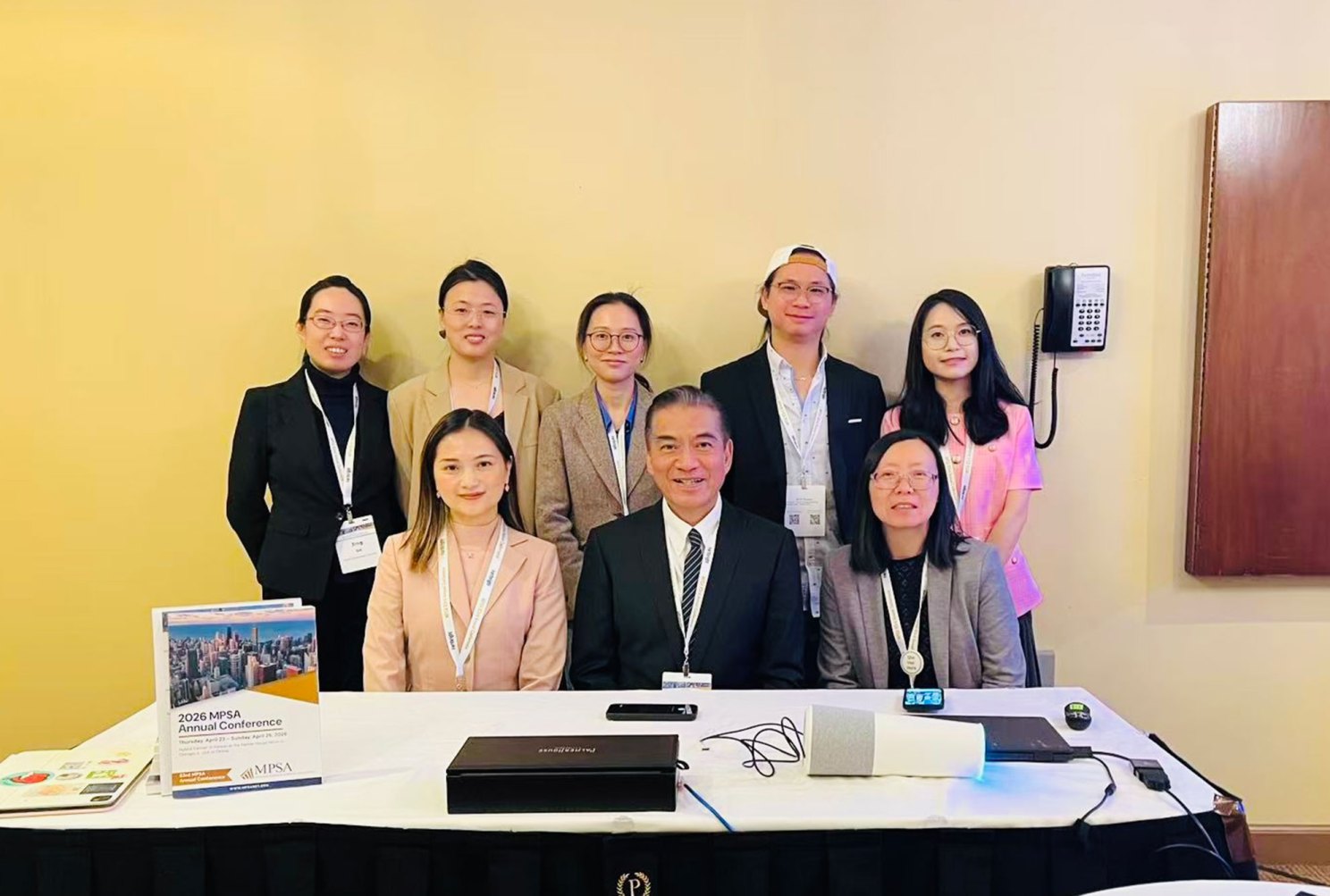
The 13th China Development and Governance Workshop (CDGW) was held on April 25–26, in a hybrid format at the MPSA Annual Conference at the Palmer House in Chicago. Organized under the theme “Moving Forward: Continuing the Study of China’s Development and Governance,” the workshop brought together 31 scholars and practitioners from the United States, Canada, Mainland China, Taiwan, Hong Kong, Macau, and Malaysia to discuss contemporary issues in governance, civil society, culture, digital transformation, global governance, and state–society relations. Participants attended both in person and online, continuing the workshop’s tradition of international and interdisciplinary exchange.
The workshop was organized by Chunying Yue and Dapeng Wang, with Rey-Sheng Her, Jun Wang, and Jing Ge serving as co-organizers. The two-day program included three keynote speeches, four panel sessions, a book talk, and a feature lecture. As in previous workshops, the organizers integrated peer review and discussion into each session, creating opportunities for constructive academic dialogue and interdisciplinary engagement.
The first panel, “Governance of NGOs in the Chinese-speaking World,” explored civic engagement, humanitarian governance, and organizational models. Keynote presentations by Rey-Sheng Her, Richard Madsen, and Helen Liu, together with a presentation by Ethan Wu, examined topics including disaster relief, moral traditions in polarized societies, and volunteer participation within circular organizational structures. Discussants, including Jiangang Zhu, Rey-Sheng Her, and Qi Jing, highlighted how civic and religious organizations can strengthen community resilience, social trust, and public welfare.
The workshop also featured a book talk titled “A Political Reflection on Shan Economy,” chaired by Xiaobei Li. In the session, Rey-Sheng Her discussed the concept of Shan economy as a framework connected not only to economic practice but also to governance, ethics, and community responsibility. Commentator Dapeng Wang emphasized the broader implications of the concept for civic engagement and social cooperation.
The second panel, “Chinese Traditional Culture and Good Governance,” chaired by Jin Zhang, examined how traditional cultural ideas continue to shape contemporary governance and political thought. Presentations by Rey-Sheng Her, Mimi Pi, and Zhilei Wu addressed themes such as the “round model” and governance of goodness, Confucian ideas of abdication and legitimacy, and governance under the “One Country, Two Systems” framework in Macau. Discussants Dapeng Wang, Qi Jing, and Yanru Yang highlighted the importance of moral cultivation, political legitimacy, and cultural traditions in understanding governance practices in Chinese societies.
In a feature lecture chaired by Xiaobei Li, artist Chenlin Cai explored the role of murals and public art in Asian societies. Titled “Art on the Streets, Culture in Motion: Murals and Community Identity in Asian Societies,” the lecture examined how public art contributes to cultural expression, collective memory, and community engagement. Chunying Yue commented on the broader social significance of mural art, emphasizing its role in fostering dialogue, participation, and belonging within communities.
The final two panels, chaired by Yuming Cui and Ruozhu Li, focused on “State–Society Relations in China.” Presenters, including Shenghua Xie, Guli Bositan, Juan Chen, Shuyun Fan, Xiaohang Luo, Jing Ge, Yuming Cui, Jin Zhang, Qi Jing, SiLang Huang, and Yang Hu, addressed a wide range of contemporary issues, including welfare perceptions toward rural–urban migrants, educational participation and inequality, China’s evolving role in global governance, digital governance and RMB internationalization, energy resilience, diaspora politics, and the impact of mobile technologies on intergenerational care. Discussants, namely Wenting Yang, Jun Wang, Kai Wang, Jin Zhang, Chen Xiang, Mimi Pi, Jing Ge, and Shenghua Xie, examined both historical legacies and emerging transformations in governance and society, drawing comparative insights from East Asia and beyond. Discussions emphasized the importance of empirical research and interdisciplinary approaches in understanding China’s changing social and political landscape.
Since its founding in 2020 by several Asia Fellows affiliated with the Rajawali Foundation Institute for Asia at the Harvard Kennedy School, the China Development and Governance Workshop has served as a platform for international scholarly exchange on China’s development and governance. The 13th workshop continued this tradition by bringing together scholars across disciplines and regions to engage in meaningful academic dialogue. From 2021 to 2026, Chunying Yue and Dapeng Wang organized 11 workshop sessions, with continued contributions from co-organizers since the ninethCDGW.
The 13th CDGW concluded by reaffirming the value of sustained scholarly dialogue across disciplines, regions, and methodological traditions. By bringing together researchers working on governance, civil society, culture, digital transformation, and global politics, the workshop contributed to a broader conversation on how China’s development and governance can be studied in comparative and international perspectives.

 Featured series