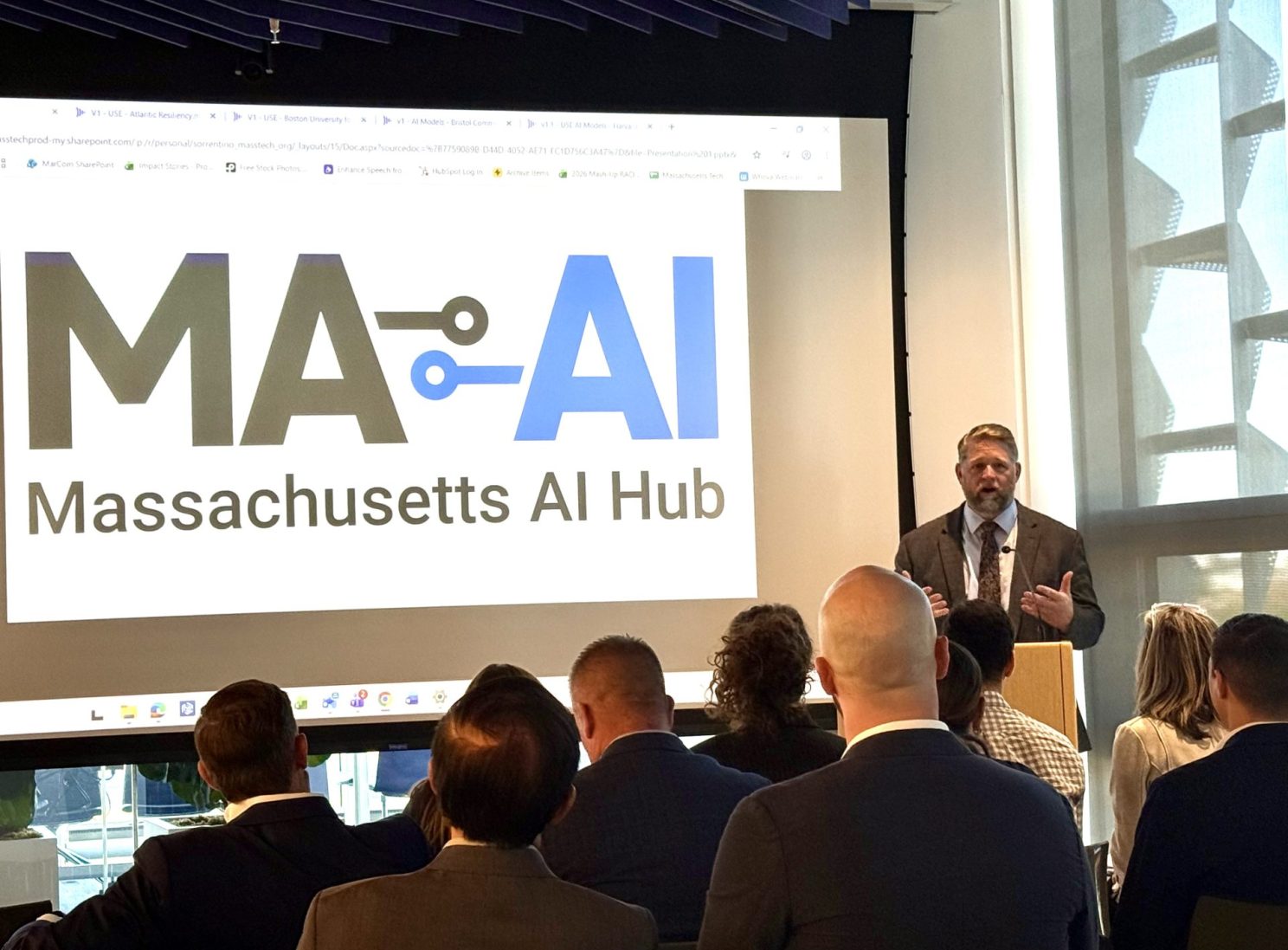
Harvard Senior Vice Provost for Research John Shaw speaks at Mass AI Hub’s 2026 Applied AI Models Innovation Challenge Award Ceremony at the Kempner Institute. Harvard is a founding academic partner in the Massachusetts AI Hub, a broader state-led initiative launched by the Healey-Driscoll Administration to establish Massachusetts as a global leader in applied AI.
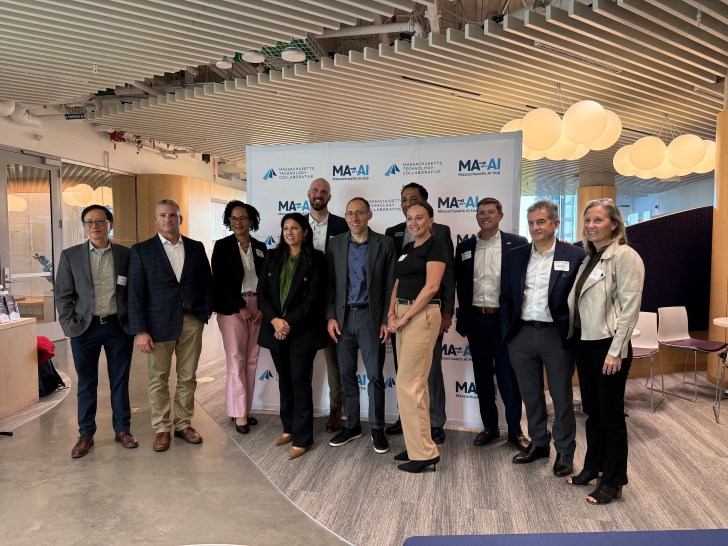
Massachusetts leaders gathered recently at Harvard University’s Kempner Institute for the Study of Natural and Artificial Intelligence to celebrate five recipients of the Mass AI Hub’s 2026 Applied AI Models Innovation Challenge, awarding nearly $3.3 million for projects aimed at addressing challenges across key industries. Massachusetts Secretary of Economic Development Eric Paley joined leaders from the Massachusetts Technology Collaborative and Mass AI Hub, along with Harvard Senior Vice Provost for Research John Shaw, for the celebration.
“As AI changes how we live and work, Massachusetts is committed to investing in responsible AI that addresses challenges facing industries across the state,” Paley said. “Through the MA AI Hub’s MA Applied AI Models Innovation Challenge, we are supporting innovative projects that will strengthen our economy, advance strategic sectors and reinforce Massachusetts’ position as a hub for applied AI.”
Yulin Du, an assistant professor of computer science at Harvard, and an institute investigator at the Kempner Institute, was one of the grant recipients. The funds will support his team’s work in creating large video generation models for industrial robotics — identifying how to create detailed visual descriptions that can be used to enable robots to learn how to complete industrial tasks from video demonstrations and to adapt without manual programming. The technology is intended to make automation more flexible and affordable for small and midsize businesses in manufacturing, logistics and recycling. The final step in this work will be to make the models open and available.
“We’ll ultimately plan to open source and release this model as well as provide some inference code that allows anyone to hook up these models to any type of robotics platform that they would like,” explained Du in his award video.
At the event, Shaw highlighted the Kempner Institute’s interdisciplinary approach and said collaboration across Massachusetts’ broader innovation community is essential to advancing AI and machine learning.
“It takes persistent commitment to innovation to allow us to continue to be able to have a positive impact, to recruit the very best talent, and to have the resources to enable the innovative work,” Shaw said. Adding that, “This is not Harvard specific. This is not Kempner-specific. This is the ecosystem of our partner universities around this region, our affiliated hospitals, and the private sector as well.”
In addition to the Kempner Institute project the other 2026 recipients are:
Atlantic Resiliency Innovation Institute: The Institute is developing an AI-driven coastal resilience platform to provide hyperlocal flood-risk predictions for energy infrastructure. The project combines enhanced weather models, sensor networks and infrastructure impact modeling.
Boston University: BU’s PandemIQ Llama, part of its BEACON Platform, uses a specialized large language model for real-time global disease surveillance, risk assessment and automated epidemiological reporting. The project aims to improve early outbreak detection and accelerate public health responses through an open-access system already used by public health agencies worldwide.
Bristol Community College: BCC plans to develop an AI-enabled system that assesses evidence of workers’ skills against industry frameworks. The project aims to strengthen connections between education providers and employers while supporting hiring, workforce readiness and opportunities to build new skills.
UMass Lowell Applied Research Corporation: Its Autonomous Robotic Planning and Optimization for Intelligence Sensor Fusion platform will use AI to coordinate multiple sensor systems in counter-drone operations. The project aims to create a vendor-neutral interoperability layer for robotics and defense systems.
Scholar says DOJ’s Sullivan claim has ‘no legal basis,’ adding: ‘There can’t be a federal interest in ensuring that the right partisan candidate wins.’

 Featured series