Harvard and MIT scholars gather for a dialogue on dignity in economic life
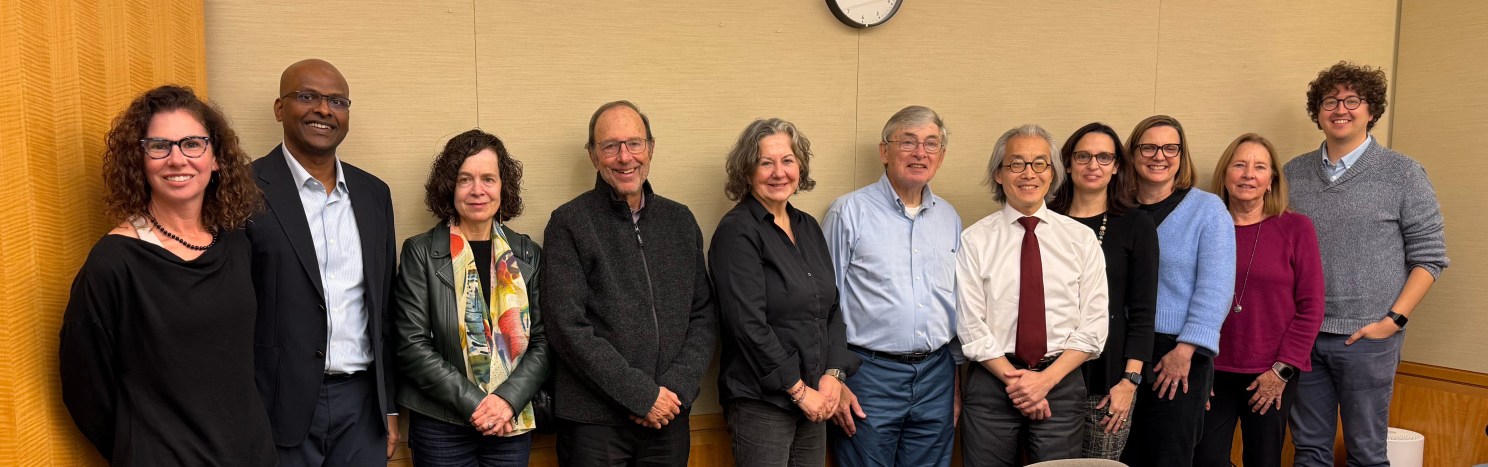
Left to right: Erin Goodman, Senthil Nathan, Rebecca Henderson, Paul Osterman, Michele Lamont, Thomas Kochan, Nien-hê Hsieh, Julie Battilana, Erin Kelly, Donna Hicks, Tony Guidotti.
Photo courtesy of Senthil Nathan
4 min read
Technology, climate change, and shifting power structures are upending work and trade. What do these changes mean for human dignity — the inherent, unconditional, and inalienable worth that all humans possess? This was the central question scholars at Harvard and MIT addressed at the inaugural “Dialogue on Dignity in Economic Life” hosted at the Weatherhead Center for International Affairs on October 19.
Convened by Senthil Nathan, fellow at the Weatherhead Center, the dialogue was the first of many more he said, that aim to “build the interdisciplinary momentum needed to make dignity an organizing principle of economic life.”
“I am curious to see what ideas emerge when we bring together influential minds from diverse disciplines to discuss a concept that is often at stake during rapid developmental and technological changes,” he said.
The kickoff event brought together an interdisciplinary group spanning sociology, labor economics and industrial relations, management and organizational behavior, philosophy and business ethics, human rights, and dignity in conflict and leadership.
Invitees explored a range of issues, including the breadth of “dignity” as a concept, the durability and usefulness of current institutions and structures, workers’ ownership and voice, and how rapid change, especially from artificial intelligence, is affecting societies.
“AI brings new challenges to understanding dignity at work, a topic of growing interest to politicians as well as social scientists,” said Michele Lamont, professor of Sociology and of African and African American Studies and the Robert I. Goldman Professor of European Studies at Harvard University. “Senthil Nathan is bringing together an exceptional group of economists and sociologists who bring their complementary expertise and methods to broaden our understanding of how to tackle these and other challenges.”
Other dialogue participants included Rebecca Henderson, John and Natty McArthur University Professor at Harvard; Paul Osterman, professor emeritus of Human Resources and Management at the MIT Sloan School of Management; Thomas Kochan, post-tenure George Maverick Bunker Professor at the MIT Sloan School of Management and faculty member in the MIT Institute for Work and Employment Research; Julie Battilana, the Joseph C. Wilson Professor of Business Administration in the Organizational Behavior unit at Harvard Business School and the Alan L. Gleitsman Professor of Social Innovation at Harvard Kennedy School; Erin Kelly, Sloan Distinguished Professor of Work and Organization Studies at the MIT Sloan School of Management and Co-Director of the MIT Institute for Work and Employment Research; Donna Hicks, associate and former deputy director of the Program on International Conflict Analysis and Resolution (PICAR) at the Weatherhead Center for International Affairs; Tony Guidotti, senior researcher for the Ownership Project at Harvard Business School and Nien-hê Hsieh, Kim B. Clark Professor of Business Administration at Harvard Business School.
“Around the world, we see growing dissatisfaction with existing economic arrangements,” Hsieh said. “The challenge is to articulate a framework that at once gives voice to that dissatisfaction while providing actionable guidance toward a constructive way forward. Our hypothesis is that the protection and promotion of dignity in economic life can provide such a framework.”
Hsieh, an expert on leadership and corporate accountability, not only served as a participant but also helped set up the initial conversation.
In addition to the dialogue series, Nathan has founded not-for-profit Dignity at Work International, and convened the group for a white paper that will be available to the public. He’s excited about the scholarship and collaboration to come.
“I sense that there are not many moments in modern history when a large segment of the world’s imagination has turned toward dignity at work,” he said.
To receive a copy of the white paper when it’s published, to learn more about the dialogues, or if you are interested in future collaboration, please contact snathan@fas.harvard.edu

 Featured series