Featured series


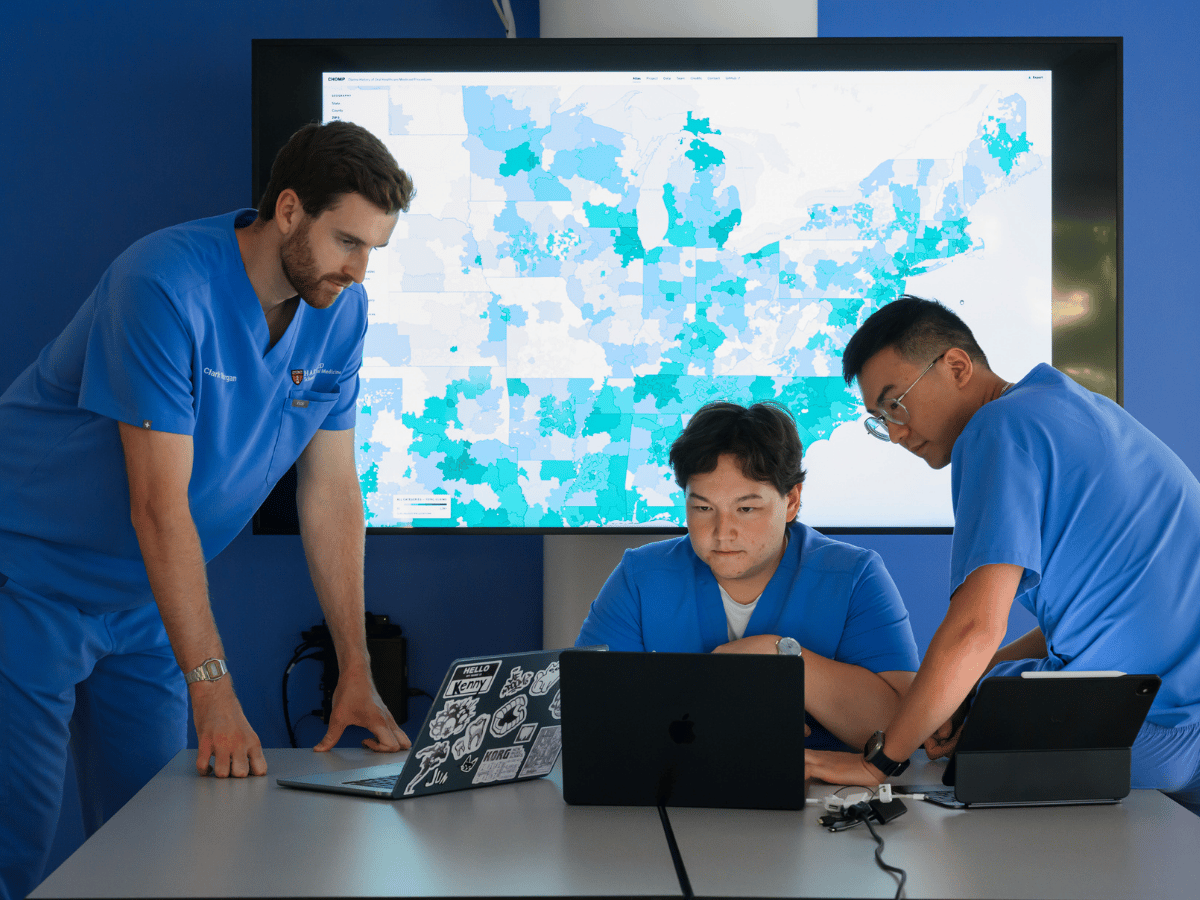
Clark Morgan (left), Samat Borbiev, and Kenny Liu.
Photo by Gretchen Ertl
Health
Dental students put Medicaid data on the map
Open-source tool reveals ‘drastic’ gaps in U.S. care
In February 2026, the Department of Health and Human Services released a massive Medicaid claims dataset spanning 2018 to 2024, opening millions of anonymized records to the public.
While the agency touted the data as a way to expose fraud, three third-year Harvard School of Dental Medicine students saw another possibility: using dental claims to reveal gaps in care and help researchers explore differences in oral health access across the U.S.
“We realized there was a great deal of dental information in the data that could be used to highlight true needs and dental care,” said Clark Morgan, D.M.D. ’28. “We could take this massive dataset that usually would cost thousands and thousands of dollars and create a public tool for researchers and policymakers.”
Morgan worked with classmates Kenny Liu, D.M.D. ’28, and Samat Borbiev, D.M.D. ’28, to develop CHOMP (Claims History of Oral Healthcare Medicaid Procedures), an interactive tool designed to map dental procedures nationwide that are covered by Medicaid.
When the team began analyzing the 227 million rows of data, the students faced the daunting task of turning the raw information into something useful. As they dug deeper, they discovered the dataset contained more detailed dental information than they had expected.
“We realized there was a great deal of dental information in the data that could be used to highlight true needs and dental care.”
Clark Morgan
“There were a couple weeks where we were just playing around with tons of data,” Liu said. Discovering that the dataset included dental procedure codes, he said, was unexpected.
The dental codes allowed the students to add layers showing Medicaid procedures by type, including diagnostic, preventive, and restorative care, as well as by dental specialty. But to make the data more usable, the students realized they needed to add provider location data as well.
“Our completed dataset is a merger of many different datasets,” said Liu. “We input both geographic information and information from the providers themselves by merging a national provider identity registry. Without that merged step it would be a huge barrier to people using the initially released federal data.”
The students used the National Plan and Provider Enumeration System, a federal provider registry, to connect claims with geographic information based on the first three digits of providers’ ZIP codes. Once they had a vision for mapping the data, Liu reached out to friends with computer science experience for help coding and turning the working dataset into a geographic information-system-based visualization.
The team then sought out Hawazin Elani, an associate professor in oral health policy and epidemiology at the Dental School, for her expertise in large-scale data analytics and health policy research, and for guidance on further developing the project.
Elani and her research team worked with the students to refine CHOMP into a tool that could support health policy and population-level research. They helped incorporate more granular geographic information, including county-level measures, link the claims with other national datasets to provide greater context for researchers, and design the tool around how researchers might navigate, filter, compare, and interpret the data. Elani also connected the students with additional Harvard resources that helped them further develop and build the site.
What emerged was an interactive research tool that allows users to explore Medicaid dental care by year, procedure, specialty, geography, reimbursement, and other contextual characteristics.
“When the students first showed me what they had built, I was impressed by the scale of the work and the originality of the idea,” Elani said. “They had taken an enormous, difficult-to-use federal dataset and created a way to see patterns in dental care that would otherwise remain buried in millions of claims. What makes CHOMP so useful for researchers is that it turns those data into something that can be explored geographically and connected with other national data. Researchers can compare communities and states, and identify policy-relevant questions that would have been much harder to recognize from the raw claims alone.”
Once the data were visualized geographically, disparities that were hard to see on a spreadsheet became immediately visible. The students were struck by the differences in Medicaid reimbursements across states, with some covering different populations and different procedures.
“I am upset by the fact that the difference in care provided between states can be so drastic,” Morgan said. Pointing to the map, he clicked on the specialty of orthodontics and showed the claims from state to state. Some states displayed none.
“I think of the person who lives right on the other side of the state line who can’t access that care. They’re just as deserving, but they can’t get care because of differing criteria in their state,” he said. He added that CHOMP could potentially help researchers investigate the long-term implications of differences in dental coverage and utilization.
“Using CHOMP, you can see the treatments that are offered, and you can see very clearly, ‘Oh, this state seems to be doing quite well in these areas of care and this state is not,’” said Borbiev.
The students see the tool as a conversation-starter for discussions about discrepancies in care from state to state and a way to inform healthcare policymaking.
“If you’re a policymaker, it can be hard to understand all the nuances of the data without this visualization,” added Borbiev. “But because our map is so visual, it’s easy to tell a story with these pictures.”
The students built CHOMP as an open-source tool, and they envision it could be expanded upon.
“Our intention is for this site to be sort of the first iteration of a larger project,” Morgan said. “By transforming this massive dataset into digestible, actionable insights at the local, state, and national level, we hope this tool and the corresponding framework to organize the data can be useful for policymakers, providers, researchers, and all others interested in improving oral and systemic health.”
All three students plan to pursue oral surgery after graduation, but developing CHOMP has given them a broader view of the forces outside the operatory that can determine the care their patients can receive.
“Beyond your professional expertise, you have all these external factors that impact the treatment you can provide. I believe very strongly that you should advocate for your patients. And to me, this is a form of patient advocacy,” said Liu.