Featured series



Nation & World
Why American electorate isn’t holding up its end on keeping informed
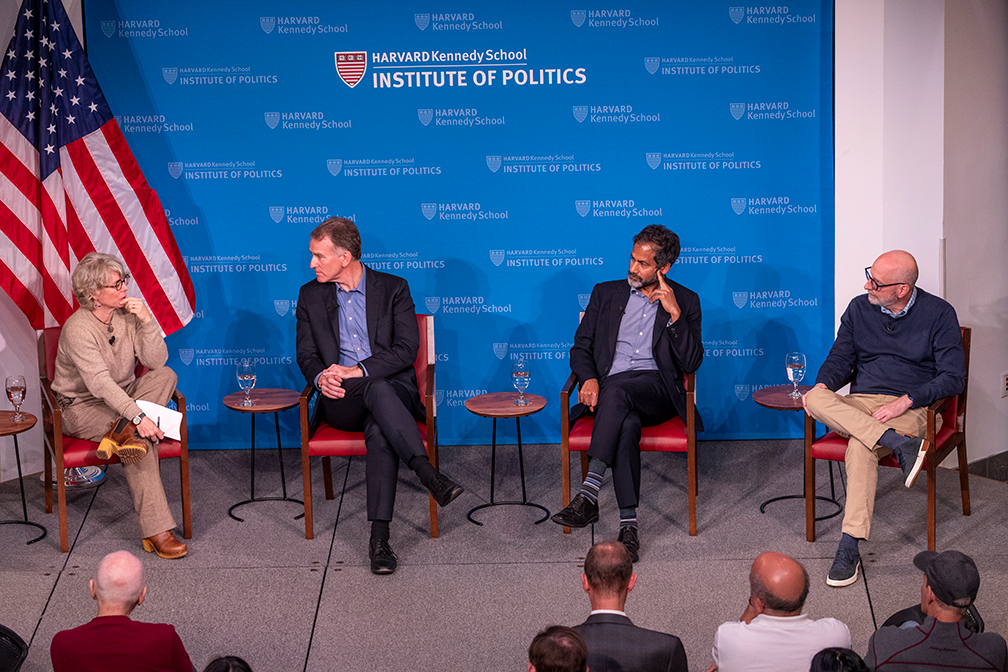
Jill Lepore (left), Steve Inskeep, Jameel Jaffer, and David French.
Photo by Mike DeStefano
Kennedy School panel blames information overload, social media political bubbles, reduced transparency in government
The founders thought an informed citizenry was essential for democracy to work and enshrined that belief in the Constitution’s First Amendment protections of free speech and particularly of a free press to hold leaders to account.
But in recent years, that implicit social contract has broken down, panelists said during a discussion Oct. 16 at Harvard Kennedy School about how it happened and the risks it poses to the nation.
“One of the problems of the moment is we now have a political class, and in many ways, a media class, that deliberately feeds on and magnifies that civic ignorance,” said David French, J.D. ‘94, an opinion columnist for The New York Times and former constitutional litigator.
While never perfect, the press used to have “a shared ethos” that its core obligation was to hold the nation’s leaders to account and that “facts mattered,” he said.
But that ethos has eroded with the emergence of social media, contributing to an environment where those with differing political viewpoints increasingly disagree on what the facts are.
“We went from a situation where a media in this age of relative consensus (and I mean relative to now), on how we covered the leaders and held them to account, to where all bets are off,” he said.
“And so, you are now able to find whatever information that reinforces your priors, and then once you find it, it’s deliberately, algorithmically fed to you from that point forward to the point where not only are you ignorant, you’re very confident in your ignorance and extremely angry when someone tries to ameliorate that ignorance.”
The talk was part of an ongoing series hosted by Jill Lepore, the David Woods Kemper ’41 Professor of American History and professor of law.
The project examines the history of American democracy and the tools necessary to maintain what the Declaration of Independence refers to as “the consent of the governed.”
“Two hundred and fifty years ago, the United States was founded on the radical proposition that people are capable of governing themselves,” provided one condition was met, Lepore said.
It would only work “so long as citizens are able to acquire knowledge of the world and of their condition in it through education and through the freedoms of thought and expression and of the press,” said Lepore, a staff writer at The New Yorker.
Her book, “We, The People: A History of the U.S. Constitution,” won the 2026 Pulitzer Prize in history.
In many respects, civic obliviousness stems from having too much information, which has driven everyone to “terminal distraction,” said Steve Inskeep, host of NPR’s Morning Edition and author of several books on American history, including “Differ We Must: How Lincoln Succeeded in a Divided America.”
“We don’t have time to reflect on whether something that our political leaders are saying makes any sense. We are encouraged, actually, to have a gut reaction to everything, and we’re in a world where I think the gut reaction is often wrong.”
Steve Inskeep
“It’s that we don’t have time to complete a coherent thought,” he said. “We don’t have time to reflect on whether something that our political leaders are saying makes any sense. We are encouraged, actually, to have a gut reaction to everything, and we’re in a world where I think the gut reaction is often wrong.”
Beyond technology and always-on media, another trend that has distorted the public’s understanding and participation in governance over the last 25 years is a loss of transparency in government, said Jameel Jaffer, J.D. ’99, director of the Knight First Amendment Institute at Columbia University.
The problem emerged in the wake of 9/11, he said, when important decisions about war, national security, and immigration increasingly were made behind closed doors, without much public debate.
“Even if you think all those kinds of questions needed to be decided in secret, I think that, to some extent, we lost the muscle of debating these kinds of questions and stopped expecting that we should be in the loop … on a question like, ‘Are we going to torture prisoners?’” said Jaffer, a former ACLU litigator.
“If you think of yourself as participating in a society in which individuals are governing themselves, then you might want a say in this question,” he said.
Jaffer also reminded the audience that most of the freedoms we now associate with First Amendment free-speech protections were not effectively put into practice until the 1919 Supreme Court case of Abrams v. United States.
In that case, a group of Russian-born immigrants were convicted under the Espionage Act of printing and distributing circulars denouncing U.S. military intervention in the Russian Revolution and calling for a halt to American munitions production.
Supreme Court Justices Oliver Wendell Holmes and Louis Brandeis famously wrote in a dissent of the importance of a so-called marketplace of ideas in the nation, a set of ideas that laid the groundwork for modern First Amendment jurisprudence.
“So, I think it’s helpful to remember how new all of this is only because it gives us a kind of agency. It gives us a sense that this is something we can affect, something that could change, something that could evolve, and something that we have the ability to shape,” he said.