Featured series

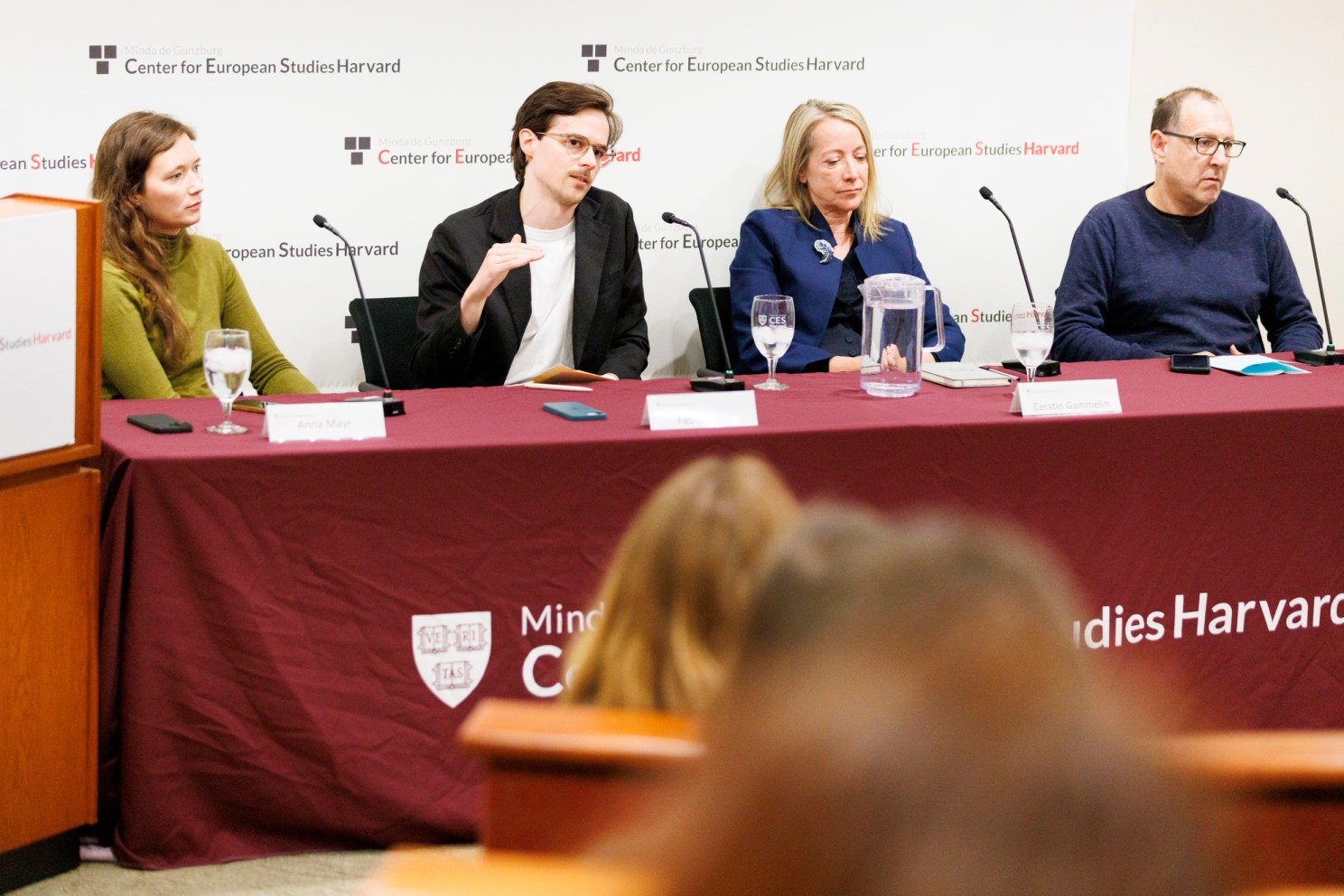
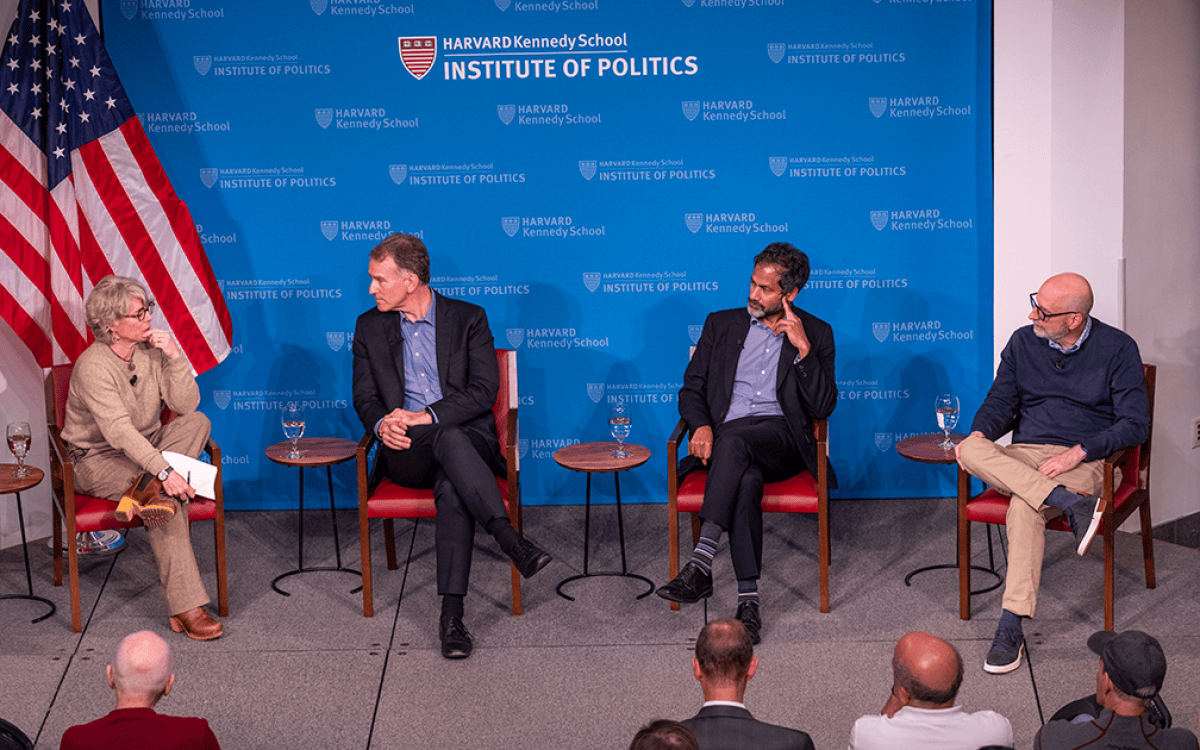
Anna Mayr (left), Fabio Ellger, Cerstin Gammelin, and David Art.
Veasey Conway/Harvard Staff Photographer
Nation & World
Far right’s breakthrough year in Germany
Panelists at the Center for European Studies weigh what AfD’s rise means for German politics
The far-right Alternative for Germany party appears to be having a pretty good year, raising concerns in the nation and across much of Europe, according to German political experts at a recent campus event.
Classified as a right-wing extremist movement by Germany’s domestic intelligence agency (a designation put on hold by a court), the AfD has largely been ostracized by other parties who refuse to include the group’s politicians in governing coalitions.
But as the fastest-growing party in Germany, the AfD is gaining power.
In October elections, Saxony-Anhalt, one of the nation’s 16 states, elected an AfD speaker to a parliamentary position — the first member of a far-right party to win such a seat since World War II.
The group currently holds 150 of 630 seats in the Bundestag, the country’s primary federal legislative body, making it the second-largest party and largest opposition party.
The recent discussion about the AfD’s breakthrough year was hosted by the Minda de Gunzburg Center for European Studies and moderated by David Art, seminar chair and Tufts political science professor. Three panelists discussed the rise of the party and its implications for the country and Europe more widely.
Cerstin Gammelin, spokeswoman for German President Frank-Walter Steinmeier, was raised in East Germany. She recalled how her optimism over her nation’s future was bolstered by movements for free speech, travel, elections — and the fall of the Berlin Wall.
Now there is change in the air.
“In 1989, I had a feeling that everything was possible,” she said. “Suddenly, you have a negative connotation of the sentence, ‘Everything is possible.’”
“In 1989, I had a feeling that everything was possible. Suddenly, you have a negative connotation of the sentence, ‘Everything is possible.’”
Cerstin Gammelin
AfD, which embraces populist, anti-immigrant, nationalist policies, now has its strongest foothold in the eastern part of the country, driven by disparities in wealth, demography, and representation. These differences, some of which she once thought would be temporary responses to reunification, have remained or worsened over the decades.
Gammelin expressed optimism that the AfD’s continued growth wasn’t inevitable. She noted the party had briefly declined in popularity after the Eurozone sovereign debt crisis, which started in 2009, and before Germany’s acceptance of more than one million refugees about a decade ago became a major political issue.
Others were less positive.
Fabio Ellger, a postdoctoral research fellow at the Berlin Social Science Center and a fellow at the Center for European Studies, said, “It will become an inevitability that the AfD will be in charge somewhere at some point.”
He said that in six of the eight German elections he looked at this year, the AfD improved on its previous result more than any other party.
Part of the reason, explained Anna Mayr, political correspondent at Die Zeit, is the freedom the AfD has to ignore the social rules of the political system.
The group can freely choose which issues to highlight as it is unencumbered by ties with governing coalitions and free of established relationships with local politicians, police, and other departments.
The AfD, she said, “has the money, and they carry no responsibility but for campaigning for themselves. I think there is basically no better position in a race to power than that.”
The panelists discussed what the AfD might do with that power and whether the party would moderate, as other insurgent German parties have done in the past. They discussed the possibilities of the AfD joining a center-right minority cabinet or becoming more moderate after gaining an absolute majority in a state election.
Ellger said he could imagine “drastically different” futures for the German center right, depending on whether they decide to cooperate with the AfD.
While moderation is possible, Ellger pointed out that the AfD is the rare radical party that has grown quite large without any sort of moderation.
“That might be due to the brand now and due to the fact that it’s not in office yet,” he said, “but we cannot be sure.”
Mayr said that the AfD has shown that it doesn’t want to alienate its most hardcore voters.
Asked whether the Holocaust was the worst crime in history, Ulrich Siegmund, the AfD’s lead candidate in the Saxony-Anhalt state election, replied that he couldn’t judge because he couldn’t “scrutinize all of humanity.”
Panelists also pointed out how the “firewall” placed around the AfD helps strengthen the party and the loyalty of its voters.
“You shouldn’t have to become undemocratic in trying to save democracy,” Mayr said. If the other parties portray members of the AfD as unworthy of participation, “it’s very hard to win them back.”
The polarized politics have taken a toll on relationships of German citizens. Gammelin recalled talking to a friend at a party last year who said he was voting for the AfD because it was the only way to get the government to pay attention, adding that he didn’t want to put them in power.
Just a few weeks ago, she talked with the same person and felt a more chilled environment.
“It was just more polarization, just as a feeling in the air,” she said. “It’s kind of a fight now, us against them, and that actually is very worrisome.”
The tense political environment will likely continue as the AfD negotiates its increasing popularity. Despite what people might want to think, Mayr said, “It is normal in Germany to vote for the AfD. …It’s not nice, but it is how it is.”