Featured series


Health
It’s good to break a sweat, but don’t sweat the details
‘What’s important is the total amount of human movement.’
Your body doesn’t care how you move, as long as you move.
That was the message delivered Thursday by panelists at the Chan School in conversation about the benefits of staying active and the excesses of “no pain, no gain.”
Though studies of the health effects of physical activity are often conducted with a focus on specific exercises, Meagan Wasfy, Harvard Medical School associate professor of medicine at Mass General, said that the development of wearable fitness monitors has enabled researchers to see the impact of a greater variety of activities. The results have been clear.
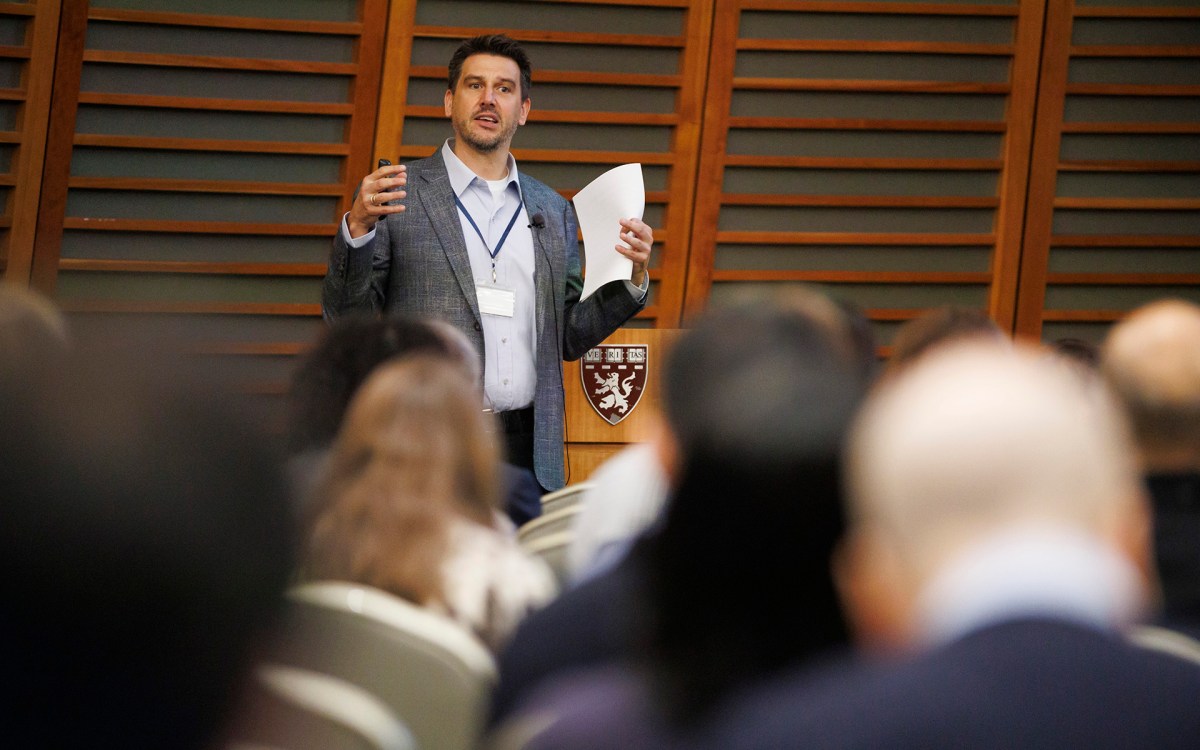
“The heart — and also the whole body — doesn’t know what shoes you have on your feet,” said Wasfy, an MGH sports cardiologist and echocardiographer.
“The heart — and also the whole body — doesn’t know what shoes you have on your feet.”
Meagan Wasfy
Wasfy’s co-panelists at the event, “Reframing Exercise,” were Mia Sanchez, a marathoner who studied environmental health at the Chan School; Brooke Forde, an Olympic silver medal swimmer and project coordinator at the Chan School; and I-Min Lee, a professor of epidemiology at the Chan School and of medicine at Harvard Medical School.
Sanchez and Forde spoke about their transitions from competitive to casual exercise. One thing they learned? Exercise doesn’t have to hurt.
“I was able to stop and reflect on my ‘why’ of exercise and how I could find that balance,” Sanchez said of an enforced pause due to a stress fracture. “Then, moving on from college into graduate school, there wasn’t as much time for that high-intensity training that I was used to for so long. But I was able to find love for not only running but other forms of exercise, like going outside and playing soccer or volleyball with my friends.”

Mia Sanchez (top left) Gretchen Reynolds, I-Min Lee, Brooke Forde (bottom left), and Meagan Wasfy.
Veasey Conway/Harvard Staff Photographer
For those looking to slim down, panelists said that staying active can help with weight maintenance, but that it’s not, on its own, a great way to shed pounds. Even so, research has shown that among people with obesity, those who exercise are healthier than those who don’t.
For anyone starting an exercise regimen, physical activity is most beneficial when it is regular and habitual, Lee noted. Also, your hard-charging past won’t save you today.
“It appears that what you currently do is more important than what you did in the past,” Lee said. “Harvard athletes who play a lot of sports when they’re in College but become couch potatoes actually don’t do as well as people who did no sport in college but are currently physically active.”
Panelists endorsed the government’s recommendation of 150 minutes of moderate physical activity per week as a good starting point for most people. Another popular guideline is 10,000 steps per day, which dates to a study done in the 1960s. Here, the group offered caveats.
For older adults, they said, citing more recent data, the cardiovascular and cancer benefits start to taper at 6,000 steps. (Which doesn’t mean you should stop: The social or psychological benefits may continue to mount.) For sedentary adults, health gains begin to accrue almost right away, even at 500 to 1,000 steps. For them, walking a half-hour or an hour provides significant benefit.
“What’s important is the total amount of human movement,” Wasfy said. “What’s important for the health benefits is the total dose. The details don’t matter quite as much.”