Featured series


Arts & Culture
When Egyptians made blue
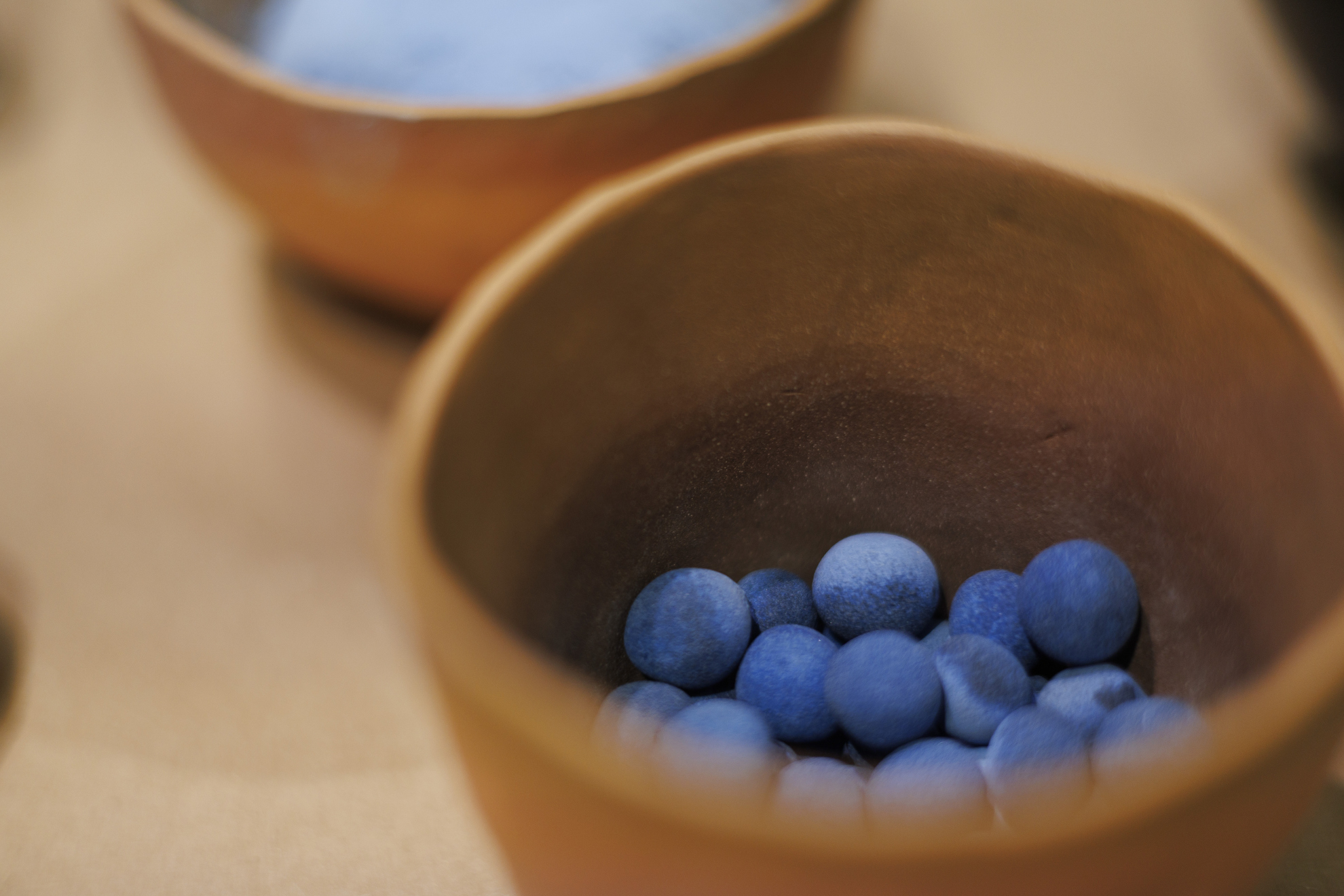
A pot of Egyptian blue pigment pellets.
Photos by Grace DuVal
Art Museums workshop explores 1st synthesized pigment, examines its legacy
The very earliest pigments, like those used in prehistoric cave paintings, were made from ground-up earth minerals and organic materials like charcoal.
The ancient Egyptians made a major breakthrough in becoming the first to synthesize a pigment, paving the way for the eventual creation of thousands of others, to the delight of artists, manufacturers, hobbyists, and other consumers.
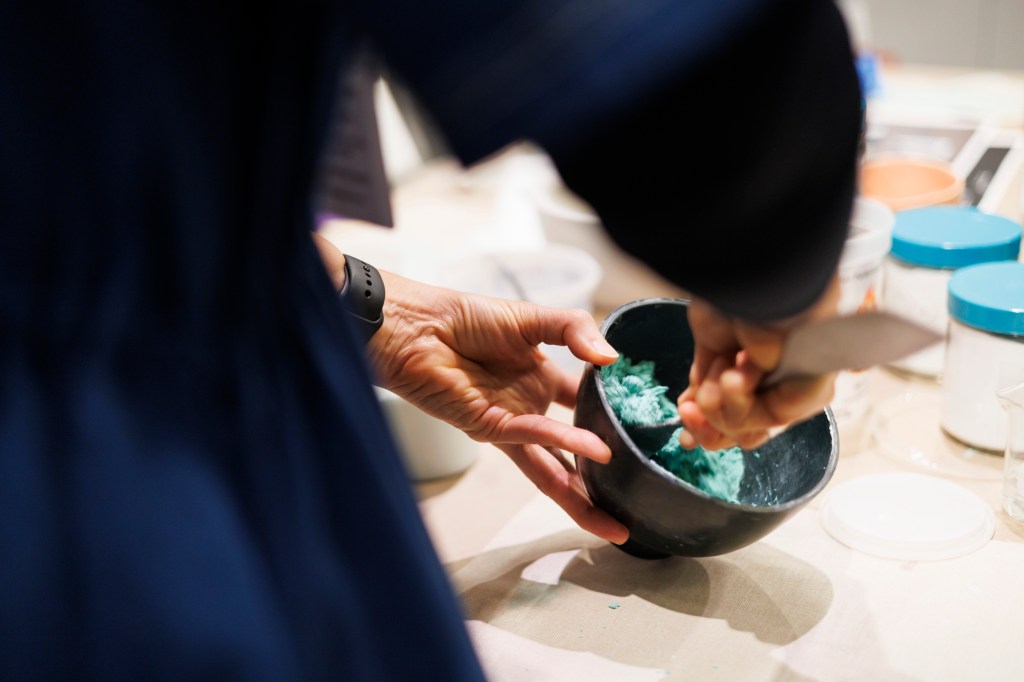
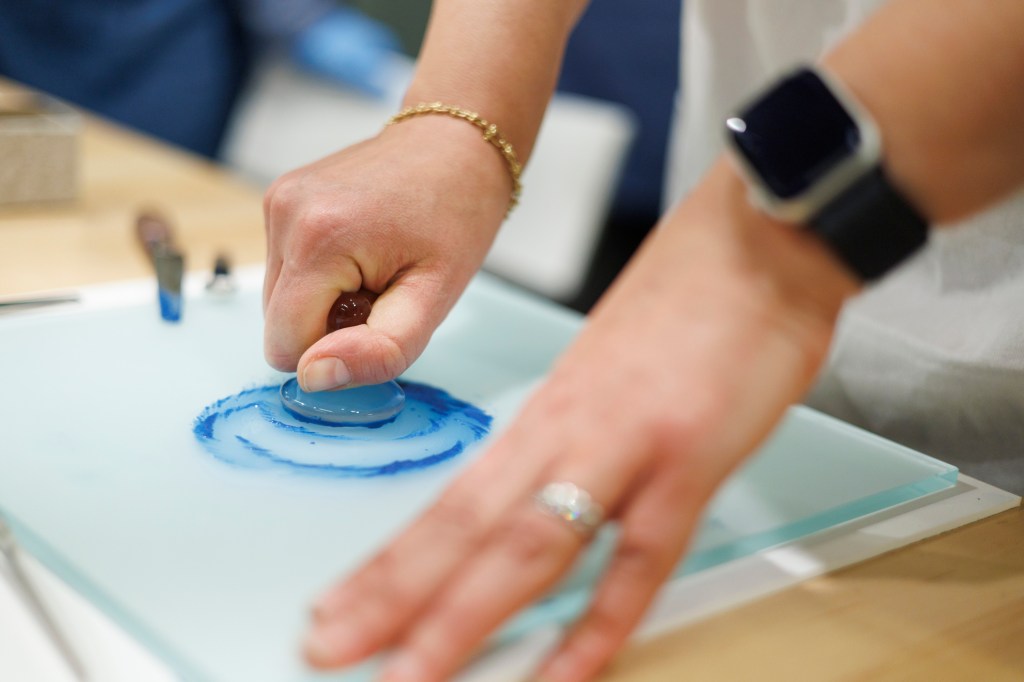
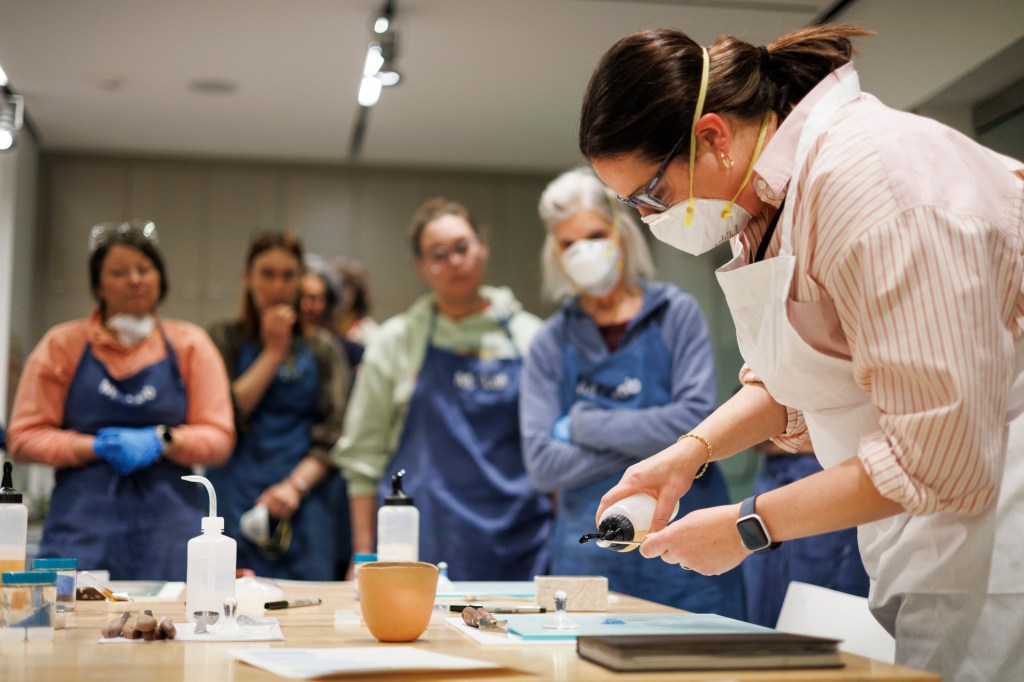
In a recent Materials Lab workshop at Harvard Art Museums, conservators gave a hands-on crash course in creating the first synthetic pigment — known as Egyptian blue — while also exploring its legacy.
“Pigments are everywhere. You can find them in dry media, like pastels, crayons. They’re in papers, they’re in photographs, they can be in plastics,” said Lisa Barro ’97, an adjunct professor in art history at NYU, who helped lead the workshop. “Egyptian blue was the earliest synthetic pigment, made around 3100 B.C.”
The vibrant blue was the product of advances in Egyptian pyrotechnology that allowed silica, copper, calcium, and sodium salt to be combined at a high heat. It was a cheaper alternative to rare, mined lapis lazuli and went on to become a favorite among artists for centuries.
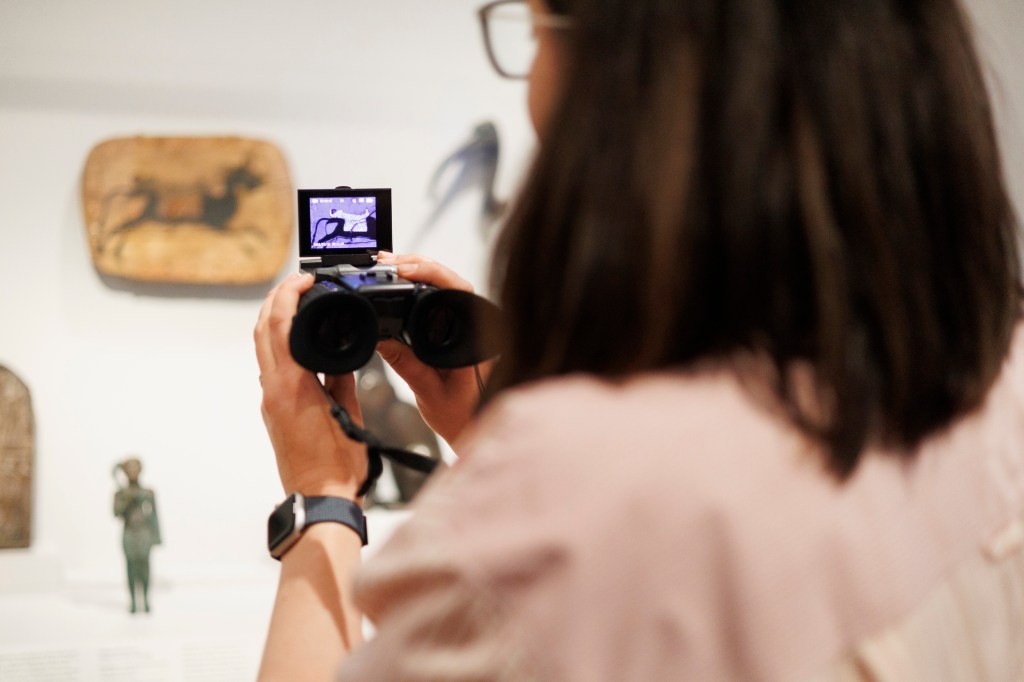
How can scholars be certain that what they’re looking at is Egyptian blue? During the workshop Barro, along with conservator Carolyn Riccardelli of the Metropolitan Museum of Art, utilized a novel technique known as visible-induced luminescence imaging, or VIL.
This is how it works: Researchers examine a piece illuminated by visible light using a device equipped with infrared detection technology (often an infrared camera or night vision gear). Areas containing Egyptian blue appear to be almost glowing amid the otherwise black-and-white VIL image.
“So if you use a put a special filter on your camera, to block the reflected visible light, you can see this luminescence,” Barro said.
Before VIL imaging was developed by Giovanni Verri in 2007, Barro said, detecting Egyptian blue would require an invasive process of analyzing samples for their unique chemical profile. Egyptian blue has a distinct crystalline structure that differentiates it from other similar materials, such as Egyptian faience.
“Every year, there are new discoveries about Egyptian blue, and our understanding of the chemistry is evolving, and our ability to detect it keeps improving,” she said.
Barro and Riccardelli showed examples of VIL imaging of works containing Egyptian blue in Harvard galleries: a Persian relief from the fifth century B.C., a foot panel from an Egyptian coffin, a composite funerary portrait of a man from Roman Egypt, and a cylinder seal with imagery of an archer shooting a winged bull.
Researchers have also found Egyptian blue to be useful in providing insights into ancient civilizations.
Recently, researchers from MIT made a new discovery in Pompeii that a small blue room preserved by the eruption of Mount Vesuvius in the first century A.D. was actually a fresco wall painted with Egyptian blue.
Scientists were able to calculate the amount of Egyptian blue used on the walls, observe the quality of the decoration, and conclude the home’s owners were likely among Pompeii’s elite.
“When I was here as a student I learned that the end date for using Egyptian blue was around 900 A.D.,” Barro said. “That is not true. With this new imaging technique the dates keep stretching, and we keep finding new samples of Egyptian blue.”
Also in the last decade, researchers have discovered Egyptian blue in Italian renaissance works — including in Raphael’s Roman frescoes at the Villa Farnesina.
Harvard Art Museums is home to the Forbes Pigment Collection, a collection of historical pigments compiled between about 1910 and 1944 by the director of the Fogg Art Museum. While not open to the general public, the pigments are available to view through the Conservation and Art Materials Encyclopedia Online (CAMEO) database here.