Featured series


Campus & Community
‘Truth is rarely found in echo chambers’

Julia Minson.
Photos by Grace DuVal
Faculty, staff, and students explore what it takes to connect across difference at Community and Campus Life forum
Most people find disagreeing unpleasant and try to avoid it. But sometimes it’s necessary and can lead to better solutions, or at least a more productive exchange of ideas. The question is: how to remain receptive and avoid the pitfalls of anger and defensiveness?
Faculty, staff, students, and administrators explored this predicament over three days of virtual and in-person lectures and workshops at a March 23-25 Community and Campus Life forum, “Leading With Community.”
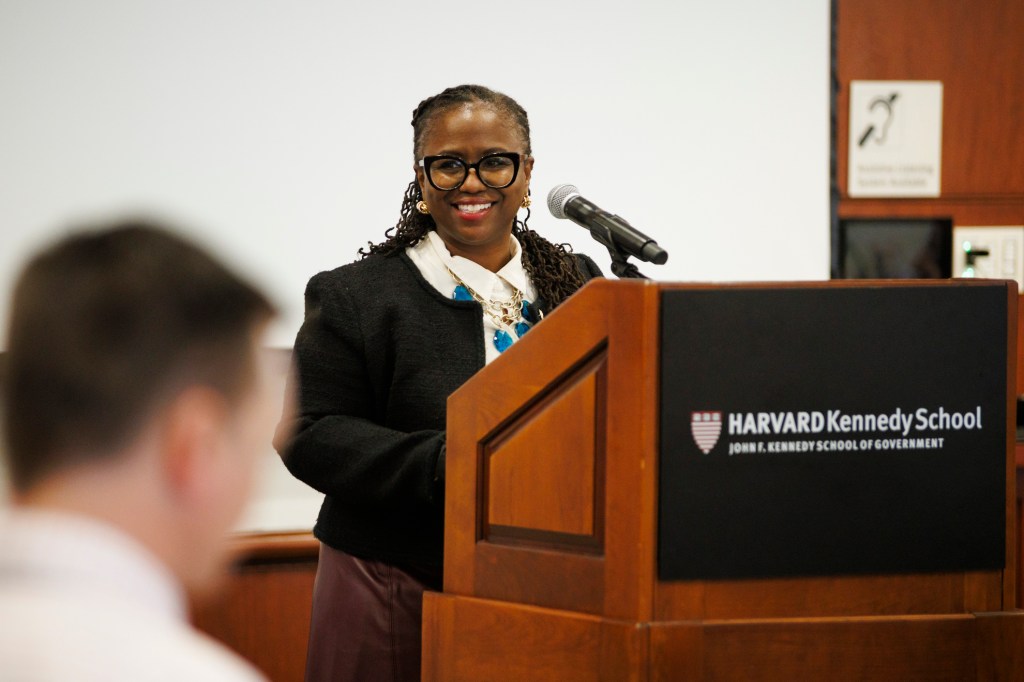
“I want each of us to leave with at least one concrete practice that you will try to do differently in your corner of Harvard, in your own lives, or in the world,” said Sherri Ann Charleston, chief community and campus life officer, on the forum’s second day. “You’re going to have a chance to lean in, to hear from your colleagues, to engage in conversation, to try new approaches to building connection across differences.”
President Alan Garber said building skills to work through disagreement is about more than self-improvement. It also speaks to the University’s central mission, noting that “sustaining our academic excellence and nurturing our campus culture are not separate goals.”
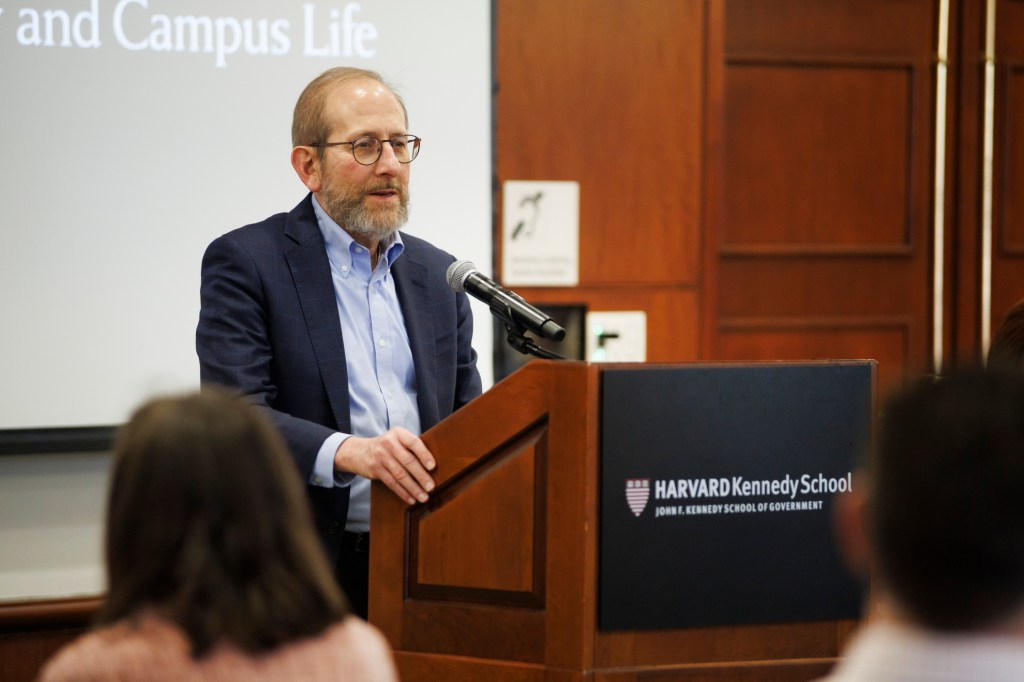
“Truth is rarely found in echo chambers,” he said. “Many of the most profound breakthroughs in our understanding of the world and of humanity did not come from consensus. It came from individuals who dared to challenge orthodoxy … If we hope to continue making profound breakthroughs, we must have a community culture that genuinely welcomes the expression of a wide range of views, rooted in different backgrounds, interests, and beliefs.”
Helping the audience develop practical strategies for dealing with diverse views was Julia Minson, professor of policy at the Harvard Kennedy School and a behavioral scientist whose first book, “How to Disagree Better,” was released on March 24, the day she spoke.
Minson began her talk by pointing out an inherent tension.
“There is a huge behavioral science literature that says disagreement is good for us, right? When we are really thoughtfully engaged with opposing perspectives, we make better decisions,” she said. When multiple perspectives are taken into account at once, companies are better at forecasting future events and retaining employees. Conflicts are less likely to spiral out of control.
“When we are really thoughtfully engaged with opposing perspectives, we make better decisions.”
Julia Minson
“On the other hand, we hate it, and we try hard to avoid it,” Minson said. “Most regular people tend to not want to engage with views that are dramatically different from their own.”
Throughout her talk, Minson debunked common ideas about disagreement.
For example, when we talk to someone who belongs to a group whose views are in opposition to our own, we tend to believe that person’s views are much more extreme than they actually are. We also believe their views are more simplistic, and we overestimate that person’s level of animosity towards us.
Minson provided some strategies for having more productive disagreements based on her research.
People tend to put a lot of emphasis on their mindset or body language when entering a difficult conversation, but the person on the other side often fails to register — or misinterprets — those cues, she said.
Instead, her research found specific tactics that make the other person feel more respected and heard. A good way to remember them, she said, is to think of the acronym H.E.A.R.: hedge your claims, emphasize agreement, acknowledge other perspectives, and reframe to the positive.
When it came to having better conversations, Minson encouraged attendees to pay less attention to projecting the correct feelings or cues and more to implementing these concrete behaviors.
“It’s relatively easy to train, because we’re not talking about years of therapy,” she said. “We’re talking about: ‘Memorize these words.’”
She broke the audience into groups of three, each with one person assigned to be difficult, another asked to be unfailingly accommodating, and a third to keep track of how many H.E.A.R. phrases the accommodating people used in response to their disagreeable interlocutors.
At the end of the exercise, one attendee said that as hard as she tried to instigate, her partner’s unflinching receptivity and search for common ground made it difficult to remain contentious.
It’s not a rare outcome, Minson said. With some practice, anyone can defuse acrimonious conversations and create reasonable ones instead.