Featured series


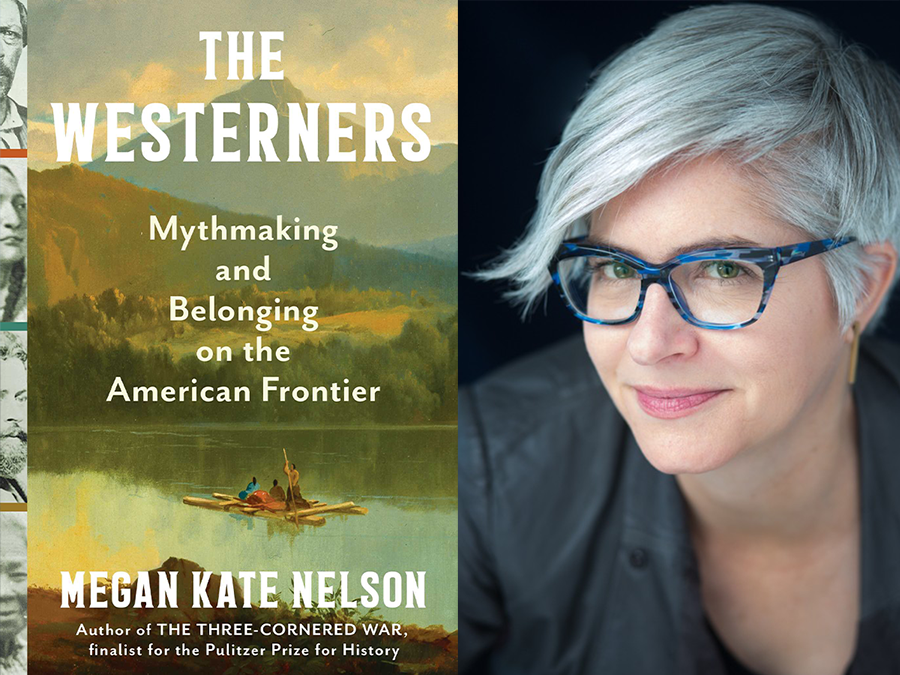
Photo by Sharona Jacobs
Arts & Culture
Not your father’s Wild, Wild West
Megan Kate Nelson’s new book challenges myths of American frontier, finds more diverse, complex saga
Megan Kate Nelson has often been surprised by the misconceptions people have about the West.
Raised in Littleton, Colorado, in a family of avid road-trippers, she had visited 45 states by the time she started at the College in 1990. Nelson said classmates (who’d presumably spent less of their summers in the family car) would ask, “Did you ride your horse to school?” “I grew up in the suburbs!” she’d say. “No, I didn’t ride my horse to school.”
And those students weren’t alone. Nelson ’94 came to understand over decades of historical research how incorrect the founding myth of westward expansion was: that white men single-handedly brought American ideals to the undeveloped frontier along the Oregon and Santa Fe Trails and shaped the West.
In her new book, “The Westerners: Mythmaking and Belonging on the American Frontier” (Scribner), the Pulitzer Prize-finalist historian puts forth a sprawling, interwoven saga through the stories of diverse, dynamic individuals who traveled and settled west of the Mississippi as the U.S. expanded its boundaries and influence in the 19th century.
Nelson’s story runs through seven protagonists, whose paths intersect as they criss-cross American territory, and sometimes beyond it.
Some characters will be familiar to readers, like Sacagawea, the Indigenous woman who helped lead Meriwether Lewis and William Clark’s expedition through the Louisiana Territory. Others, like Maria Gertrudis Barceló, a prominent Sonora-born saloon owner in Santa Fe, are lesser-known.
Nelson expands the stories of even characters like Sacagawea, whose life is often described in the context of a single American expedition.
“This was an extraordinary moment in her life,” said Nelson in an interview, “but it was only one moment.”
“We think of the West as such an enormous region, and it is, but in the 19th century, the population was relatively small, and the chances that people would run into each other, or had heard of one another, were pretty good.”
Before meeting Lewis and Clark, she had traveled a great deal of the American West — born in Shoshone lands in the northern Rocky Mountains, stolen by another tribe, and brought to the Upper Missouri Valley.
Years after the expedition, she put her 6-year-old son, Jean Baptiste Charbonneau, under the care of Clark, which she believed could help create bonds between the Hidatsa people of Knife River and Americans in St. Louis.
Her son would become a prominent figure in the West, encountering people like Virginia native Jim Beckwourth, a fur trader, scout, and entrepreneur who serves as the connective tissue between many of the book’s protagonists.
Nelson said she’s heard Beckwourth referred to as the “Forrest Gump of the 19th century,” a description that seems apt given Beckwourth’s frequent and varied appearances at important moments in the history.
Born to an enslaver father, he migrates West, joins the Rocky Mountain Fur Co., embeds in the Crow Nation, moves to California for the Gold Rush, discovers and promotes a key route through the Sierra Nevada, and works as an Army scout, among other endeavors.
“We think of the West as such an enormous region, and it is,” said Nelson, “but in the 19th century, the population was relatively small, and the chances that people would run into each other, or had heard of one another, were pretty good.”
The characters throughout the book are always on the move or influenced by those on the move.
Barceló migrates from the northern portion of New Spain, which encompassed a large part of southern and western North America, to Santa Fe and becomes one of the most powerful businesswomen in what would become New Mexico Territory.
Though she remains in place for decades, her life—and fortune—is affected by the people passing through: traders on the Santa Fe Trail after ownership of the region transferred from Spanish to Mexican hands, soldiers from both sides during the Mexican-American War, and migrants settling in the area after the United States took control of the territory.
The book rebuts aspects of the gunslinging, rugged individualistic narrative of westward expansion, weaving instead a tapestry of stories that show how the West became as diverse racially and culturally as it was geographically.
Chinese immigrant Polly Bemis, one of the book’s other protagonists, is trafficked from Guangzhou and Hong Kong to San Francisco, and eventually a majority-Chinese town in the mountains of Idaho.
She achieves a level of semi-celebrity, Nelson says, among later visitors who are stunned to discover in the remote rural town an elderly Chinese resident who has been there for 40 years.
“The reason they can’t believe it is because Chinese people have not been included in the frontier myth,” Nelson says.
The characters who populate Nelson’s new history go a long way toward explaining how the American West became the culturally and politically complex region it is today.