Featured series

Nation & World
How 3 mayors are combating homelessness
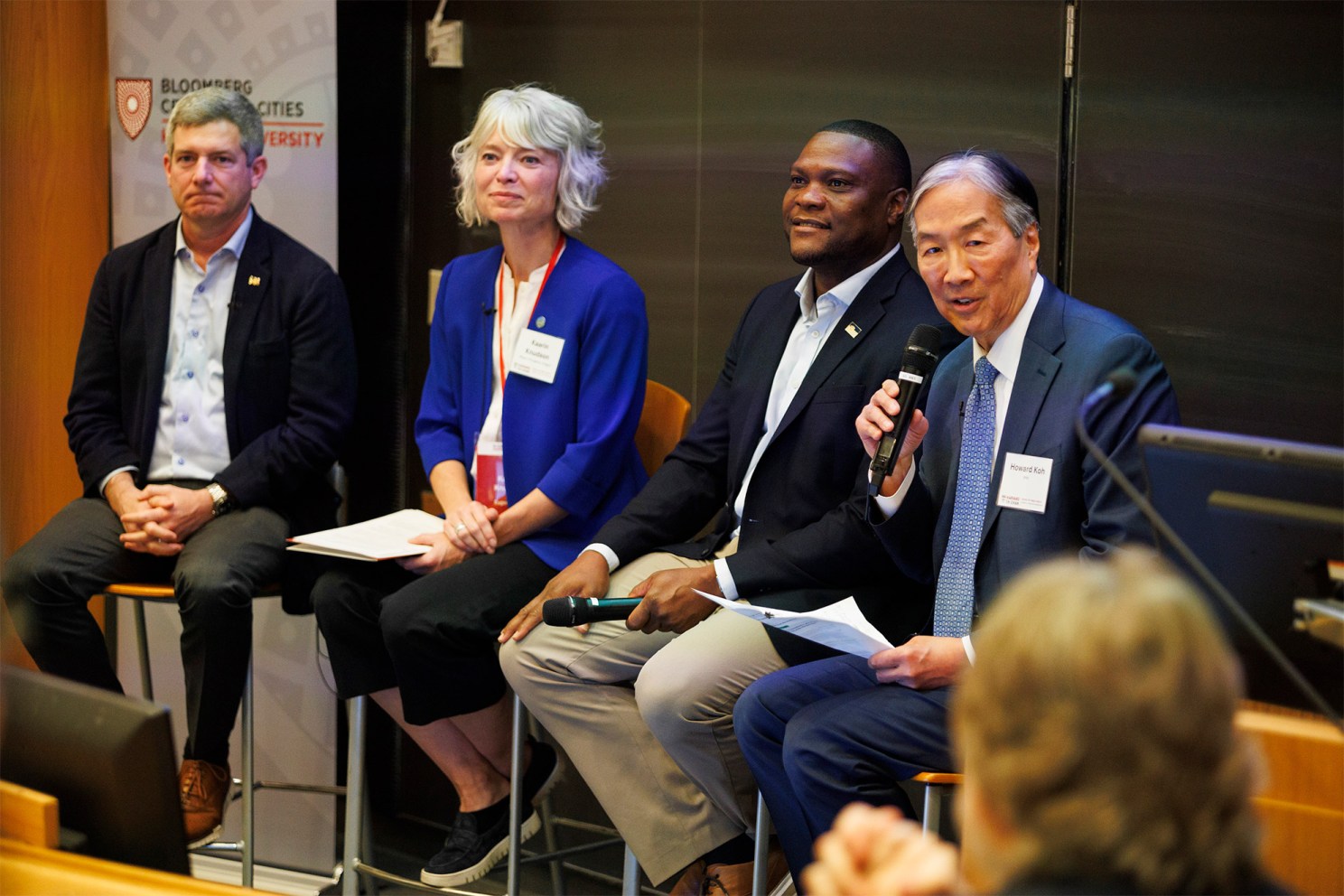
Mayors Patrick Farrell (from left), Huntington, West Virginia, Kaarin Knudson, Eugene, Oregon, and Monroe Nichols, Tulsa, Oklahoma, with moderator Howard Koh.
Photo by Grace DuVal
City leaders meet to discuss ‘highly visible and highly unacceptable’ crisis
Three American mayors gathered at Harvard on Tuesday to share the strategies they’ve deployed in their cities to address homelessness.
An estimated 770,000 people were homeless in the U.S. as of the most recent data, up 18 percent from the previous count. Of those, about one-third were unsheltered, meaning they were sleeping on the street, while two-thirds were living in homeless shelters, temporary housing, or “doubled up” with friends or relatives.
It’s a crisis that affects much more than housing, said panelist Monroe Nichols, mayor of Tulsa, Oklahoma. “Public safety, public health: All the things we do as a city are impacted by the issue of homelessness.”
The forum — held at the Chan School of Public Health and co-sponsored by the Bloomberg Center for Cities, the Initiative on Health and Homelessness, and the Harvard Urban Health Initiative — was part of the Bloomberg Center’s Global Mayors at Harvard Day. In more than 30 events across different schools on campus, 45 mayors — representing 16 countries — from the Bloomberg Harvard City Leadership Initiative gathered to share perspectives, compare experiences, and explore solutions to the complex challenges of local governance.
“We are here because we understand that homelessness represents a highly visible and highly unacceptable humanitarian crisis,” said moderator Howard Koh, the Harvey V. Fineberg Professor of the Practice of Public Health Leadership at the Chan School and inaugural chair of the Initiative on Health and Homelessness. “But we can solve it if we have everybody in this room, and all the leaders and all the sectors across society, and especially our political leaders, our mayors, stepping up and taking charge of this crisis that is growing by the day.”
Joining Nichols on the panel were mayors Patrick Farrell of Huntington, West Virginia, and Kaarin Knudson of Eugene, Oregon. Koh asked each mayor to describe the challenge of homelessness in their community and their unique approaches to fixing it.
Farrell traced homelessness in Huntington to the ongoing effects of the opioid epidemic. He said that solving the issue is not only about the well-being of people living on the street, it is also about the perceived safety of the community.
“We weren’t going to be able to attract businesses; we weren’t going to be able to fix the infrastructure,” Farrell said. “We weren’t going to be able to give hope to the young people in our city who want to stay. It became the first thing to tackle to be able to build everything else.”
Farrell’s approach has been to convene hospitals, businesses, nonprofits, and government to work together on the problem. He launched a public safety dashboard to track the city’s progress.
“We had to show them that when we take somebody living on the street to the ER and back to the street, then to jail, it’s the most costly, least effective way to solve this problem.”
In Tulsa, Nichols also organized his community around hard numbers.
“We have about 3,000 people who become homeless in our community every single year. So driving indicator No. 1 is, do we have 3,000 units in our community that we can get those people into? We’re not there yet, but that’s the goal.”
He also pointed to what he called a rapid exit strategy. When he took office, the time between a homeless Tulsan’s first interaction with a caseworker and the time they got housing was 220 days — and that was an average. His administration shortened the wait time to 37 days.
Knudson said good data collection showed her that Eugene actually didn’t need many more units of transitional housing. “We need maybe 100 more spaces, maybe 200, but what we really need to work on is the pipeline out of that experience.”
She said that due to federal funding cuts, Eugene had lost some of the case managers who helped people out of transitional housing and into permanent housing.
The mayors highlighted the systemic challenges facing their communities — challenges that require investment beyond the level of city government.
In Eugene, the housing vacancy rate has been below 5 percent for a decade, said Knudson, who has taught planning and urban design at the University of Oregon College of Design. At the same time, she said, the average unit of housing was well out of reach for a person making the average wage.
“It’s an incredibly brittle, inaccessible housing market,” Knudson said. In addition to increased funding for mental health and addiction services, “The policy action that we need is to fund the housing our communities need.”