Featured series



Julia Minson.
Photo credit: Parker, Fine & Brower
Arts & Culture
Ways to keep talking — and maybe find way forward — amid riven times
Julia Minson’s new book says starting point involves signaling goodwill, respect, highlighting shared interests
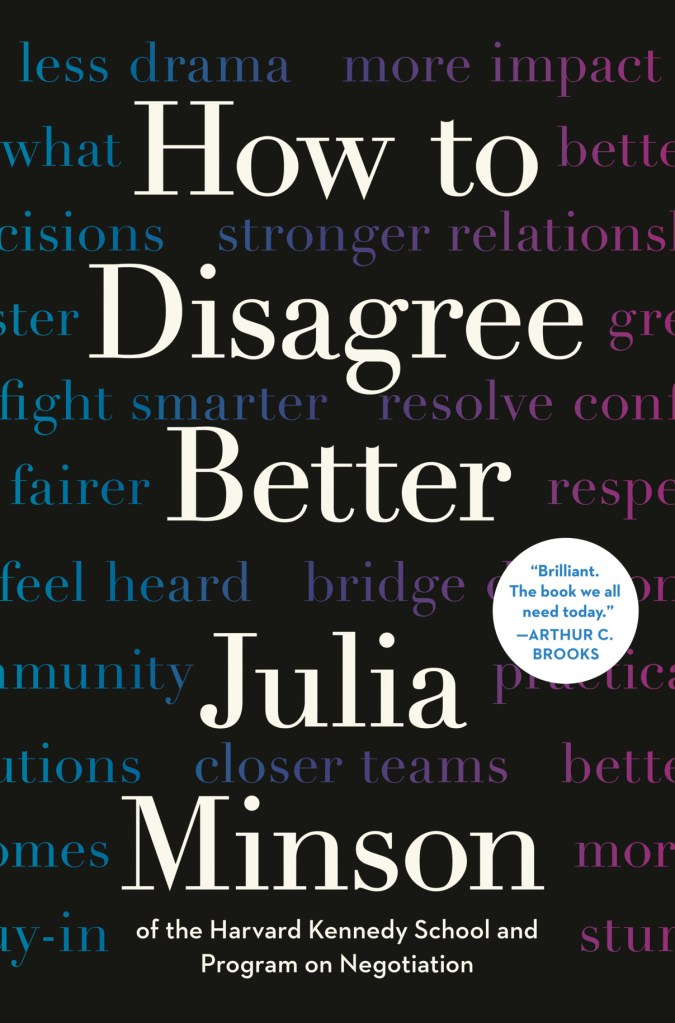
Excerpted from “How To Disagree Better” by Julia Minson, professor of public policy. Published by Avery, an imprint of Penguin Publishing Group, a division of Penguin Random House, LLC.
The algorithm we developed not only helped us identify which words and phrases of conversational language increased and decreased perceptions of receptiveness but also which features were the most important because they had the greatest impact or could be ignored because they were very rarely used in natural conversation. I am not very creative, but thankfully my students are. After a bit of brainstorming, they came up with a snappy acronym to help memorize the most important features of conversational receptiveness. The acronym is H.E.A.R. as in “I HEAR you.” H.E.A.R. became a way for us to teach people a “receptiveness recipe” — years of research condensed into a list of bullet points.
The “H” in H.E.A.R. stands for “Hedging your claims.” Hedging makes it clear that no matter how right you think you are, you recognize that there are exceptions to nearly every rule and that most issues are complex and multifaceted. Here are some examples:
“While most doctors believe that COVID-19 vaccines are generally safe and effective, some people have experienced dangerous side effects.”
“It seems that most immigrants are law-abiding and well intentioned people, but many reasonable voters are still likely to believe that borders should be secured and laws should be followed.”
Using hedging words such as “sometimes,” “perhaps,” “possibly,” “most,” and “some” shows your counterpart that you recognize the complexity and nuance of the world we live in. A point made with a verbal hedge (“I think that most of the time women do just as well in high-stress jobs as men”) is more likely to advance the conversation productively than the same point made without the hedge (“Women do just as well in high-stress jobs as men”).
The advice to hedge accurate claims can sometimes raise eyebrows among people who are concerned about sounding less certain than how they really feel. But remember, the goal is to show that you are engaged with the other person’s point of view, not that you have so completely rejected it as to have zero doubt about your own correctness. To the extent that the issues we debate are multifaceted and complex, hedging shows a person to be more thoughtful and have better judgment than someone who expresses their own views with no room for doubt.
The “E” in H.E.A.R. stands for “Emphasizing agreement.” Almost in any argument, two people can find something to agree on. You might be pro-life, and I might be pro-choice, but we both agree that parenting is hard work. You might believe that gun rights should be limited, and I that they are fundamental to individual freedom, but we both agree that a gun in the wrong hands can lead to tragedy. You might think we need to cut staff and I think that we need to add more, but we both agree that client satisfaction is our top priority. Using words such as “we both agree that” or “I also want to” or “I share some of your concerns” allows parties to identify common ground, which is often more extensive than they initially imagined. Highlighting shared areas of understanding makes people feel that they are on the same team, navigating the disagreement together.
Importantly, emphasizing areas of agreement does not mean changing your mind or compromising. Rather, it means recognizing common values and experiences that connect us all and devoting a few words toward making that agreement explicit. In cases of known disagreement (like when we belong to different political parties or different competing departments, or when we’ve had this argument before), people tend to exaggerate the magnitude of that disagreement and hold negative and often inaccurate beliefs about their counterparts’ views. Emphasizing agreement can mitigate the effects of those stereotypes by highlighting to your counterpart how much you have in common.
The “A” in H.E.A.R. stands for “Acknowledging other perspectives.” In most disagreements, people make their point quickly and repeatedly. They will often interrupt their counterpart to contradict their ideas, as if the opposing argument is an annoying stinging insect to be swatted out of the air as quickly as possible. Go ahead and ask your spouse to explain their perspective on a long-running disagreement and try not to interrupt them for five minutes — it is incredibly difficult! Acknowledging the opposing perspective is even harder. Acknowledgment means that when it is finally your turn to speak, you must donate some of your own precious airtime to restate the other person’s point of view so as to show them with your words that you really heard them. This may be done with phrases such as “I understand that you really care about …” or “Thank you for telling me about …” or “You are suggesting that …” Performing acknowledgment effectively means slowing down the argument to show you’re listening even as you are about to launch into your own spiel.
Acknowledgment is certainly not a new idea, and many of you may have taken a leadership or communication training that advised you to tell counterparts in disagreement that you “hear them.” Indeed, this advice has become so common that poor execution of acknowledgment has spawned a variety of popular memes. On Instagram and TikTok, a variety of comedic characters (my favorites are evil-looking cats) say things like “I hear you, but …” The stony-faced expression of the cat makes it very clear that it did not in fact “hear.” By contrast, effective acknowledgment requires restating the counterpart’s point of view in your own words, to behaviorally demonstrate that you did in fact do the listening and understanding what you want to get credit for.
For example: “I hear you, but we just don’t have the budget” is no good. A better version might be: “I hear you. You are really concerned with how the quality of the cabinet hardware will impact the overall appearance of the new construction. I know that meeting the highest standards of quality is really important to you. I just don’t think we have the budget.” In this example, the speaker demonstrated that they heard their counterpart and the exact nature of their concerns. They didn’t just claim that they understood with no evidence. Notice that in both cases the end is the same — the speaker believes that there is no budget for upgraded hardware — but the fact that they demonstrated listening through acknowledgment makes a big difference in how that conclusion is likely to land.
The “R” in H.E.A.R. stands for “Reframing to the positive.” The R does double duty by reminding you to avoid negation words (such as “can’t,” “don’t,” won’t,” and “no”) and negative emotion words (“hate,” “terrible”), and adding more positively valanced words (“great,” “like,” “win”). For example, if I am feeling frustrated in a conversation because my counterpart has interrupted me, I might be tempted to say, “I hate it when people interrupt me. Please don’t.” But instead, the same message can be delivered by saying, “I can tell it’s hard for you to hear me out. I would really appreciate your letting me finish.”
Just like the earlier components of H.E.A.R., “Reframing to the positive” is not intended to change the core of the message. The speaker is still conveying their desire to finish their sentences at their own pace. But adding the positive framing creates a perception of warmth and is more likely to avoid escalation.
The H.E.A.R. framework captures a lot of the important components of conversational receptiveness, but if you have a bit of extra brain space, I want to highlight two more that are worth keeping an eye on. First, try to avoid reasoning words such as “because,” “therefore,” and “explain.” These words often crop up when you are patiently trying to enlighten your counterpart about the obvious and extremely logical conclusions that anybody with half a brain ought to draw in a particular situation. “And because heat rises, the car will be much warmer if you use the vents by your feet.” Heat does rise, and the car will probably be warmer, but the explanatory words make the argument sound condescending. By trying to sound extra smart and logical, you are actually decreasing the chances that your counterpart will take your well- meaning advice.
The other feature to avoid is “adverb limiters.” You can be forgiven if you have never heard the term, but adverbs are words that modify other words. Adverb limiters are the little words that make the word coming after them seem smaller, and less consequential. “It’s just polite to ask before you borrow somebody’s stuff.” Or “I am merely suggesting we consider the consequences of this policy before we roll it out company wide.” Words like “just,” “simply,” “merely,” and “only” are often intended to show that what you are asking for or claiming is simple, obvious, and should be easily agreed to. But instead, they serve to minimize the validity of your counterpart’s view and again, add a dash of condescension. Try to avoid these little packets of conversational poison.
The receptiveness recipe turned out to be easy to learn. In experiment after experiment, we presented the components of the H.E.A.R. framework to research participants and gave them some examples of each feature. It turned out that they could easily incorporate our advice into arguments on a variety of topics. The participants trained in conversational receptiveness were seen as more trustworthy, more objective, and more desirable as future teammates and collaborators by those with whom they disagreed. Importantly, these effects persisted even when people debated some of the thorniest topics of our day: the necessity of COVID-19 vaccines, affirmative action in hiring, the Black Lives Matter movement, and the American investment in fighting international terrorism. And importantly, because participants were randomly assigned to receive or not receive training in conversational receptiveness, we could conclude that their word choice, and not some other extraneous features, caused these positive outcomes.
In sum, using conversational receptiveness enabled our research participants to express their point of view while being seen as more reasonable, thoughtful, and trustworthy, even when they were discussing some of the most inflammatory topics we could think of. It also led their counterparts to be willing to have additional conversations on these and other topics, opening the possibility of ongoing dialogue and problem-solving. When participants were not trying to score a quick rhetorical point by being extra clever and dogmatic in their arguments, they were seen as the sorts of people that others want to keep talking to. And isn’t that the key to influence?
Copyright © 2026 by Julia Minson.