Featured series

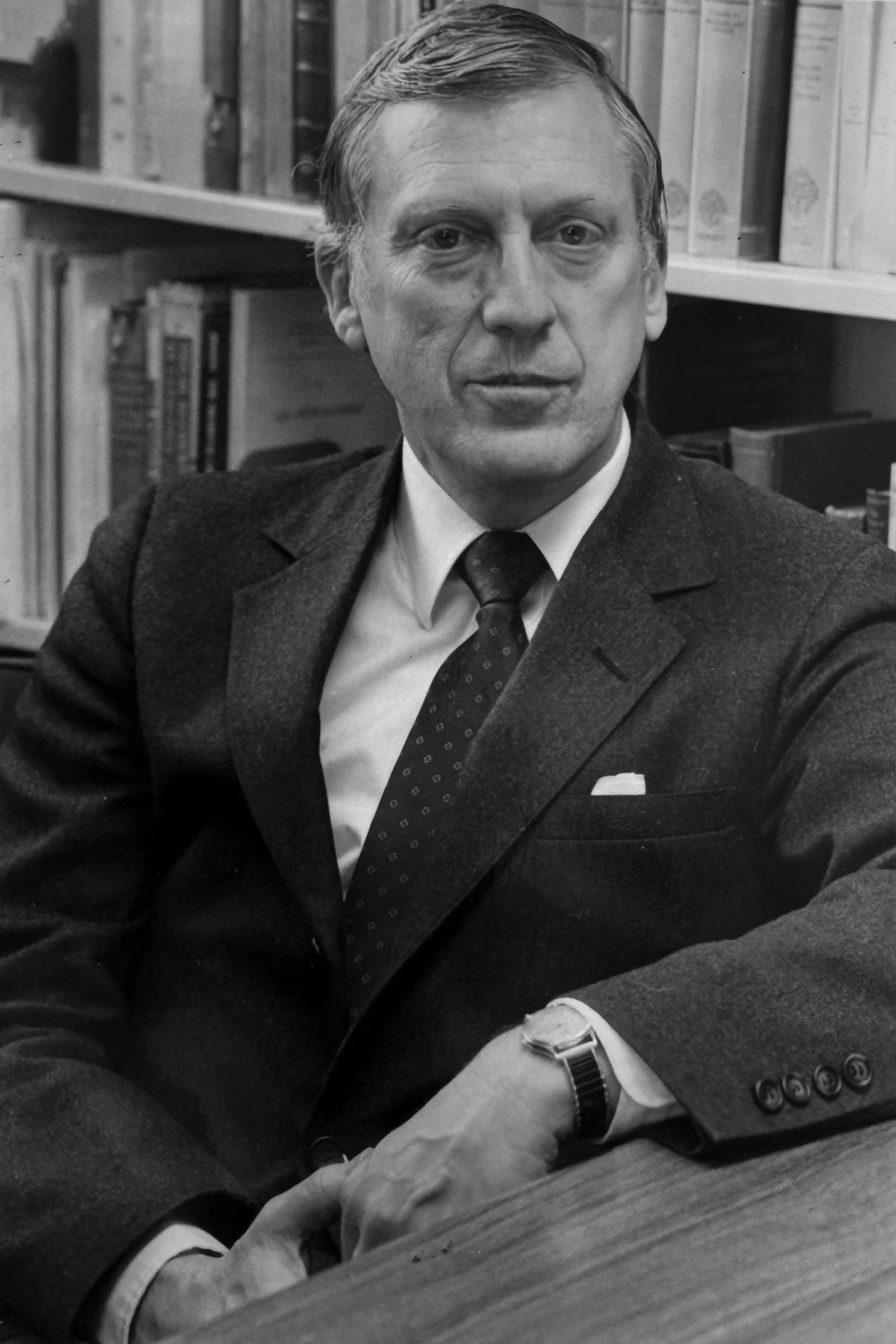
Thomas Bisson, 1987.
Harvard file photo
At a meeting of the Faculty of Arts and Sciences on March 3, 2026, the following tribute to the life and service of the late Thomas Noel Bisson was spread upon the permanent records of the Faculty.
Born: March 30, 1931
Died: June 28, 2025
Thomas Noel Bisson, Henry Charles Lea Professor of Medieval History, Emeritus, died on June 28, 2025, at the age of 94. A distinguished historian and teacher of medieval Europe, he focused on institutions, the transpersonal structures of governance that emerged painfully and fitfully from the doings of those in service to the great and the powerful, particularly in the portentous 12th century C.E.
Bisson was born in New York City in 1931, but his formal schooling began in China; he remembered riding to school in a rickshaw. His father, the American political writer and journalist T. A. Bisson, was studying Japan and China. His maternal grandfather, John E. Williams, had been Vice-President of the new Nanking University and was murdered during the Nanking Incident (1927). The elder Bisson ultimately lost his academic appointment during the McCarthy era, finishing his career in Canada.
Thomas Bisson was educated at Haverford College (B.A. 1953) and Princeton University. At Princeton he took his Ph.D. (1958) with Joseph R. Strayer, the eminent historian of medieval institutions, and studied also with Ernst Hartwig Kantorowicz of the Institute for Advanced Study. Bisson taught at Amherst College, Brown University, and Swarthmore College before moving to the University of California, Berkeley, for 20 distinguished years (1967–1987). He came to Harvard in 1987, where he was the Henry Charles Lea Professor of Medieval History from 1988 until he retired in 2005. He chaired the Department of History from 1991 to 1995 and, at both great institutions, trained as graduate students many of the next generations’ leading medievalists, of whom he was justifiably proud. After his retirement, Bisson continued to prove his dedication to the liberal arts through his quietly thoughtful undergraduate teaching, including First-Year Seminars. Many of his former students gathered joyously at his home on Hammond Street to honor him for his 94th birthday in the spring of 2025.
Bisson pursued his abiding interests in medieval Europe’s history in ways that typify the man and the scholar: quietly, rigorously, and thoroughly. He had a profound respect for others and the rare ability to listen carefully. As a mentor of graduate students, he was famously strict while always remaining deeply humane. Despite a discipline of steel, Bisson’s gentle laugh abetted a modest sidelong glance and quiet thoughtfulness that endeared him to those around him. As a close colleague, Tom was simply wonderful. Bisson’s seven monographs and five edited volumes of his own and others’ articles are mostly weighty tomes whose rigorous scholarship illuminates the medieval forms of what would lead to big institutions in the modern world; they continue to serve as foundational works across the later medieval history of Europe. Their impact can be judged by their translations into the native languages of the places he studied: French, Catalan, and Italian.
Bisson’s “Assemblies and Representation in Languedoc in the Thirteenth Century” (1964) shed light on the rising institutional power of new socioeconomic groups before and after the incorporation of this region into the Capetian kingdom of France. The book was followed by his innovative “Conservation of Coinage” (1979), where Bisson’s meticulous study of charters and coins brought to light a remarkable manifestation of what he saw as the spirit of suspicion against arbitrary rule across France, Catalonia, and Aragon in the 11th and 12th centuries. Both books bear witness to the broad European range of Bisson’s historical curiosity. His austere 1984 study, “Fiscal Accounts of Catalonia Under the Early Count-Kings” — the money trail in contemporary parlance — was another impressive contribution to understanding the early mechanisms of secular governance. Bisson’s deeply empathetic experiment with microhistory yielded in 1998 those medieval Catalan peasants’ “Tormented Voices” that echo the violent impact of fast economic change; perhaps his favorite work, this Catalan story resonated with Bisson’s personal concern with the public good in our own time. His greatest monograph is surely the 2009 “Crisis of the Twelfth Century,” where he tracked how arbitrary lordship shifted toward more settled forms of power. Crisis displayed Bisson’s virtuosic command of the evidence across all of Europe, down to Magna Carta and “a Parliamentary Custom of Consent.” He distilled much of his deep research into “The Medieval Crown of Aragon: A Short History” (1986). His final work was, again, one of austere and lasting scholarship: a critical edition, translation, and commentary of Robert of Torigni’s “Chronography” (2020), a crucial source for Anglo-Norman history, whose mysteries Bisson unraveled and clarified as none before him.
Bisson earned all the major fellowships and awards, including All Souls College and Guggenheim fellowships. His work was recognized by elections to the American Philosophical Society, American Academy of Arts and Sciences, British Academy, Royal Historical Society, Reial Acadèmia de Bones Lletres, and Institut d’Estudis Catalans. His North American peers signaled their esteem by electing him President of the Medieval Academy of America, and the government of Catalonia awarded him the Cross of St. George, one of their highest civil distinctions.
Bisson lost his beloved wife, Carroll (Webb), a deeply cultivated Classicist, in 2005, after 43 harmonious years of shared pleasure in literature, music, and travel. A lifelong baseball fan, Bisson avidly followed the Red Sox. He was a talented and dedicated pianist, whose later musical life centered on the interplay of music and text in Schubert’s Lieder. Just a few weeks before his passing, he described with quiet joy the last time he had played “Wandrers Nachtlied” with family. Among scholars, Bisson will be remembered as an immensely productive yet meticulous historian whose painstaking research and writing bowed to few fashions. He did not fear tackling deep and difficult questions on the basis of the original, often unknown archival documents; the impact of his teaching has already stretched over three or four generations of medieval historians. Bisson is survived by his daughters, Noël Bisson, Dean for Academic Programs in the Harvard Kenneth C. Griffin Graduate School of Arts and Sciences, and Susan Bisson Lambert, as well as by four cherished grandchildren.
Respectfully submitted,
Dimiter Angelov
Charles S. Maier
Michael McCormick, Chair