Featured series



Robert Sampson.
Niles Singer/Harvard Staff Photographer
Nation & World
New factor in predicting who becomes criminal: when you were born.
Sociologist Robert J. Sampson investigates plunging arrest rates for youngest millennials
Who is most likely to become a criminal? Social scientists have traditionally weighed assorted factors related to family, neighborhood, and personal character.
“But there’s a whole other layer to consider,” said sociologist Robert J. Sampson, Woodford L. and Ann A. Flowers University Professor. “We also need to look at how individual history intersects with a changing society.”
In “Marked by Time: How Social Change Has Transformed Crime and the Life Trajectories of Young Americans,” Sampson mines 30 years of data on more than 1,000 Chicagoans born in the 1980s and ’90s.
The youngest cohort, born in the mid-1990s, came of age amid declining rates of violence, incarceration, and even lead exposure. Those in this younger sample proved far less likely to be arrested than the study’s oldest participants, those born in the early to mid-1980s. The youngest were also less likely to use a firearm or witness gun violence.
The new release builds upon Sampson’s previous investigations into the individual, family, and community drivers of adult outcomes, including “Crime in the Making: Pathways and Turning Points Through Life” (1993) and “Great American City: Chicago and the Enduring Neighborhood Effect” (2012).
“I view the new book as tackling some unfinished business in my career,” Sampson said. “It basically argues that when we are also makes us who we are. You can think of it as the birth-lottery of history.”
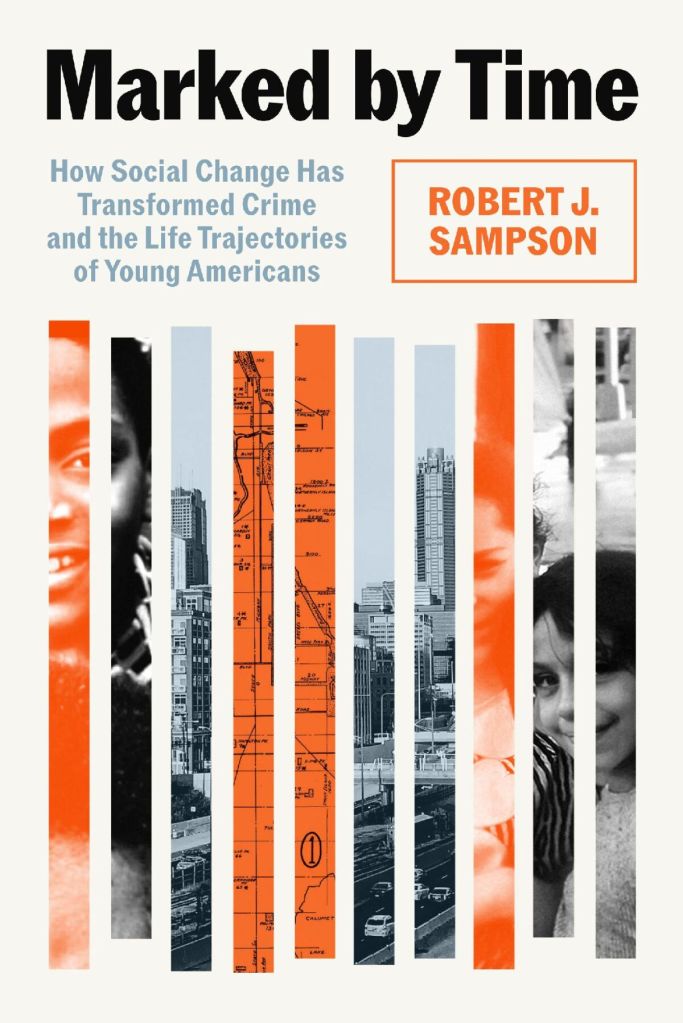
In an interview with the Gazette, edited for length and clarity, Sampson discussed his findings and their implications for future work on criminal behavior and prevention.
This is your second book to build upon the long-running Project on Human Development in Chicago Neighborhoods study? Can you offer a brief introduction?
Back in the early ’90s, I was on faculty at the University of Chicago when we started working on this large-scale study. In retrospect, it’s important to know this was an era of peak violence. The Chicago Tribune ran a prize-winning series in 1993 called “Killing Our Children.”
We know exposure to violence has fundamental consequences for child development.
A lot of longitudinal studies, including ones I’ve worked on, focus on just one birth cohort. But we came up with a novel birth-cohort design, following multiple cohorts in sequence. That means we enrolled study participants ranging in age from zero to 18.
We had no idea that violence would plummet just as our infant cohort was born in 1995. When these kids turned 15, when they turned 18, they experienced a very different world than those born in the early ’80s.
How did this play out as the Chicagoans in your sample moved from childhood to adolescence to adulthood?
I actually start the book with two individuals born into similar circumstances. They’re both of the same race. They both grew up living in high poverty, family disruption, and with similar levels of neighborhood disadvantage. But Andre was born in the early ’80s, and Darnell in the mid ’90s. It turns out, they had very different outcomes. Andre was arrested; Darnell was not.
These are just two individuals, but the broader pattern holds. We know that crime tends to climb rapidly in the late teenage years. At age 20, the oldest cohort’s arrest rate was double that of the youngest cohort.
We also found a two-to-one differential between the older cohorts and the younger cohorts when it came to gun use. You might think it has to do with demographic differences. But we found cohort divergences were not explained by race, family structure, or poverty.
Drug enforcement and policing saw big changes over the period you studied. How did these trends show up in the data?
The War on Drugs is often named as an important contributor to mass incarceration. Less recognized is the fact that drug arrests fell pretty rapidly from the late 1990s into the 2000s. I show that drug arrests declined in Chicago by 70 percent between 1995 to 2021, while drug use remained flat.
At the same time, arrests for public disorder — almost the poster child for so-called broken windows policing — declined by over 90 percent.
If you were a kid born in the ’80s smoking a joint or roughing it up in public, you had a very high probability of being arrested compared to the next cohort.
The younger cohort wasn’t so lucky when it came to victimization.
The poorest of the poor, or what the great Harvard sociologist William Julius Wilson called “The Truly Disadvantaged,” benefitted most from these declines. But those benefits were interrupted by the chaos of the pandemic and the unrest associated with the police killings of Michael Brown in Ferguson and George Floyd in Minneapolis.
I show how even though the youngest cohort grew up with lower arrest rates and lower exposure to certain kinds of violence, their late teens and early 20s bumped into the spike in gun homicides we saw in 2016 and 2021. By their mid-20s, they experienced gun violence victimization at rates similar to those born in the ’80s.
Another memorable finding concerns individuals described by a parent as having high or low levels of self-control in childhood. How did this personality trait intersect with rates of arrest?
“What this result shows is that low self-control manifests differently across cohorts.”
Robert Sampson
Within each of our cohorts, kids with low self-control were much more likely to be arrested. But I show that high-self-control kids in the older cohorts had the same arrest rates at age 20 as the low-self-control kids in the youngest cohort.
What this result shows is that low self-control manifests differently across cohorts. Its power to predict the magnitude of future criminality is not as strong as traditionally thought.
Speaking of prediction, your findings hold big implications for Risk Assessment Instruments (RAIs). Can you speak to what they are and how social change challenges their reliability?
There are all kinds of ways in which society — not irrationally — views arrest as a marker of criminal propensity. Criminal histories are commonly used in employment screening and occupational licensing.
RAIs have been widely used in the criminal justice system going back decades. Some of the earliest prediction tools were designed in the 1920s. They were eventually used to selectively incapacitate people in prison or to determine whether an individual should be offered bail.
The use of RAIs has increased with the advent of large administrative databases and new statistical tools. Some of today’s well-known predictive instruments incorporate factors like number of arrests, employment, and drug use. RAIs can also be trained on the relationship between alleged risk factors like poverty or family structure or immigrant status.
But history is baked into each of these factors. They carry the imprint of the past. I show that RAIs trained on information from older cohorts overpredict the criminality of younger cohorts.
What do you take from this finding?
“Our world has been fundamentally transformed when it comes to violence. “
Robert Sampson
I worry that we’re fighting the wrong battle — or an old battle based on memories of past crime increases. A report just came out showing record declines in murder and other violent crimes last year. Crime rates in many U.S. cities were back to where they were in the 1960s and ’70s.
Our world has been fundamentally transformed when it comes to violence. Using models based on information collected before this transformation can lead to big problems with our policies and our assumptions about people.
These changes weren’t caused by any one thing, but we have pretty good evidence on a constellation of factors I review in the book. My argument is that we need to invest in more cultivation of these conditions rather than just predicting the next criminal.
Robert J. Sampson discusses “Marked By Time” with Harvard Kennedy School’s Robert D. Putnam on Feb. 24, 7 p.m., Harvard Book Store.