Harvard Library’s world-class collections are only the tip of the iceberg. One morning, students in the first-year seminar “Life of an Iceberg” arrived expecting to study frozen landscapes — and found themselves rethinking how those landscapes are documented, mapped, and understood.
Class began in Widener Library, itself tied to the Titanic disaster that claimed the life of its namesake after the ship struck an iceberg.
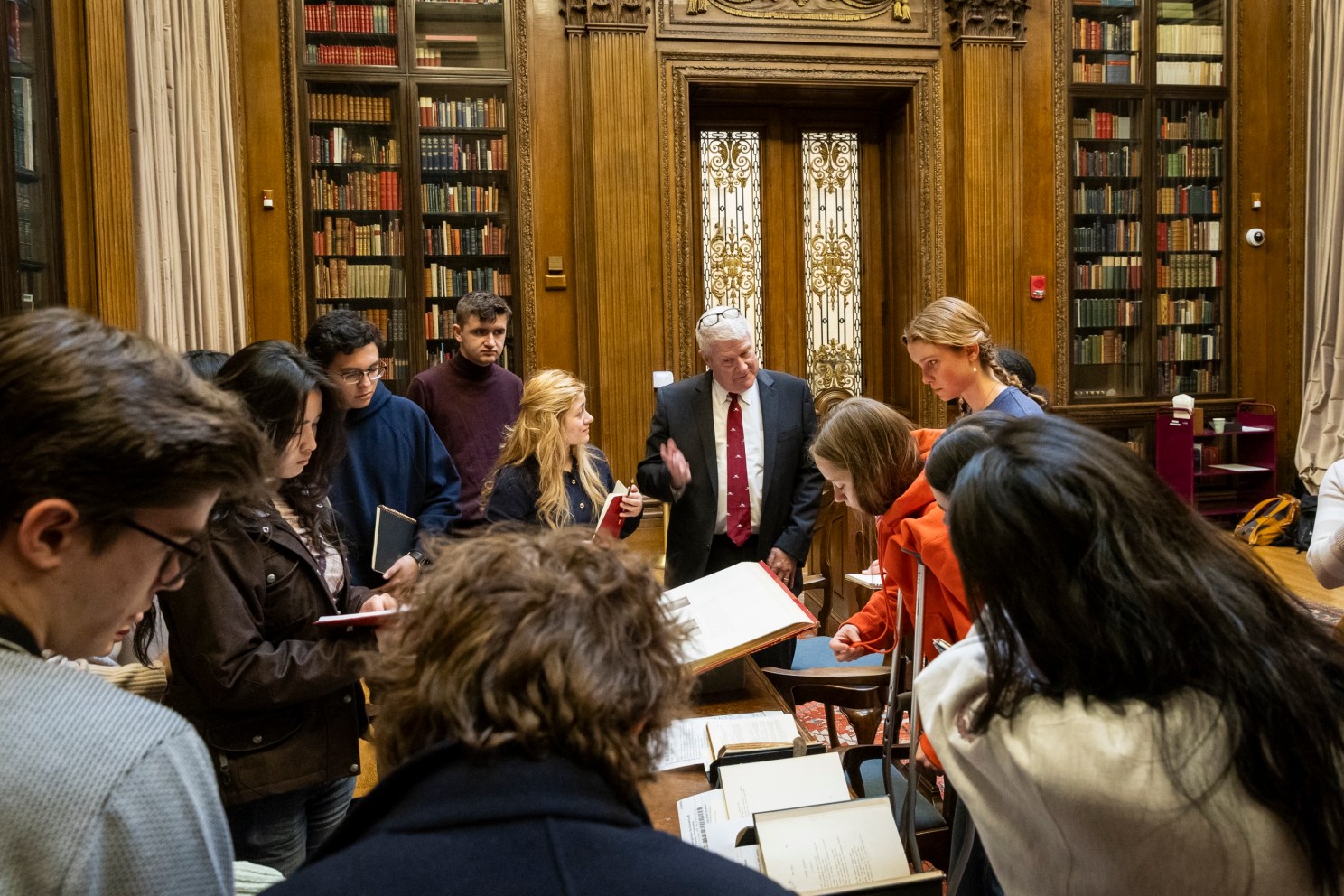
Peter X. Accardo, curator of the Harry Elkins Widener Collection and librarian for Scholarly and Public Programs at Houghton, told the students about Widener Library’s origins and the Titanic sinking. Members of the Widener family were on board, and Eleanor Widener, who survived, made a gift to Harvard in honor of her son, Harry, Class of 1907.
Accardo debunked some myths about the library. Mrs. Widener did not stipulate a swimming test for students, but did request fresh flowers in the Memorial Room. To this day, a local florist brings in flowers weekly.
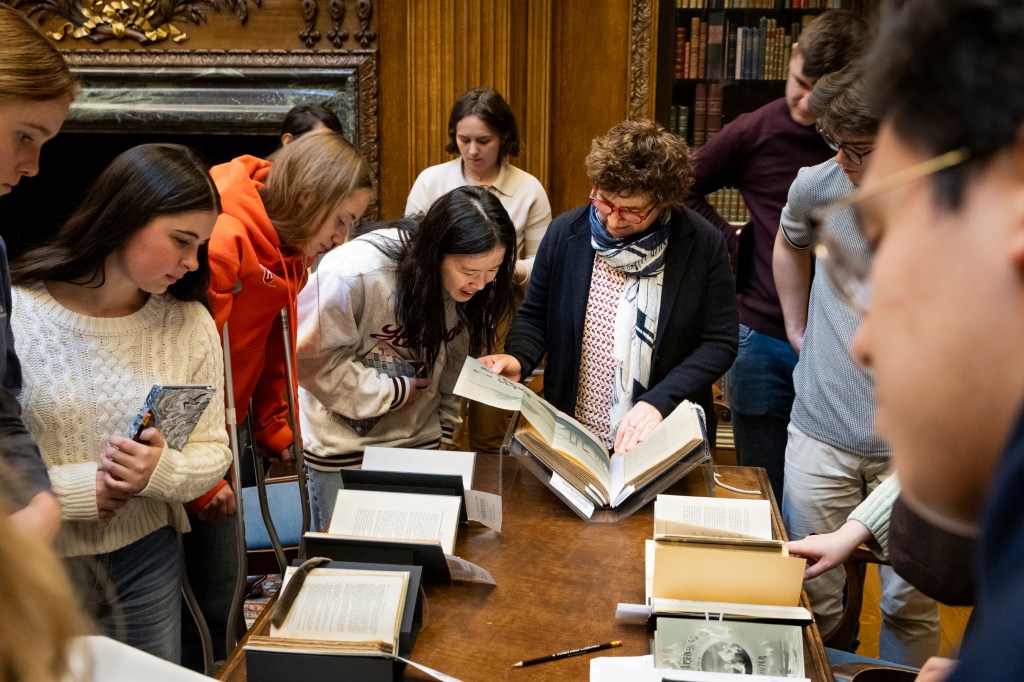
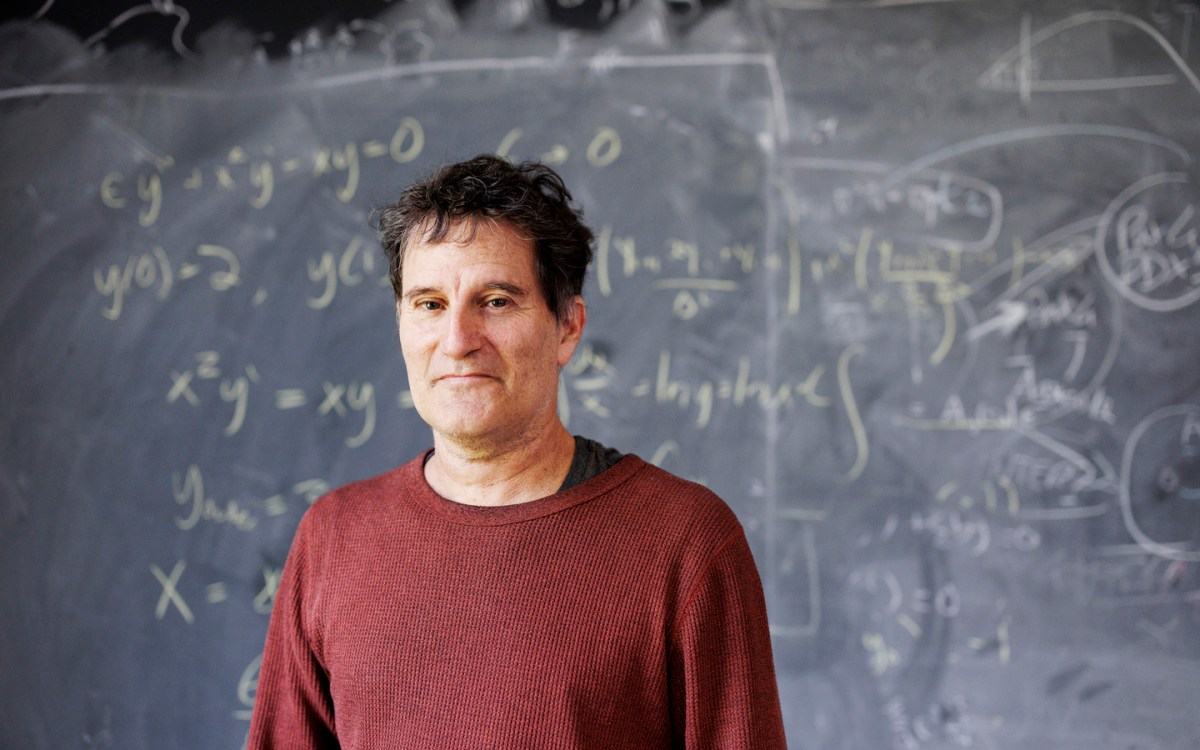
Professor Fiamma Straneo, Gordon McKay Professor of Environmental Science and Engineering, with her class in Widener Library.
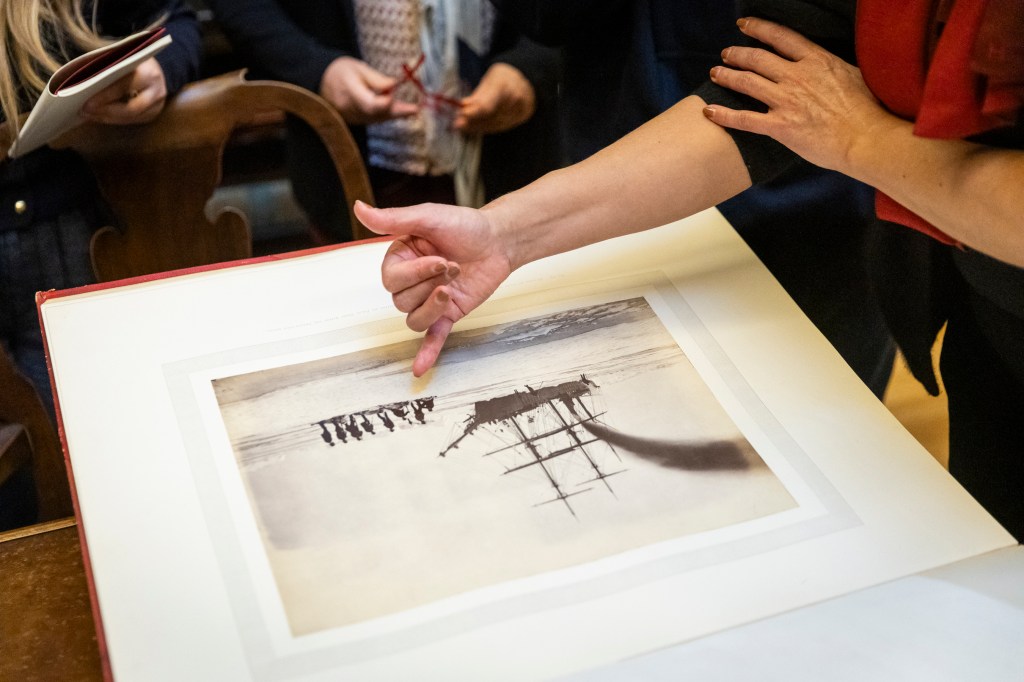
After admiring the Gutenberg Bible, a cornerstone of the Widener collection, students looked at books on the Arctic, chosen by Accardo. Along with manuals on Arctic exploration, there was a book of poems by Elizabeth Bishop opened to “The Imaginary Iceberg” and a book from the Theatre Collection with stage directions on how to make icebergs for a play.
“Peter Accardo is the algorithm behind this selection,” Sarah DeMott, librarian for the first-year seminar, told students. “Our collections have been curated by specialist librarians with the help of our faculty. These are academic, peer-reviewed, trustworthy sources, and they are curated specially for you.”
“It’s arts and sciences, not arts or sciences,” said Accardo, as students around him leafed through the books on the table and took photos, making the point that the two disciplines are not mutually exclusive. “Whether you are taking reference pictures on a cell phone or creating a freehand sketch in a notebook — it’s all very important human engagement with the natural world as depicted in books.”
Professor Fiamma Straneo, Gordon McKay Professor of Environmental Science and Engineering at Harvard, agreed. “We don’t have to choose a single way of seeing something and exclude another. Ways of seeing can combine science, humanities and art — and keep all channels open,” said Straneo.
For the students, it was a rare chance to step into the Widener Memorial Room and explore Harry Widener’s personal library, a collection he had started while an undergraduate at Harvard.
From developing class sessions for faculty to working with students to design custom maps, library staff provide a range of services to enrich teaching and learning at Harvard.
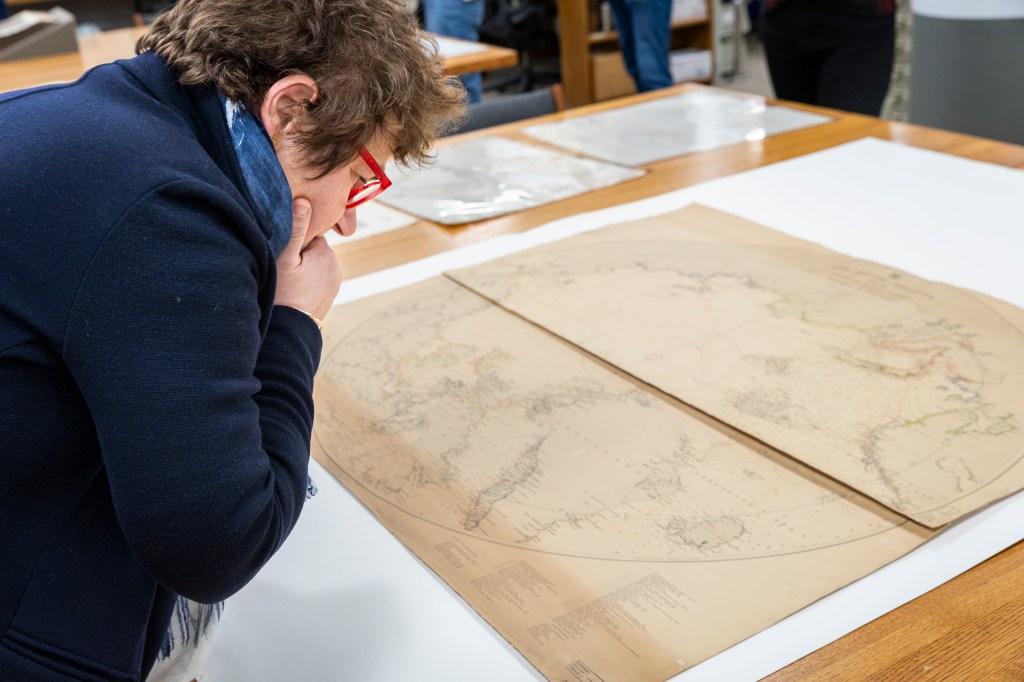
Next, the class visited the Harvard Map Collection in Pusey Library, where Map Librarian Molly Taylor-Poleskey explained that Western mapping techniques have some limitations when it comes to natural phenomena. “Our particular Western way of mapping developed with imperial impulses, and tries to stabilize land as static property. But it doesn’t express dynamic systems well — watersheds, animal migration, language, disease, weather, and yes, icebergs,” said Taylor-Poleskey.
The students studied the maps in front of them, including maps of the Arctic and Antarctica, as well as of 19th- and 20th-century voyages of exploration into the unknown. One of the maps even showed the tracks of search parties—a reminder of the dangers of ice and icebergs.
If the students wanted to map an iceberg for their final project, all they had to do was ask a librarian.
Professor Fiamma Straneo examining a map in the Harvard Map Collection.

 Featured series