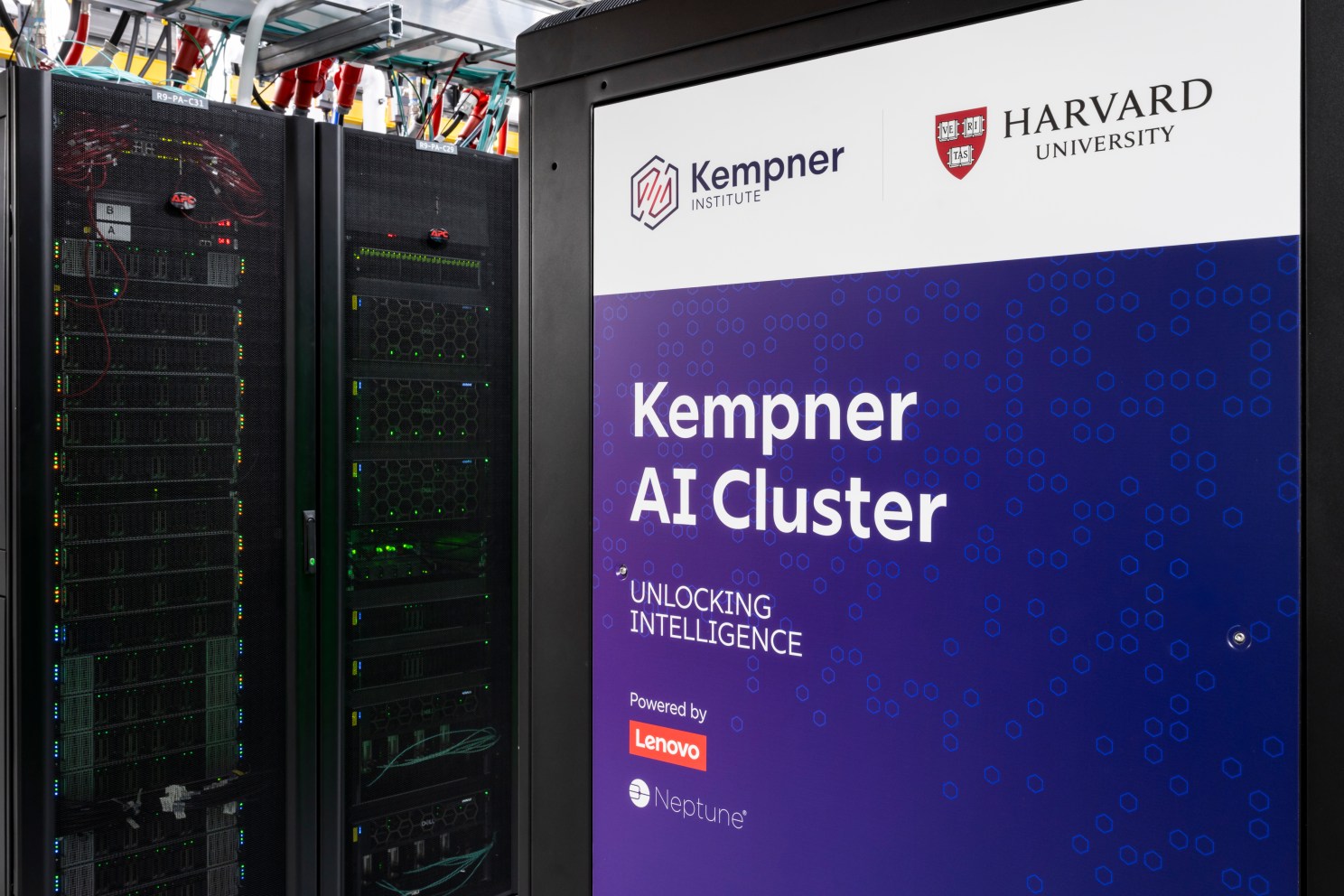
Massive increase of computing power for Kempner Institute
With a total of 1,144 graphics processing units (GPUs), the Kempner’s expanded AI cluster will join an elite league of systems whose performance is measured in exaFLOPS.
The most powerful supercomputer at Harvard is about to get larger and faster. Much faster.
The Kempner Institute’s AI cluster, already one of the fastest AI supercomputers in the world, is undergoing a major expansion, adding more than 500 NVIDIA graphics processing units (GPUs) — the specialized processors that make modern graphics and AI possible — to scale-up its capacity for cutting-edge research on intelligence.
Once the upgrade is complete this spring, the enhanced Kempner AI Cluster is expected to join an elite league of systems whose performance is measured in exaFLOPS. One exaFLOP equals a quintillion (that’s a billion billion) mathematical operations per second, which means that in a single minute the cluster will be able to perform a task that would take a personal computer several years to complete.
“There are very few academic institutions on the planet that offer this scale of compute to a research community of our size,” says Kempner Institute Executive Director Elise Porter. “This expansion will allow for research in AI and natural intelligence at Harvard that would not otherwise be possible.”
The expansion will bring 424 of NVIDIA’s top-of-the-line H200 GPUs and 192 RTX PRO 6000 Blackwell GPUs into the institute’s high-performance computing environment, joining an existing array of 144 A100 and 384 H100 units and bringing the total number of GPUs to 1,144.
All the GPUs will be linked in a single, purpose-built system designed to help researchers train, test, and refine large-scale AI models that support work in machine learning, neuroscience, robotics, biomedical research, and a host of other disciplines.

 Featured series