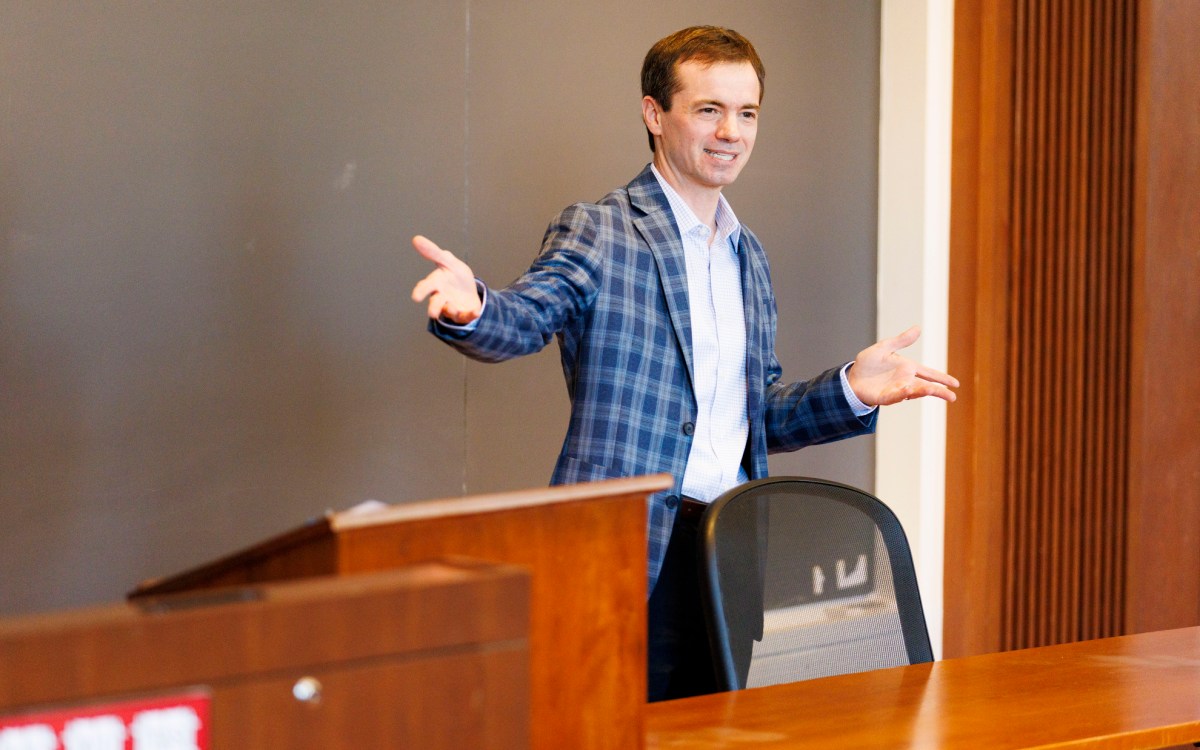
Joshua D. Greene picked for civil discourse professorship
The experimental psychologist, neuroscientist, and philosopher is the inaugural Alfred and Rebecca Lin Professor of Civil Discourse.
Dylan Goodman / Harvard University
ContactChristy DeSmith
4 min read
Joshua D. Greene ’97, a faculty member in the Department of Psychology and Center for Brain Science, has been named the inaugural Alfred and Rebecca Lin Professor of Civil Discourse.
The experimental psychologist, neuroscientist, and philosopher is known for creative approaches to easing intergroup conflict, including the recently released cooperative online quiz game Tango.
“It’s an incredible honor,” Greene said of the appointment. “We have these conflict entrepreneurs sowing division for their own advancement. There needs to be a countervailing force that unites human groups instead of dividing them.”
Greene, who joined the faculty in 2006, is the author of “Moral Tribes: Emotion, Reason, and the Gap Between Us and Them” (2013). He has taught the popular General Education course “Evolving Morality: From Primordial Soup to Superintelligent Machines” since 2017. The curriculum challenges students to see everything, from the tiniest organism to the era’s most divisive political issues, as products of the evolutionary processes of cooperation and conflict.
The new professorship was made possible by a gift from business leader Alfred Lin and artist Rebecca Lin, both ’94.
“Joshua Greene was selected because he brings a distinctly philosophical cast of mind — careful about concepts, reasons, and what we owe one another — together with cutting-edge psychological science about moral judgment and polarization,” said Eric Beerbohm, Alfred and Rebecca Lin Professor of Government and director of the Edmond & Lily Safra Center for Ethics. “He helps us see why disagreement so quickly becomes personal and tribal, and he also builds practical ways to reverse that slide.”
Greene’s recent work concerns alternatives to civil dialogue, the traditional cornerstone of political bridge-building. “I’m trying to build tools and structures that work even for people who are not feeling particularly civil,” he explained.
Tango, developed over the past few years with the help of current and former students as well as the Washington, D.C.-based Global Development Incubator, turns players with conflicting viewpoints into winning teammates. Each round of trivia is evenly split with questions Greene and his collaborators have devised to advantage those on the political left or right. With an in-app chat function designed to bolster collaboration, two-player teams quickly discover that ideological diversity provides an edge.
Piloted last year, Tango has already proven a powerful tool for reducing intergroup tensions. As research released last summer showed, the effect on 4,000 of the game’s earliest players was equivalent to rolling back approximately 15 years of rising polarization in American political life.
“It’s a playful, cooperative intervention that makes the theory tangible and gives people a real-time experience of disagreeing better, with Josh’s well-known sense of humor doing real work in lowering defenses,” Beerbohm observed.
Undergraduates at several schools have already reaped the benefits. That includes more than 1,000 members of the Harvard College Class of 2029, who played several rounds of Tango at orientation last summer. Going forward, Greene and his team plan to roll out their game on even more U.S. campuses.
“Universities, for all of their flaws and recent challenges, are still places where people with different values and different beliefs come together in an atmosphere that assumes a level of mutual respect,” Greene said. “They’re one of the few viable launching pads for tools that can build a larger us.”
The Tango team is also at work adapting the game for other politically divided countries including Northern Ireland and Israel. But their most ambitious undertaking is developing an online version of the U.S. game, with the long-term goal of making it free and instantly available to all.
“That could be our route to reaching millions,” Greene said.

 Featured series