Empowering change: GEM Incubation Fund awardees catalyze AI for inclusive development
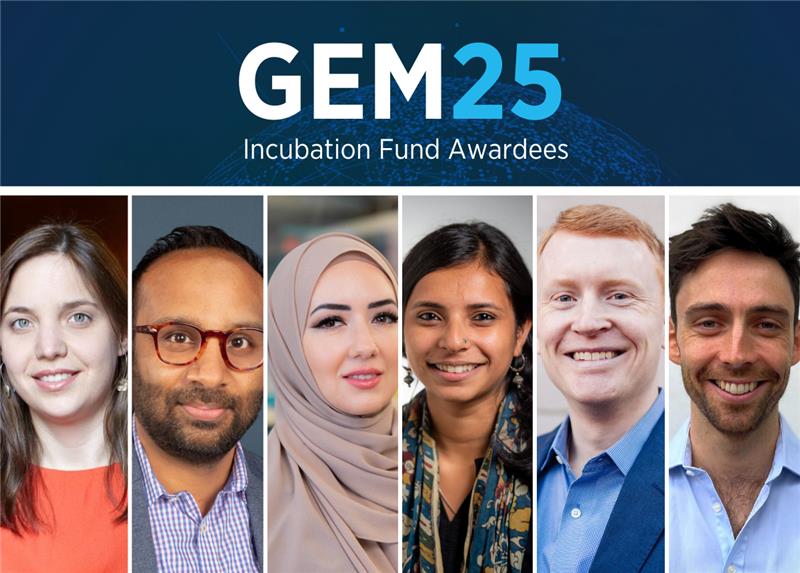
The 2025 GEM Incubation Fund award winners. Emily Breza, Harvard University (from left), Sharad Goel, Harvard Kennedy School, Emilia Gracia, Arizona State University, Aarushi Kalra, University of Oxford, Nicholas Ryan, Yale University, and Duncan Webb, Nova School of Business and Economics.
The Harvard Center for International Development’s (CID) 2025 Global Empowerment Meeting (GEM) explored AI’s potential to drive more inclusive global development. At the conference, CID launched the annual application cycle for the GEM Incubation Fund to support research innovations with a direct impact on developing economies. Today’s announcement introduces the 2025 awardees — researchers whose innovative proposals translate the energy and insights of GEM into actionable early-stage projects poised to shape policy and expand opportunity.
Launched each year in conjunction with GEM, the GEM Incubation Fund supports emerging research that embodies the creativity, experimentation, and collaborative spirit of the convening. In a year focused on harnessing artificial intelligence for equity and inclusion, the 2025 awardees reflect a dynamic cohort of scholars leveraging AI — and insights shaped by AI’s rapid evolution — to address critical challenges in health, education, agriculture, climate adaptation, and crime. Their projects share a commitment to ensuring that technological progress expands opportunity and improves well-being for underserved communities globally.
The funded projects showcase a wide range of methodological approaches — from qualitative fieldwork and early-stage pilots to AI-driven simulations and system-level analysis. While diverse in focus, the 2025 awardees share a unifying vision: to harness the potential of AI in ways that are responsible, inclusive, and transformative.
“This year’s Incubation Fund cohort captures the ambition and urgency of GEM’s theme,” said CID Faculty Director Asim I. Khwaja. “Their work pushes us to think more expansively about what AI can enable, and who it can empower.”

 Featured series