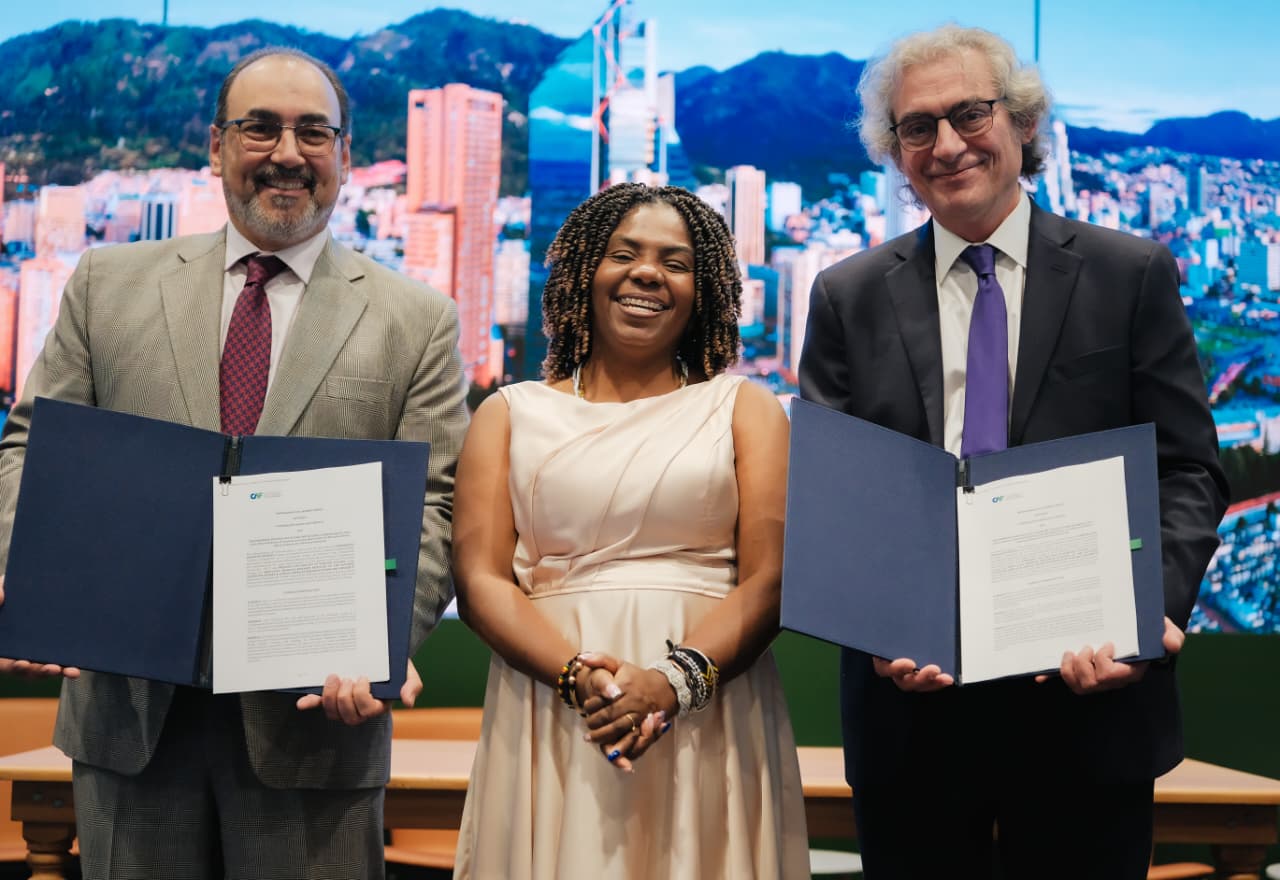
Within the framework of the CELAC–Africa High-Level Forum, held in Bogotá from March 18–21 under the auspices of Colombia’s Vice President Francia Elena Márquez Mina, the Afro-Latin American Research Institute at Harvard University (ALARI) and CAF – Development Bank of Latin America and the Caribbean signed a Memorandum of Understanding aimed at strengthening knowledge production in the field of Afro-Latin American studies.
The agreement was signed on March 20 by Alejandro de la Fuente, director of ALARI, and Sergio Díaz-Granados, executive president of CAF. As Vice President Francia Elena Márquez Mina stated during the ceremony, “Afro-Latin American Studies is a field that rethinks Latin America and the Caribbean in terms of ethno-racial justice. For this reason, this collaborative project will make it possible to develop research and generate new knowledge. This CAF-ALARI alliance is a great marriage. It is a promise of a future dedicated to education and development.”
As a first joint initiative, ALARI and CAF will collaborate on the IV Continental Conference on Afro-Latin American Studies, to be held at Universidad Icesi in Cali, Colombia (July 22–24, 2026). This event will bring together over 1,500 scholars, researchers, and key stakeholders working on a variety of disciplines and themes connected to racial stratification and justice in the region.
Sergio Díaz-Granados, president of CAF, pointed out that signing this memorandum represents a step to overcome entrenched patterns of inequality that persist in Afrodescendant communities in Latin America and the Caribbean. “We want to broaden our understanding of how to move forward toward greater ethnic and racial justice, how to incorporate these issues into a development bank, and how we see them within the bank. Being able to close those historical gaps, which are persistent and stubborn. This is a step in that direction,” he emphasized.

 Featured series