Featured series

Arts & Culture
Hannah and the Janes
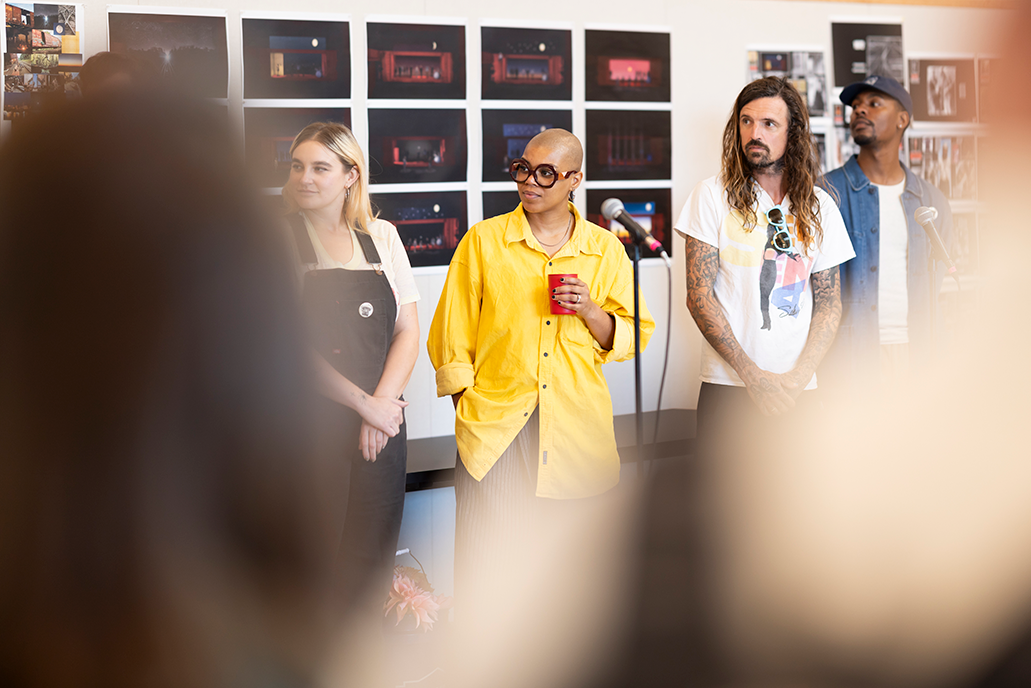
Gracie McGraw (Hannah), Khaila Wilcoxon (Harlan), JR King (Demi), and Jhardon DiShon Milton (Ensemble/Milt) at the first rehearsal for A.R.T.s world-premiere production of “1972.”
Photos by Maggie Hall
New A.R.T. rock opera looks backward to era before Roe v. Wade, finds resonance with today’s post-Roe world
Hannah is on the run from an abusive relationship. She’s 19 and pregnant, and it’s back in the days when abortion was largely illegal across much of the nation. So starts her odyssey, and along the way she meets a group of crusading activists who help give women a choice.
This sits at the heart of American Repertory Theatre’s new rock opera “1972,” which opens Oct. 27 and runs through Nov. 22 at Farkas Hall.
Though the production is set a half-century ago, it opens just four years after a Supreme Court ruling overturned the Roe v. Wade decision of 1973, which guaranteed a nationwide right to an abortion. In 2022, the decision in Dobbs v. Jackson Women’s Health Organization spawned a patchwork of state abortion restrictions, harkening back to the decades before Roe.
“This is so timely,” said the show’s co-creator Jessie Nelson, whose credits include “Waitress” and “I Am Sam.” “It’s so urgent. It really meets the moment in our world.”
“This is so timely. It’s so urgent. It really meets the moment in our world.”
Jessie Nelson
That the new production is a rock opera is thanks to Nelson’s co-creator Chadwick Stokes of the Boston indie bands Dispatch and State Radio.
“Growing up listening to ‘Hair’ and to ‘Tommy’ and to ‘The Wall,’ I was into this idea that you could have this expansion into many songs and different characters,” said the musician-activist.
Stokes studied the form while at New York University, even composing his first rock opera in a self-created course there. He credits recent events with helping him focus on a narrative for this project.
“About 10 years ago, I started thinking about a journey story,” he explained. “When Roe was overturned, I knew that [Hannah’s] impetus for traveling is to try to get an abortion,” said Stokes.
What he didn’t know was that in the late 1960s, before Roe, there was a real-life underground network of women, the Jane Collective, who helped women like his protagonist end unwanted pregnancies.
“Even after Roe was overturned and I had this idea of where she was going, I still didn’t know about the Janes,” said Stokes.
“I was talking to a friend of mine — her name is Jane — and she said, ‘You must know about the Janes,’” recalled Stokes.
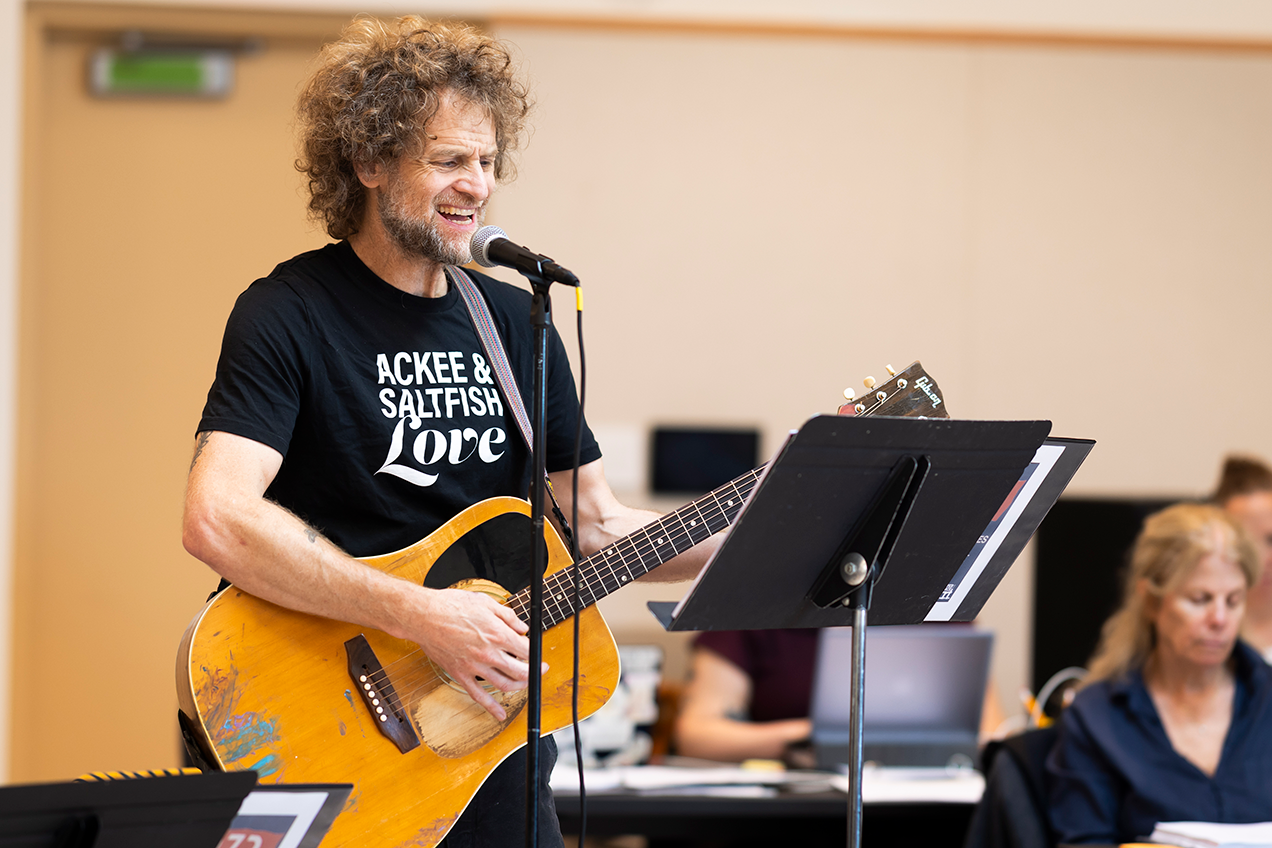
Chadwick Stokes (creator, composer, lyricist, co-writer, Depot) at the first rehearsal for A.R.T.’s world-premiere production of “1972.”
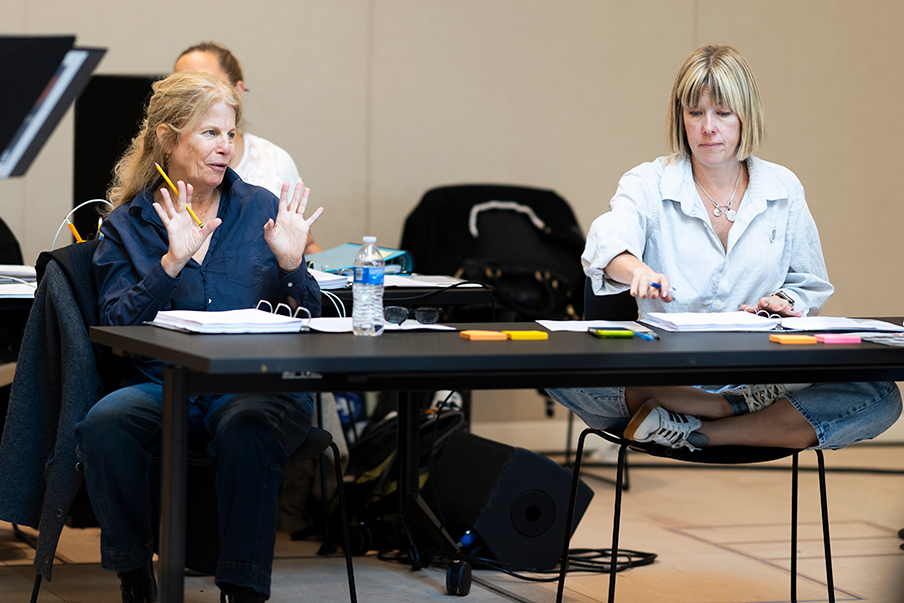
Jessie Nelson (director, co-writer) and Abbey O’Brien (associate director and
choreographer) at the first rehearsal for A.R.T.’s world-premiere production of “1972.”
He quickly learned about the Chicago group, which connected women with doctors willing to perform the procedure.
“I was stunned,” he said. “I love history, and I could not believe I’d never heard of these women.” The impact on his work-in-progress was immediate. “Aha,” he recalls thinking. “Now we know where the story ends.”
The concept took a major leap forward when mutual friends introduced Stokes and Nelson on Martha’s Vineyard a couple of years ago. To his raw ideas and songs, she brought extensive experience in musical theater.
“When I heard all of the music he had written, it was this explosion of creativity,” Nelson said. “Then it was about really honing what the story was and what could stay in the piece, what could be repurposed, and how we could really enhance the narrative.”
Nelson also had a history of working with rock and pop musicians, most notably collaborating with Sara Bareilles on “Waitress.” In Stokes, she said, she found a “natural.”
“It’s really incredible to watch someone whose gift can so beautifully transfer to this medium,” she said.
The collaboration continued even when Stokes was touring with one of his bands.
“I was on the road,” said Stokes, recalling reaching out to Nelson. “I’m in a hotel room in Cleveland and Jesse has some time …”
“We would just comb through the script and the lyrics and talk about our intention for each scene and what needed to be highlighted or what would make the next song, what would launch the next song in a more beautiful way,” said Nelson. “We would just comb through it lyric by lyric by lyric, basically just sculpting.”
The duo workshopped some of the numbers at Joe’s Pub in New York City.
“We would learn a lot from those experiences,” Nelson said. “We would come back and go, ‘OK, what is working? What isn’t working?’”
Three of the surviving Janes attended those workshopping nights.
“We talked to the Janes after one of those Joe’s Pub nights,” said Stokes. “They gave us a little bit more info and just a vibe check with just how badass they were. And then we were able to infuse that going forward.”
Going forward, the partners stress, can involve learning from the past. It doesn’t mean returning to it.
“When Roe was overturned [there was] this palpable aching in our communities,” said Stokes. “This does feel crucial now.”
Members of the Jane Collective will speak after the Oct. 31 performance. An A.R.T. “1972” pop-up exhibit at the Schlesinger Library at the Harvard Radcliffe Institute will feature primary source materials from its collections related to the history of the Chicago Women’s Liberation Union, the Janes, and reproductive rights and access to abortion in the U.S. in and around 1972. The exhibition will be on view Oct. 30 (3 – 5 p.m.), Nov. 3 (1 – 3 p.m.), and Nov. 10 (3 – 5 p.m.).