Featured series

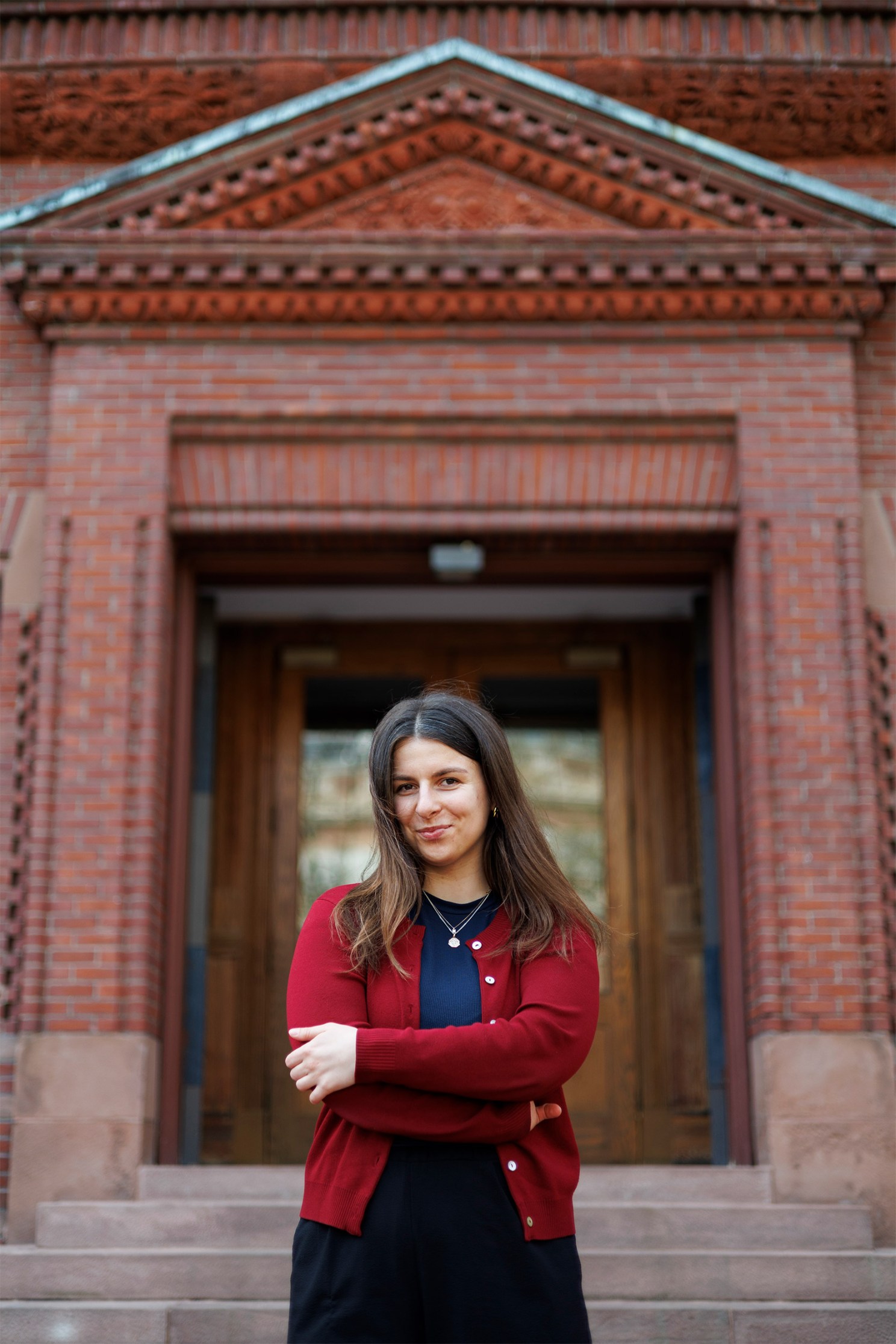
Anastasiia Pereverten.
Photo by Grace DuVal
Campus & Community
Probing the war of public opinion
Seeing Americans rally for her native Ukraine inspired Anastasiia Pereverten’s thesis
Part of the Commencement 2026 series
A collection of features and graduate profiles covering Harvard’s 375th Commencement.
When Russia invaded her home country of Ukraine in 2022, Anastasiia Pereverten was more than 5,000 miles away, studying at the University of Wyoming. From that distance, she watched a surge of support from Americans who were far removed from the conflict.
“All this, so far away from Ukraine?” said Pereverten. “People were so incredibly vocal and supportive, and wanted to know more. I wanted to understand what shaped that.”
That question — how public support for foreign policy forms, and how it can be mobilized — became the focus of her academic research.
Pereverten, who completed her bachelor’s degree in 2024, is now graduating from Harvard’s Russia, Eastern Europe, Central Asia master’s program. Her thesis examines how Ukraine advocacy groups persuaded and mobilized Americans to support Ukraine, and how Americans form their opinions about foreign policy.
“I am excited to return to Kyiv — to be close to my family, be an active citizen, and put everything I’ve learned at Harvard in political science, negotiations, and public opinion research to work for Ukraine’s resistance and reconstruction.”
Anastasiia Pereverten
“I’ve worked with many students over the years on their research projects, but few have been as focused and self-motivated as Ana,” said her thesis adviser George Soroka, a lecturer in Harvard’s Department of Government. “Her findings are important and resonate beyond the immediate context of the Russo-Ukrainian war.”
Pereverten’s thesis draws on interviews with 30 advocates and activists in the U.S., as well as an original survey of more than 600 Americans. It describes how Ukraine advocates capitalized on intense media attention to marshal support for policies and humanitarian aid.
Her work builds on existing political participation research that shows people are likelier to take action — whether calling an elected official, donating to a cause, or posting a sign on their front lawn — when they are already psychologically engaged with an issue, believe their actions will be effective, and observe similar behavior from people in their social networks.
“I now understand the importance of visibility of the issue that creates its salience for the public,” Pereverten said. “Knowledge about the war and about Ukraine, along with the salience of the conflict as a public issue, was shaped by strong media coverage, which helped keep the public aware and engaged.”
Russia’s invasion of Ukraine accelerated Pereverten’s interest in public policy and international relations, but it didn’t begin there. Growing up in Kyiv, she closely followed the political upheaval that unfolded during Ukraine’s 2013-2014 Euromaidan protests, sparked when former President Viktor Yanukovych changed course on a deal to pursue closer ties with Europe.
“We were watching the news, and I remember the atmosphere of, ‘What’s going to happen next?’” recalled Pereverten, who was about 11 at the time. “Everything was changing.”
Pereverten is also passionate about the arts. She studied piano and worked at an art museum in Kyiv. For college, she combined her interests in art and international relations and pursued a degree in cultural diplomacy at the National University of Kyiv-Mohyla Academy.
But when her university went online at the start of the COVID-19 pandemic, she applied for the U.S. State Department’s Global Undergraduate Exchange Program, which offers one-semester scholarships to U.S. schools. She was awarded a scholarship to the University of Wyoming.
“I got there in January 2022, and in February 2022 the full-scale invasion of Russia began,” Pereverten said. “So the school, after some time, offered me a scholarship to finish my degree there.”
The early weeks of the war were a challenging time for Pereverten. “People I knew were risking their lives, and I was in physical safety in Wyoming,” she said.
She became a vocal advocate for Ukrainians in the Wyoming media and organized lectures and art exhibits to help Americans understand what was happening half a world away.
“It was the least I could do. I realized that I could be useful in international relations and diplomacy.”
Eager to deepen her understanding of international relations, public opinion, and persuasion, Pereverten applied to several master’s programs but decided on Harvard after attending Admitted Students’ Day. She became one of eight students in the two-year Davis Center for Russian and Eurasian Studies graduate program cohort and quickly fell in love with the center’s close-knit international community.
“It’s a very close cohort, and all of us really shaped each others’ time at Harvard. We have people from Estonia, Lithuania, the U.K., Poland. It’s such an incredible, international environment that I don’t take for granted.”
At Harvard, Pereverten got to work acquiring the tools to answer her questions about foreign policy opinions. Courses in data science helped her analyze public attitudes, while John Zwaanstra Professor of International Studies and of Government Joshua D. Kertzer’s graduate seminar on political psychology and international relations equipped her with theoretical frameworks to interpret the results of her research.
“I’ve worked with many students over the years on their research projects, but few have been as focused and self-motivated as Ana.”
George Soroka, thesis adviser
In the summer of 2025, Pereverten interned at the Embassy of Ukraine in Washington, D.C., where she supported diplomatic engagements by drafting briefing material and knowledge notes.
Soroka commended her hard work under difficult circumstances.
“Despite all the turmoil the war has caused her, Ana is remarkably warm and charming — always quick with a smile and a joke. Her poise is all the more remarkable given how deeply worried she is about friends and family back home.”
Soroka continued, “I have no doubt in my mind Ana, and people like her, will be critical in rebuilding Ukraine once the current war inevitably ends. And I’m so happy that Harvard played a role in shaping who this remarkable young woman is — and will one day become.”
Pereverten hopes further research can illuminate how persuasion works in low-information domains like foreign policy and how audiences can be mobilized to take action.
She dedicated her thesis to her uncle Zhenya, a soldier in Ukraine’s armed forces who was injured in 2025 and has been undergoing a “long and challenging process of rehabilitation.”
Pereverten is eager to get back to Ukraine. After she graduates, she plans to join the World Bank Group’s Pioneers program there, where she will monitor and report on global aid flow.
“I am excited to return to Kyiv — to be close to my family, be an active citizen, and put everything I’ve learned at Harvard in political science, negotiations, and public opinion research to work for Ukraine’s resistance and reconstruction.”