Featured series

Campus & Community
Need a time-saving robot? Find a busy person to build it.
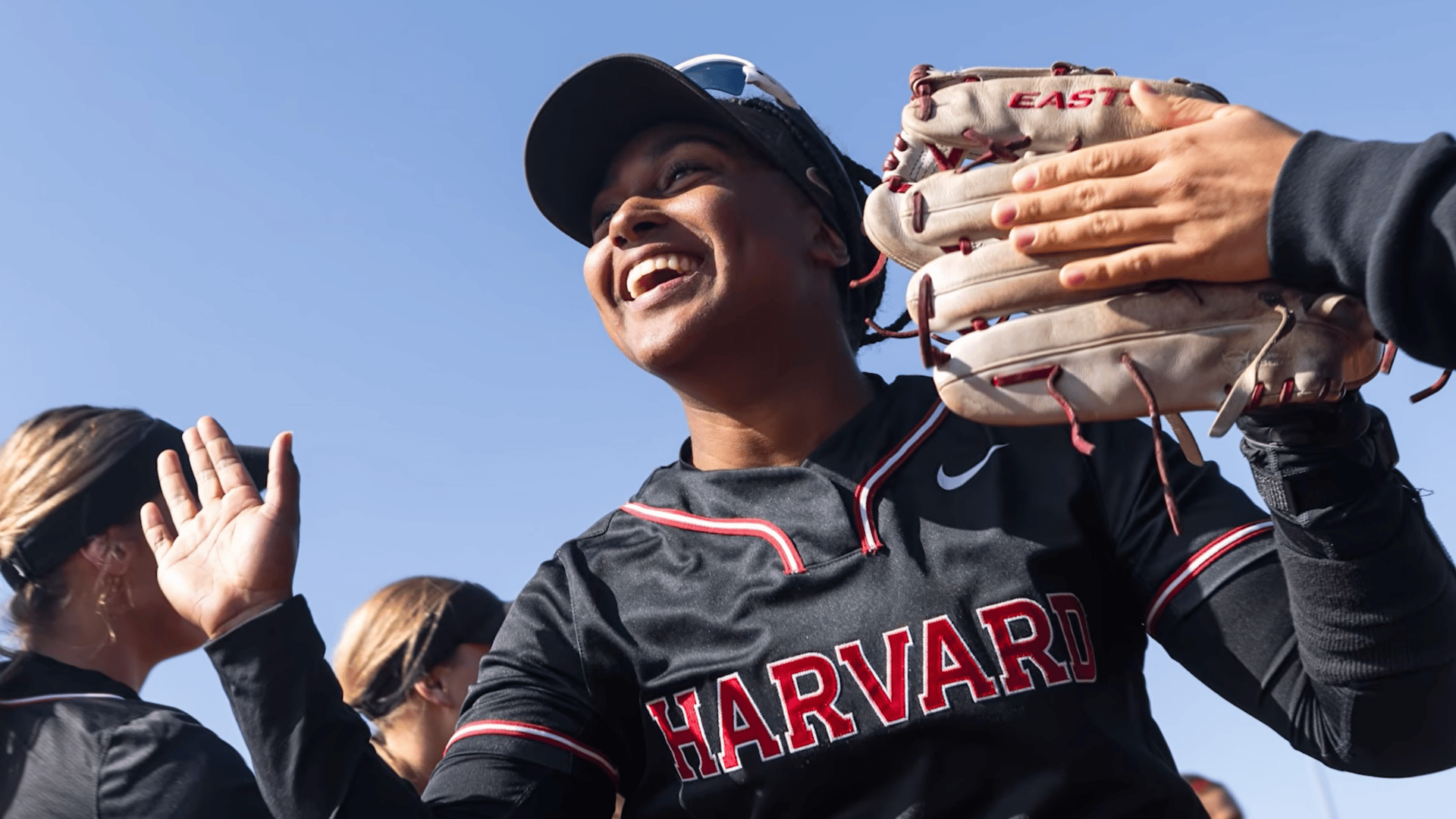
Lael Ayala.
Photo by Harvard Athletics
Lael Ayala’s thesis project combined her passions for softball, engineering
Part of the Commencement 2026 series
A collection of features and graduate profiles covering Harvard’s 375th Commencement.
That Lael Ayala chose a time-saving device makes sense.
The mechanical engineering concentrator and softball outfielder’s senior thesis project is an autonomous robot that can detect and collect softballs in the outfield after hitting drills.
“What stood out to me most was that the project was directly connected to her passion for her sport, and she was very motivated to use her engineering background to address a real-world problem,” said Professor Seymur Hasanov, Ayala’s thesis project adviser.
Shagging balls may seem mundane, but it is time-consuming, and Ayala ’26 had little to spare.
When she wasn’t running drills with her Crimson teammates on Soldiers Field, she was either in the lab, hip-deep in engineering homework, or doing coursework for Army ROTC. The little discretionary time she had left was taken up by meetings for Harvard Athlete Ally or giving tours at the Harvard John A. Paulson School of Engineering and Applied Sciences.
“If I was to be an athlete at any other school, I wouldn’t have the time to pursue my engineering goals” and other interests, said Ayala, a native of Atlanta. “Our coaches and the Ivy League allow us to develop so many different interests and ideas while still competing at a high level.”
When it came time to come up with her thesis project, Ayala was pleased to be able to merge her two major passions.
“I built a robot that can shag balls, almost like a Roomba, out in the outfield during practice,” she said. “To be able to combine both of my worlds is truly special.”
Ayala began work on her project in the fall, employing machine learning to train her SoftBot, using hundreds of photographs, to recognize softballs.
This spring, she combined all the systems to create a cart-like robot that could collect, on average, 6.5 softballs per testing session. A horizontal roller would take in the softballs, and a ramp would slide them down into the onboard storage.
“Over the course of the thesis project, Ayala grew significantly as an engineer and designer. With each iteration, she became more confident in making technical decisions, testing her ideas, and improving the robot based on what she learned,” Hasanov said.
“I think the skill that transfers the most between softball and ROTC is building camaraderie. All the things you do within the military are highly challenging, and you have to find ways to stick together during those difficult moments.”
In ROTC, Ayala gained useful leadership and tactical skills that translated to other areas of her life.
“I think the skill that transfers the most between softball and ROTC is building camaraderie. All the things you do within the military are highly challenging, and you have to find ways to stick together during those difficult moments,” Ayala said. “The same applies to softball. When you’re down in the seventh, how do you build that camaraderie to make the comeback and win? Having that fortitude translates to both.”
After graduation, Ayala will attend cadet summer training and be commissioned as an Army officer. She plans to also continue working on her startup, Gander Robotics, a company that is developing autonomous underwater drones that use sonar to find victims in maritime search and rescue missions.