Featured series

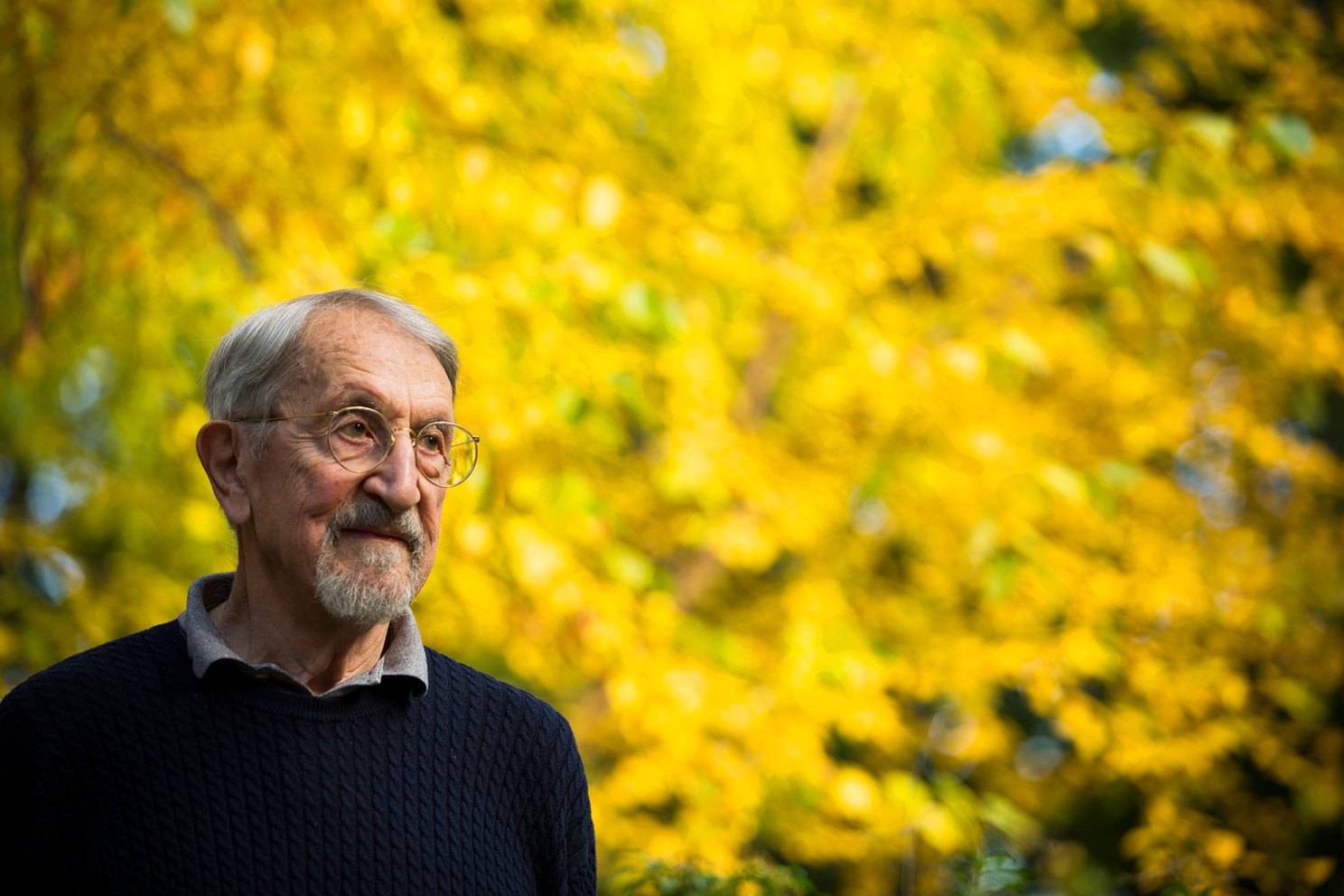
Martin Karplus.
File photo by Stephanie Mitchell/Harvard Staff Photographer
At a meeting of the Faculty of Arts and Sciences on May 5, 2026, the following tribute to the life and service of the late Martin Karplus was spread upon the permanent records of the Faculty.
Born: March 15, 1930
Died: Dec. 29, 2024
Martin Karplus, the Theodore William Richards Professor of Chemistry, Emeritus, at Harvard University and a 2013 Nobel Laureate in Chemistry, died on Dec. 29, 2024, at the age of 94. His work — entirely computational but always inspired by experimental observations — spanned chemistry, physics, and biology. In a career that extended over more than half a century and resulted in nearly 900 publications, Karplus transformed our understanding of molecular systems through his groundbreaking work in computational modeling by molecular dynamics simulations.
Karplus was born in Vienna, Austria, on March 15, 1930, into a family with a long and distinguished medical lineage. His early years were marked by a culture of intellectual richness and suburban comfort in the wine-growing district of Grinzing, but his peaceful Viennese childhood was shattered by the rise of Nazism and the Anschluss in March 1938. Within days, Karplus, his brother, Robert, and their mother fled by train to Switzerland, while his father was forced to remain behind in a Viennese jail as a hostage to ensure the family’s assets were not smuggled out. The family eventually secured visas for the United States through an affidavit provided by his uncle’s employer in Boston.
The Karplus family arrived in New York on Oct. 1, 1938, and settled in the Brighton neighborhood of Boston, where they faced a starkly different economic reality than their comfortable life in Vienna. Karplus quickly adapted and became a street kid who played stick-ball, while temporarily refusing to speak German to be accepted as an American. His parents worked as domestics during their first American summers, with his father serving as a handyman and his mother as a cook.
Karplus’ scientific interests blossomed in the woods as an avid birdwatcher. At Newton High School, he conducted a study on the behavior of nesting birds, which led him to become a finalist in the Westinghouse Science Talent Search. He entered Harvard University as an undergraduate in 1947, finishing in just three years with a concentration in Chemistry and Physics, and moved for his Ph.D. studies to the California Institute of Technology (Caltech). He joined the group of Linus Pauling, one of the founders of the fields of quantum chemistry and molecular biology. His doctoral research on the bifluoride ion brought him back to the rigors of chemistry and physics. Pauling described him as “my most brilliant student.”
After finishing his Ph.D. in 1953, Karplus received a National Science Foundation fellowship to conduct postdoctoral research at Oxford University under Charles Coulson. This period in Europe was as much about cultural exploration as it was about science; he used his stipend to travel extensively and developed a lasting connection with France.
Karplus’s independent academic career began at the University of Illinois in 1955, where he made one of his many enduring contributions to chemistry: the Karplus Equation. In those early days of applying nuclear magnetic resonance (NMR) to chemistry, he discovered a mathematical relationship between the dihedral angles of atoms in a molecule and their spin-spin coupling constants. This equation became a fundamental tool for determining the three-dimensional structures of molecules, and Karplus often spoke of it with the affection of a proud father.
In 1960, Karplus moved to Columbia University, holding a joint appointment with the IBM Watson Scientific Laboratory. His work shifted toward reaction kinetics, involving complex trajectory calculations of the H + H2 reaction using early computers. He returned to Harvard in 1966, eventually becoming the Theodore William Richards Professor of Chemistry in 1979, a chair named after the first American Nobel Laureate in Chemistry.
The 1970s marked Karplus’s return to biology, when he applied the principles of physics and chemistry to large biological macromolecules. He became fascinated by the dynamics of hemoglobin, the protein responsible for oxygen transport in the blood. While on sabbatical in Paris in 1972, he wrote seminal papers on hemoglobin dynamics. His research challenged the prevailing view of proteins as static structures, suggesting instead that their internal motions were critical to their function.
In 1977, Karplus and his colleagues Andrew McCammon and Bruce Gelin published the first molecular dynamics (MD) simulation of a protein, the bovine pancreatic trypsin inhibitor (BPTI). This 9.2-picosecond simulation was a watershed moment in macromolecular chemistry, demonstrating that computers could be used to see the dance of atoms within a protein. To support this burgeoning field, Karplus led the development of CHARMM (Chemistry at HARvard Macromolecular Mechanics), a software package that remains a standard for simulating the motion of proteins, DNA, and lipid membranes. This work led to the 2013 Nobel Prize in Chemistry, which he shared with Michael Levitt and Arieh Warshel.
Karplus was a professional-quality photographer. Exhibitions of his photographic work captured everything from the landscapes of the American West to the daily lives of people in Asia and Europe. He was also an accomplished chef with a deep appreciation for French cuisine. During some summers, Karplus would sometimes work as a substitute in the kitchens of famous restaurants in France.
Karplus is survived by his wife Marci, who became his partner both in life and in the management of his international laboratory. His first wife, Susan, died in 1982. His children followed various intellectual paths: his daughters, Reba and Tammy, became physicians, fulfilling the family destiny that had been set for him in Vienna; his son, Mischa, pursued a career in law.
Karplus was a member of the National Academy of Sciences, the American Academy of Arts and Sciences, and the Royal Society. He divided much of his later career between Harvard and the Université Louis Pasteur in Strasbourg, France, maintaining a global presence in the scientific community. His legacy lives on through the “Karplusians” — the scores of students and postdocs he mentored, many of whom are now leaders in computational biology and chemistry. In his epilogue to his memoir “Spinach on the Ceiling,” Karplus noted that “contributing to the education of so many people in their formative years is a cardinal aspect of university life.”
Respectfully submitted,
Stephen Harrison
Stuart Schreiber
Xiaowei Zhuang, Chair