Featured series

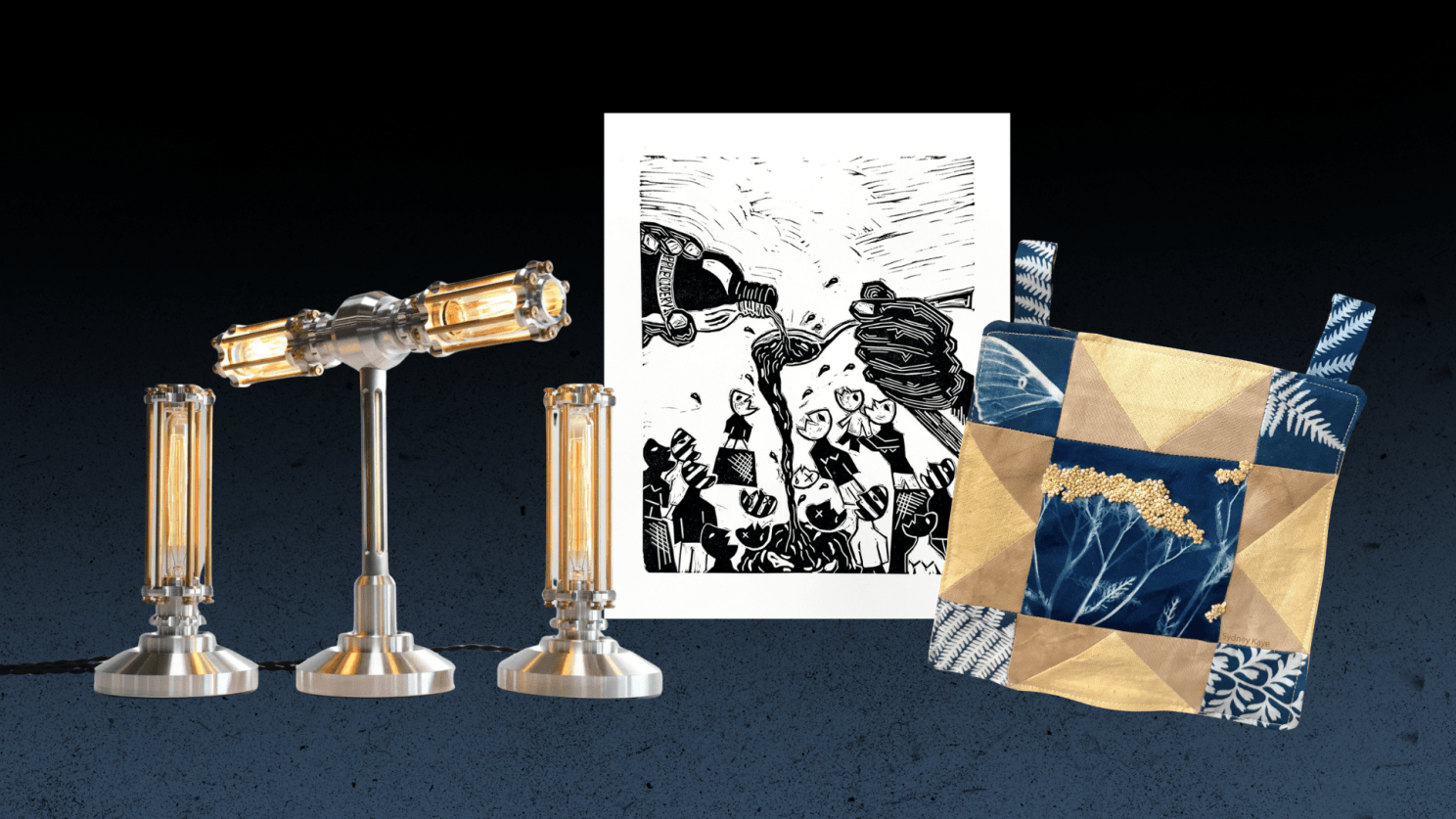
Photo illustration by Liz Zonarich/Harvard Staff
Campus & Community
Getting to know your colleagues’ creative side
Staff Art Show puts hundreds of Harvard staffers’ talents on display
Not all staffers at Harvard get the chance to flex their creative talents as part of their everyday work. So, Harvard launched the annual Staff Art Show in 2020 to give employees a forum for artistic expression. The seventh iteration of the multimedia exhibit displays the work of 215 artists in three locations across campus — Longwood’s Countway Library (through June 5), Cambridge’s Smith Campus Center (through May 4), and Allston’s Harvard Ed Portal Crossings Gallery (April 16-May 14). Here we profile three artists in just a small sample of the talent on display this year.
Fabricating a forest
Sydney Kaye
Curatorial Assistant II, Harvard University Herbaria
“Forest Floor,” botanically dyed fabric, embroidery thread, cyanotypes, and branch
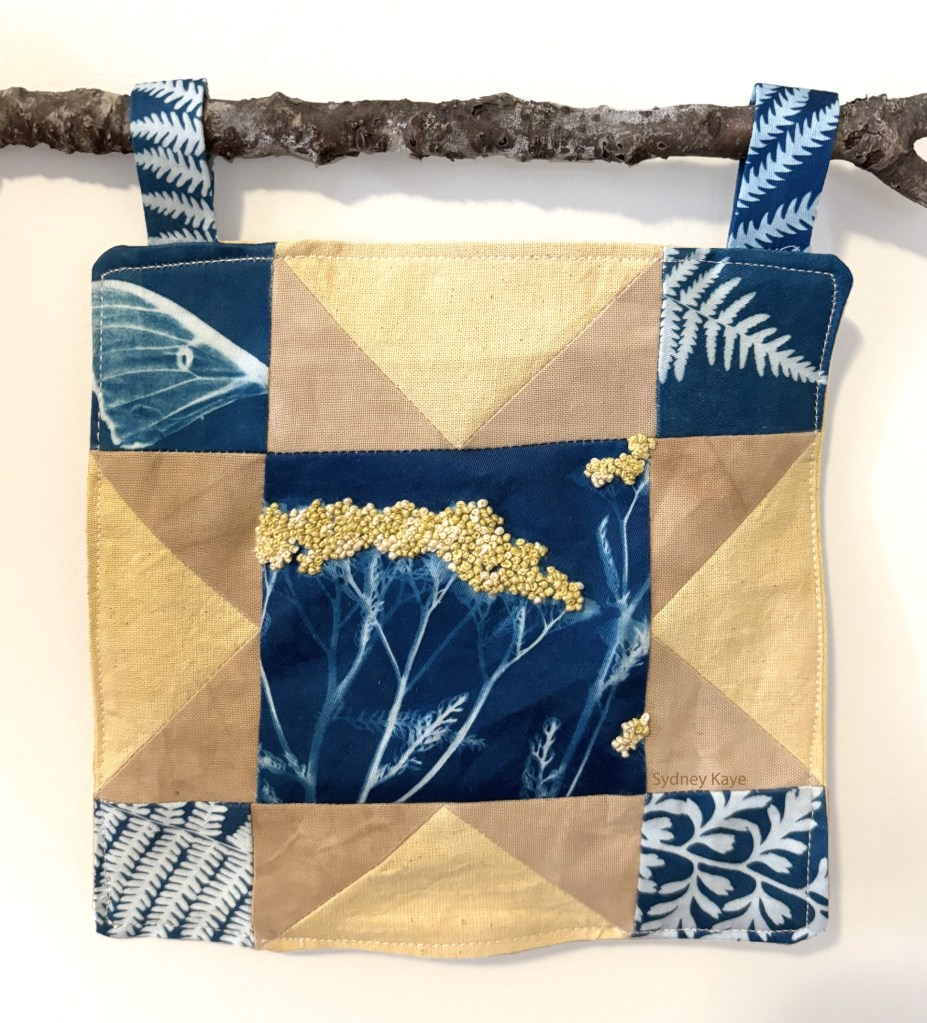
Kaye draws inspiration for her art from her day job at the Herbaria. Harvard’s collection of pressed, dried plant specimens, she stresses, is not only a great resource for research but also for the “historic, beautiful specimens that really cross the boundary between art and science.”
Kaye is currently digitizing the Herbaria’s extensive records of pressed plants, which means she is essentially photographing centuries’ worth of samples to make them accessible to researchers and the public globally.
“Forest Floor” incorporates the skills she’s learned along the way, using cyanotypes — photographic blueprints — of items found during a sojourn in Vermont, such as leaves, flowers, and the wing of a luna moth. To continue the connection with nature, she made subtly colored dyes using such plant material as sumac flowers and onion skins and added embroidery knots to lift the flowers of a yarrow plant off the fabric surface. “I wanted to figure out ways to make it a little more 3D, and I thought using the botanically dyed embroidery thread was an interesting way to do it.”
This is the second Harvard Staff Art Show for Kaye, whose textile art is on view at the Smith Center’s 10th-floor Riverview Commons.
The graduate of New York’s School of Visual Arts said her Harvard job stems — so to speak — from her vocation: “I started using plants in my artwork, and then after graduating I decided I wanted to learn more about plants.”
Looking to “find ways to have an artistic practice that didn’t create a lot of waste,” Kaye settled on using plants and other found material. That has also prompted her in her work toward a master’s degree in sustainability through the Harvard Extension School.
Along the way, Kaye is also planning more textile art inspired by her job, in particular one piece that maps out plant species in Vermont.
“I want to continue to integrate art and science, but this time, bring my own research into it,” she said. “I want viewers to feel connected to nature and reflect on the importance of biodiversity. I also hope this piece highlights the value of using natural and sustainable materials.”
Hands-on, in art and medicine
Maya Lakshmi Srinivasan
General Surgery Resident, Harvard Medical School
“Panacea,” linocut on paper
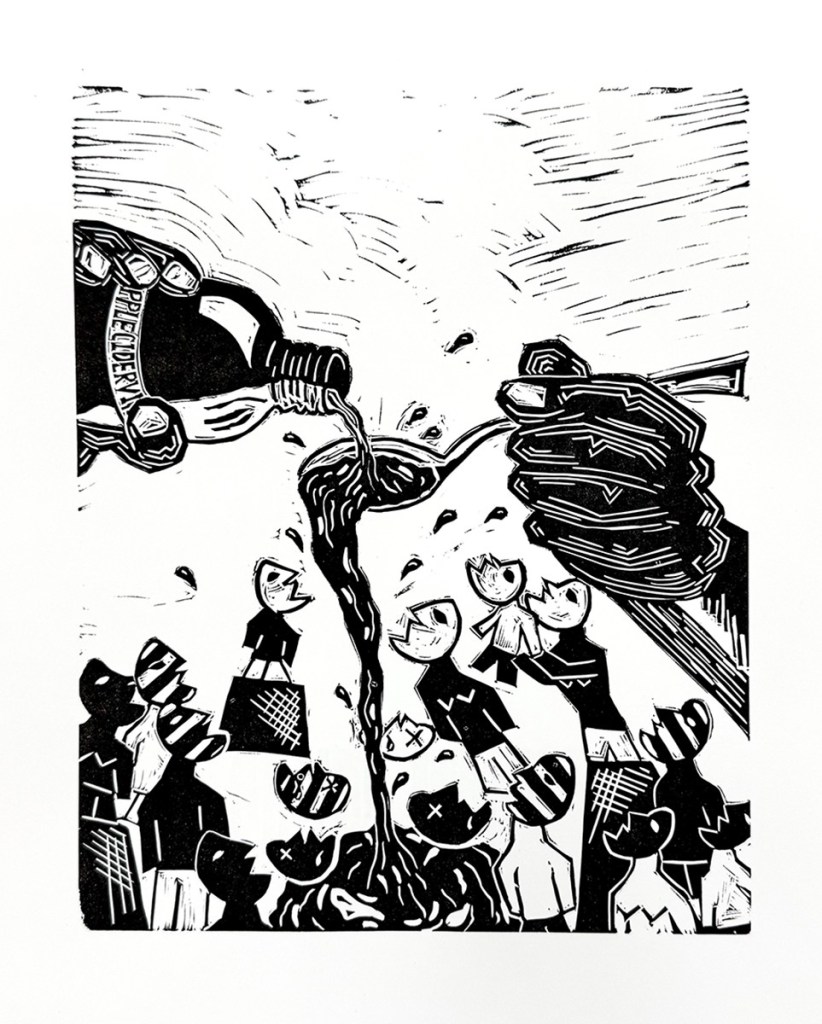
Srinivasan was attracted to art and medicine for similar reasons. In some ways, said the artist, printmaking may have influenced her to choose surgery as a medical specialty.
Linocuts like “Panacea,” as well as the woodblock prints she also creates, involve carving into linoleum to make a plate that is then inked to produce a print.
“Within medicine, I wanted that left-brain, right-brain analytical, problem-solving component that comes with any medical specialty,” said Srinivasan, who studied studio art as an undergraduate and came to medicine through the FlexMed program at the Icahn School of Medicine at Mount Sinai in New York, which encourages creative students to bring their talent to medicine. “But I also really wanted that physical component as well.”
Citing the “state of flow that you find when you’re challenged both intellectually and physically,” Srinivasan explained, “I really love working with my hands, and I wanted something very tactile in medicine. Surgery was exactly that for me.”
The second of Srinivasan’s prints to be shown in a Harvard staff art show, “Panacea” makes visual some of the issues she sees in public health today, particularly what she calls the proliferation of “anti-intellectual and anti-evidenced-based practices.” With a throng of hungry mouths reaching for a spoon of what is labeled apple cider vinegar, she challenges the idea that social media knows better than the medical profession how to treat disease while sympathizing with the desperation of people who have been led to distrust established science.
It’s a topic that came home to her while watching “Apple Cider Vinegar,” a Netflix series about a so-called “wellness influencer” who claimed near-miraculous powers for the kitchen staple. “The idea that apple cider vinegar or any other sort of dietary or wellness activity could cure cancer without the help of evidence-based medical treatment was really infuriating to me,” she said.
“But I also think learning to connect with people emotionally with my artwork has allowed me to be more empathetic and understanding with patients.”
Srinivasan, whose print is on view in the Longwood show, is currently working with the Visual Arts in Healthcare Program at Brigham and Women’s Hospital and pursuing an M.F.A. at Rhode Island School of Design. For this surgeon/printmaker, art and medicine “really do work hand in hand,” she said. “There really isn’t one without the other.
“Working on a wood block or working on a linoleum plate is akin physically to surgical dissection and the operating room,” she said. “But I also think learning to connect with people emotionally with my artwork has allowed me to be more empathetic and understanding with patients.”
Beauty meets utility: ‘Art doesn’t have to sit on a pedestal’
David Sekoll
Director of Design and Fabrication Instruction, SEAS
Double cage lamp, metal
First-time Harvard staff art show participant Sekoll knows how to make things. As director of design and fabrication instruction, he teaches students how to create the machinery for their experiments and oversees one of the SEAS machine shops. But the teacher, who has earned a master’s degree from the Academy of Art University, where he primarily concentrated on sculpture, sees the connection to art, such as his elegant Art Deco-like lamp, as essential.
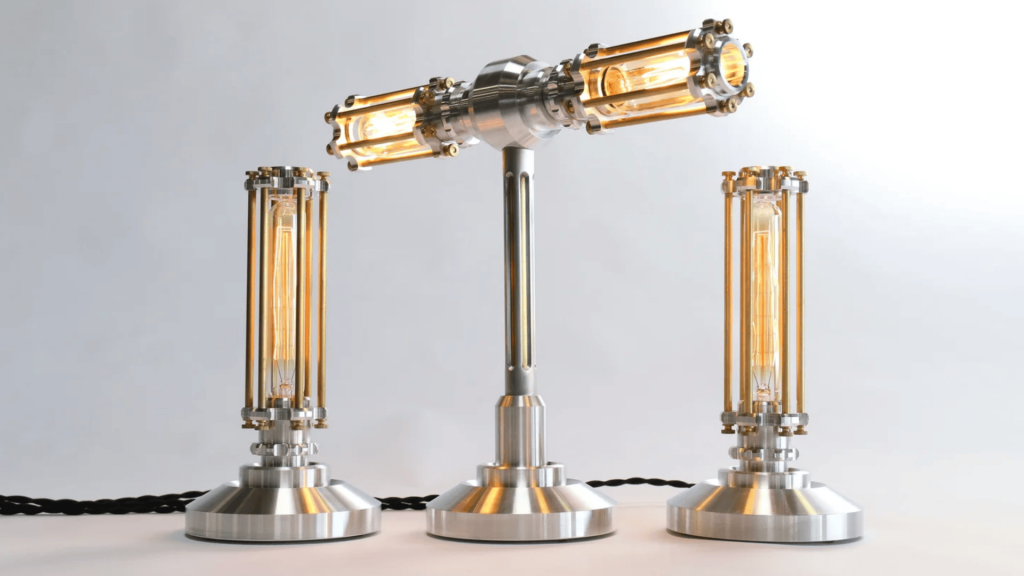
“I like working with my hands,” said Sekoll, whose double cage lamp will be on view in Allston. “I like working with tools and equipment. I’ve loved working in metal my whole life, whether it was jewelry or it was in a machine shop.”
That led him to his current job: “When I was getting my master’s degree, I got really into industrial design,” he said, citing the beauty and precision of the work.
Along the way, he discovered a passion for teaching. “I love passing on the skill sets to the next generation,” he said. “When you see their eyes brighten up and they go, ‘Oh, wow, I just made this,’ and you see how excited they get, I get that same thrill.”
For Sekoll, who also creates metal vessels that require precision measurements to seal correctly, the thrill of learning never ends. “Sometimes I just like to get a piece of metal and start playing around with it,” he said.
These days, he is focusing on how best to use tools such as the machine shop’s 3D printers, a learning process that allows him to explore for both his job and his art: “I’d like to spend a little bit more time developing my own skill sets beyond where I am now.” As he does so, he noted, “You’re learning about the machine, you’re learning new features of the machine, but you’re also making something at the same time.”
For Sekoll, the distinction between what he does during office hours and what he does on his own time is basically nonexistent. His three-piece lamp, for example, is functional. That doesn’t diminish its artistic value.
“I started with fine artwork and then got into more functional work,” he said. “For me, art doesn’t have to sit on a pedestal. Art doesn’t have to be a painting on a wall.”