Featured series


Campus & Community
You know the author. Meet the typist.
Photos by Niles Singer/Harvard Staff Photographer
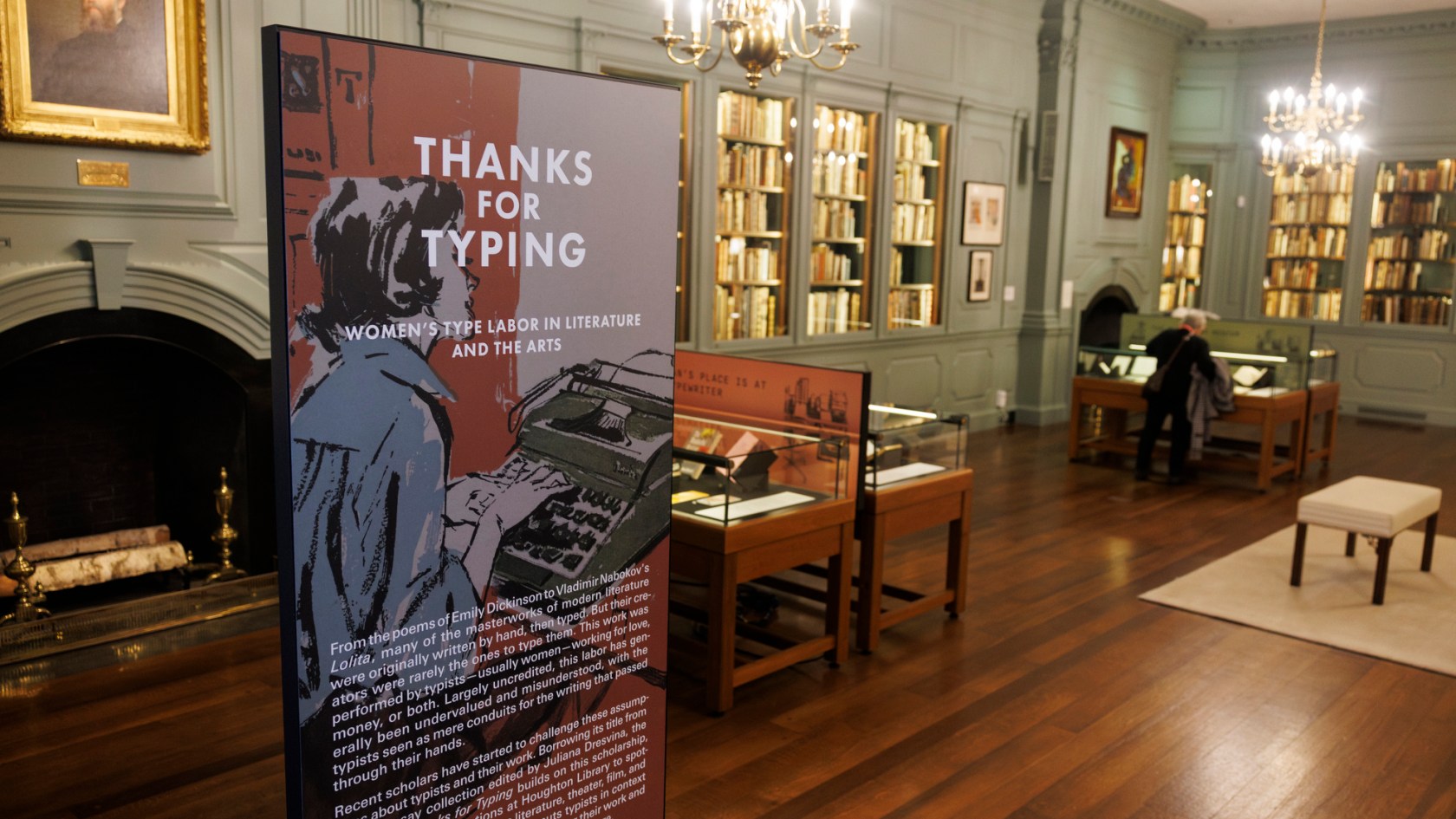
Exhibit celebrates women who labored behind the scenes of masterworks
Vladimir Nabokov never learned to type. Every word of every novel he published — including the classics “Lolita,” “Pale Fire,” and “Pnin” — was typed by his wife, Vera, before being sent to editors.
“He wrote on notecards,” said Christine Jacobson, associate curator of modern books and manuscripts at Harvard’s Houghton Library, and co-curator, with Dale Stinchcomb of New York’s Morgan Library, of “Thanks for Typing: Women’s Type Labor in Literature and the Arts.”
Nabokov, Jacobson said, would shuffle the notecards “until he liked the arc of the story. And depending on how fleshed out they were, he would then either dictate them to Vera, or if they were in complete prose, he would hand them to her to be typed.”
“Thanks for Typing” explores the stories of women like Vera — typists who helped bring the novels and stories of famous literary figures to the public — as well as the thousands of women who served as secretaries and typists for government officials, scientists, researchers, and Hollywood creatives.
The inspiration for the exhibit was a viral social media tag — #thanksfortyping — started by University of Virginia Professor Bruce Holsinger.
“He was looking through academic monographs on Google Books when he started to pay attention to the acknowledgement section and notice the same language over and over again: ‘Thanks to Judy for typing’; ‘Thanks to my wife, Mary, for typing the manuscript and transcribing the interviews,’” Jacobson said. “It was like, thanks for typing, thanks for typing, thanks for typing, over and over again.”
“And so we wondered, what might we find if we looked for these stories in our own archives here at Houghton, and what would it look like to bring greater attention to those stories in an exhibition?” Jacobson said.
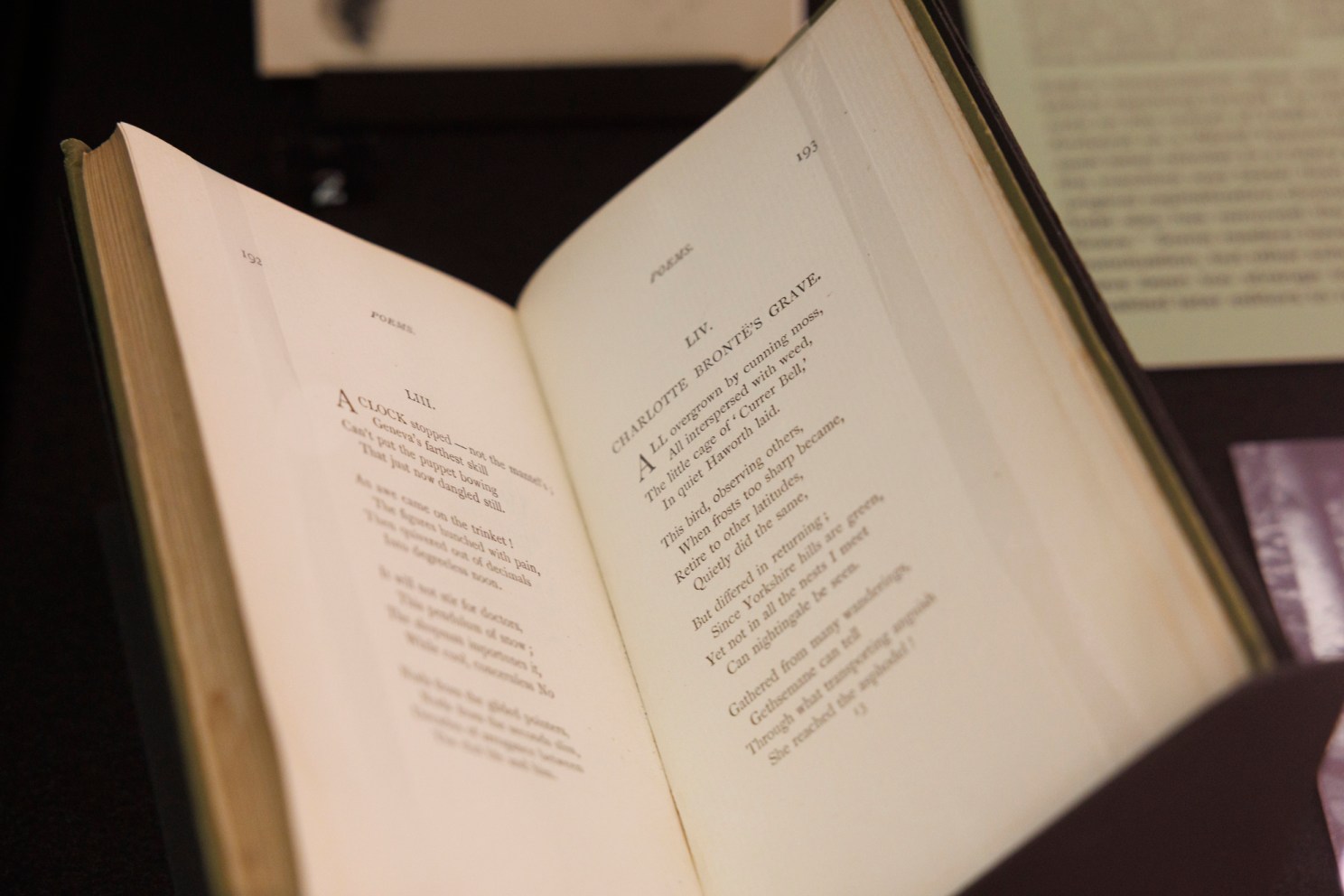
The poem “Charlotte Brontë’s Grave” by Emily Dickinson.
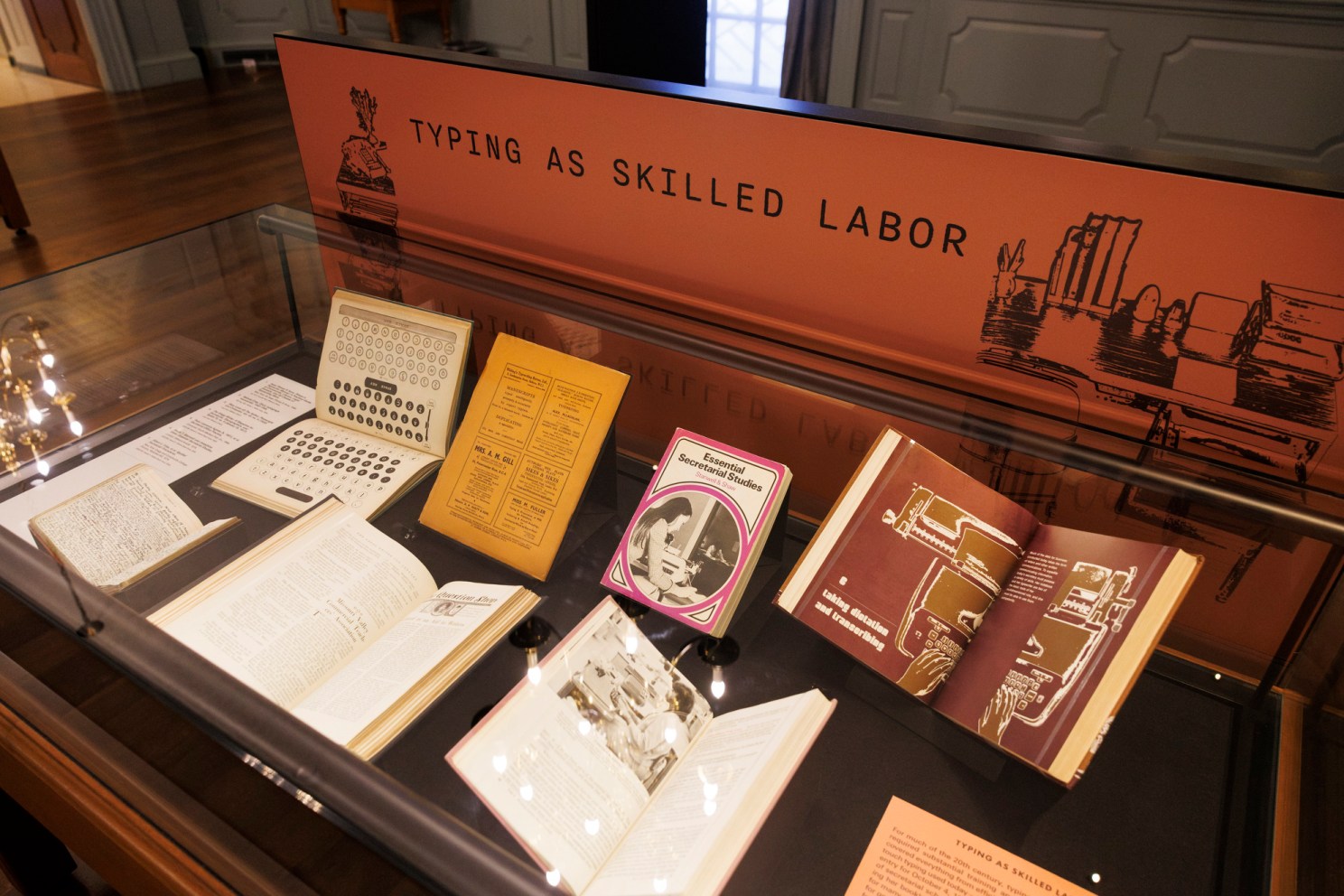
A collection of technical guides to typing.
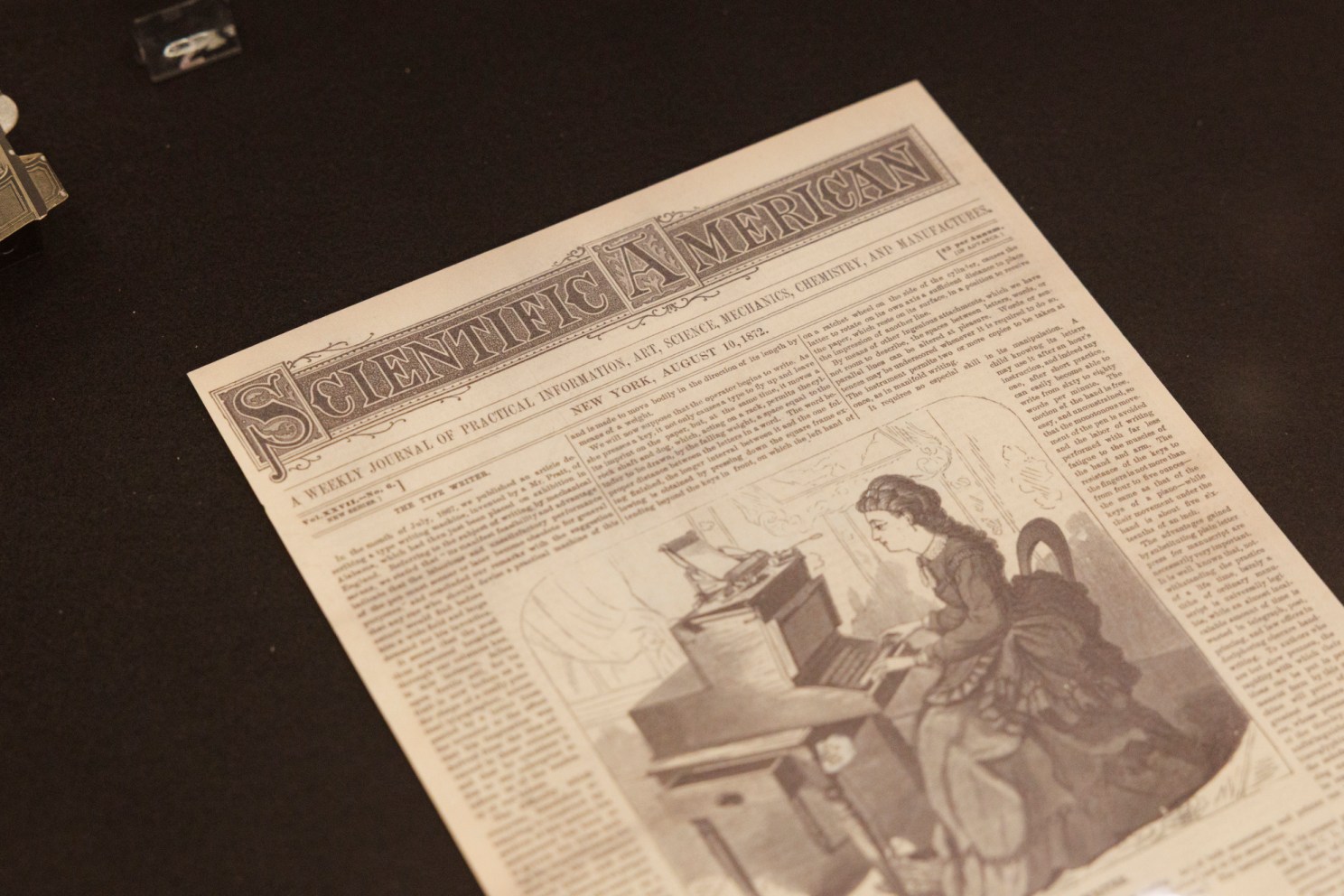
A photo of “Scientific American 27, no. 6 (August 10, 1872).”
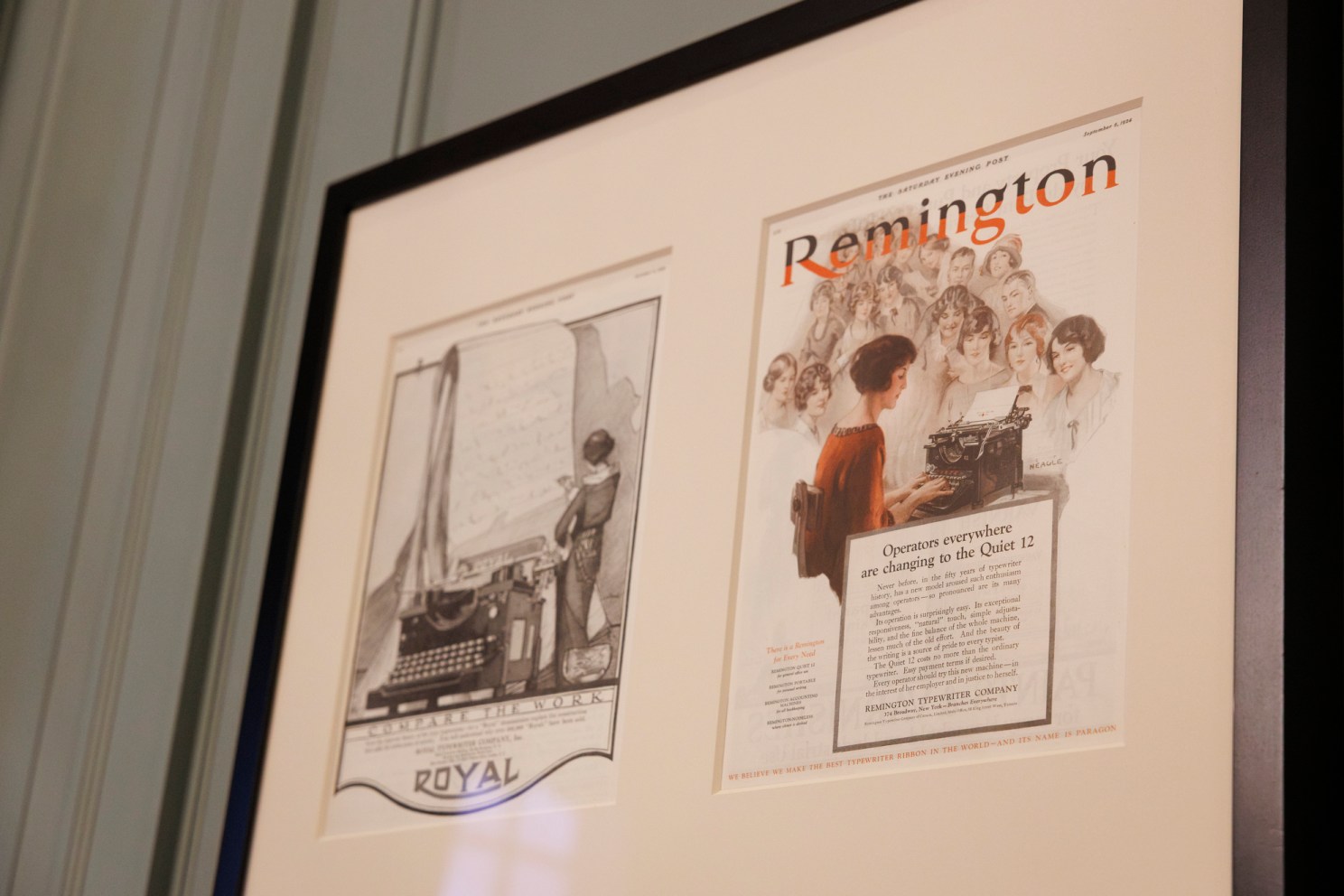
Remington advertisements from 1924.
Exploring Houghton’s archives, Jacobson and Stinchcomb discovered typists for Emily Dickinson, Henry James, T.S. Eliot, and Oscar Wilde. As part of the exhibit, the curators paired examples of Dickinson’s handwritten poems — including her unique capitalizations and paragraph indentations — with typewritten versions created Mabel Loomis Todd during the 1890s. Todd began publishing Dickinson’s manuscripts four years after her death, when Dickinson’s sister gave her hundreds of handwritten pages.
“We would not have Emily Dickinson’s poetry without her,” Jacobson said.
With responsibilities that ranged from research to copy editing, typists in some cases left an important mark on the finished product, Jacobson said, citing Todd’s decision to discard many of the oddities in Dickinson’s script and edits Vivian Eliot made to her husband’s poems.
Then there’s the influence typing had on the writer: “Henry James’ style changes very significantly once he starts dictating to a typist, and that is where you get the great late Henry James period, where his style is a lot more verbose and the sentences are very long and winding,” Jacobson said.
In addition to typists’ literary contributions, the curators wanted to contextualize how their work has been valued, or not, over time.
“From the moment the typewriter is invented, it is immediately associated with women and women’s labor,” Jacobson said.
“From the moment the typewriter is invented, it is immediately associated with women and women’s labor.”
Christine Jacobson
When Christopher Latham Sholes invented the first commercially viable typewriter in 1872, he didn’t pose for press photographs but instead positioned his daughter at the machine, she noted. The very first photograph of somebody operating a typewriter, Jacobson said, captures Lillian Sholes — the original “typewriter girl.”
“The message that this would have been sending to 19th-century audiences would have been that this machine is so easy to use that a woman can do it,” Jacobson said. “Sholes is lauded as this person who paved the way for women to enter the white-collar working world, which is definitely true, but I think the issue here is that from its inception the contributions have been minimized, and not seen as a technical skill.”
From the turn of the century to the 1950s and ’60s, Jacobson said, women’s labor continued to be minimized while depictions of it grew more sexualized.
Mid-century typewriter manuals were “very much about catering to your boss’s every need and making sure that you look beautiful and hygienic for work,” she said. “They’re objects of sexual desire. They’re meant to adorn the office.”
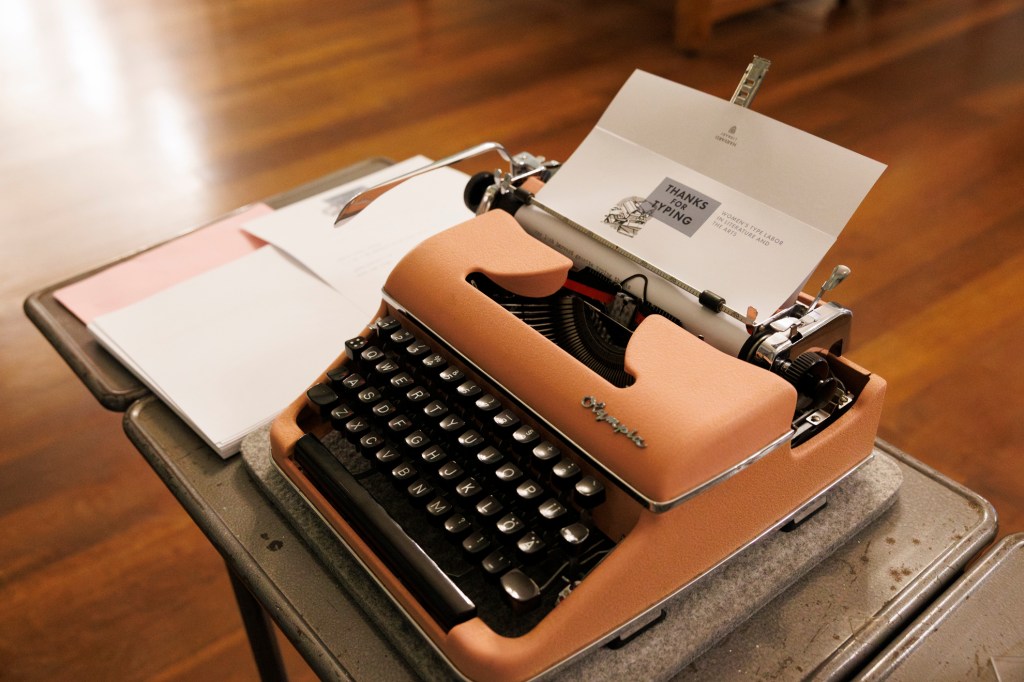
The exhibit wouldn’t be complete without a chance for visitors to type for themselves, courtesy of a vintage Olympia in the Edison and Newman Room. Houghton is also partnering with the Harvard Film Archive to spotlight women who make their living at the typewriter, with screenings of “Meet Joe Doe,” “His Girl Friday,” and “The Hudsucker Proxy.” For showtimes, tickets, and Christine Jacobson’s show notes, visit the HFA website.
“Thanks for Typing” will be on display through May 1.