Featured series


Work & Economy
Yes, China has embraced renewables – but don’t call it a transition, expert says
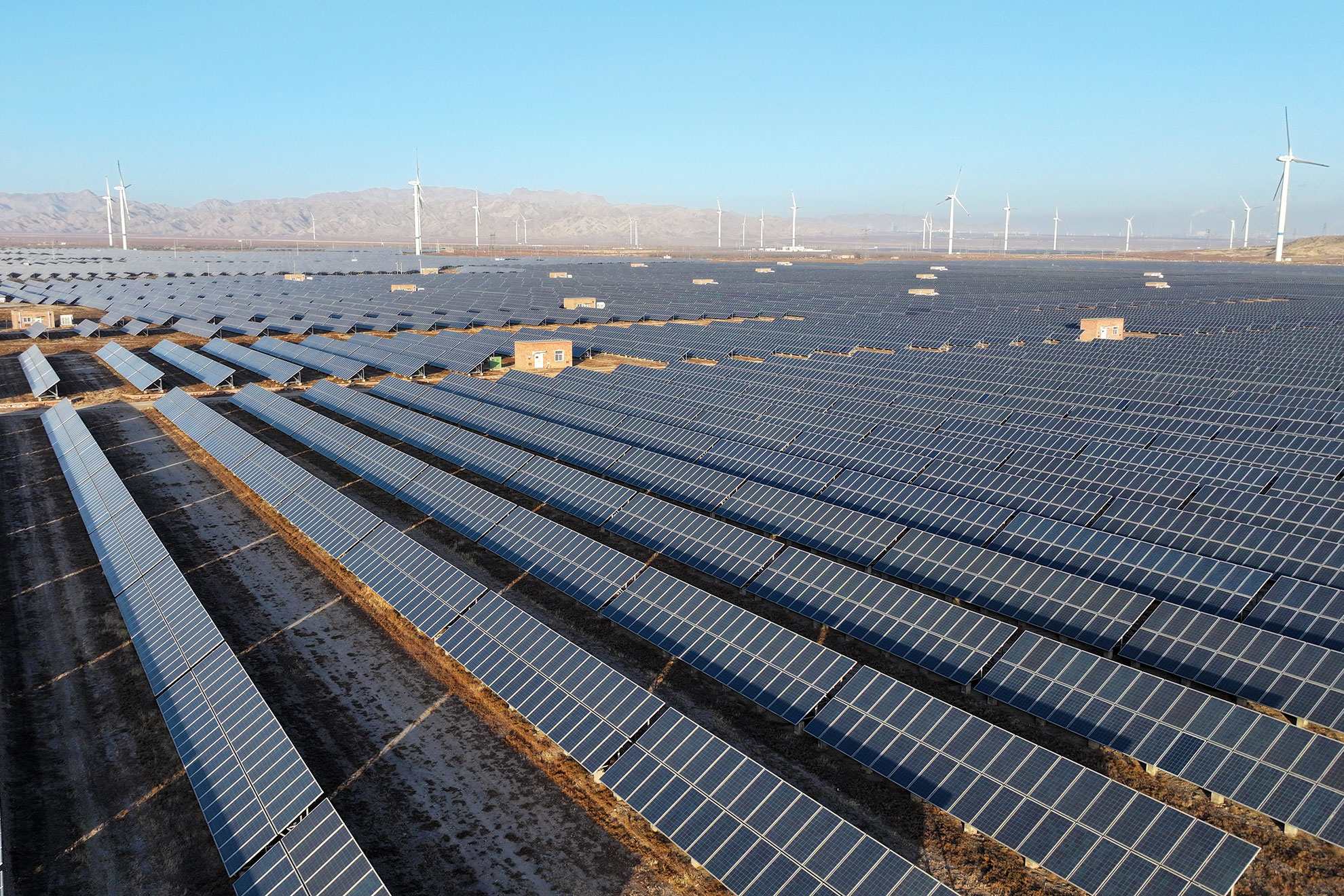
Wind turbines and photovoltaic panels at a power plant in Shizuishan City, Ningxia Hui Autonomous Region, China.
Costfoto/NurPhoto via AP
Kennedy School panelists ponder next chapter in a tale of two superpowers
China’s embrace of electric vehicles and renewable energy technology has less to do with a clean energy transition than a hunger for energy of all kinds, analysts on a Kennedy School panel said Monday.
The nation, which has dominated the global trade in solar panels and has the world’s largest wind power industry, nonetheless generates 60 percent of its power from coal and has not hit the brakes on fossil fuel plants even as it aggressively pursues renewable energy initiatives.
“We see addition, not transition,” said Yasheng Huang, a professor of global economics and management at the MIT Sloan School. “China is building alternative sources of energy as well as fossil energy sources, simultaneously. In terms of the global footprint on CO2, China is emitting twice as much as Europe and the United States. I don’t think there’s a transition going on.”
Huang spoke at a seminar sponsored by the Mossavar-Rahmani Center for Business and Government. The event, “The Great Energy Divide: Petro America vs. Electro China,” focused in part on the perception of divergent energy policies in the first year of the second Trump administration.
In fact, if one leaves out China’s massive hydropower industry, the two nations have similar energy mixes, Huang said, with China’s fossil fuel portfolio favoring coal, much of which is mined domestically, and the U.S. favoring natural gas, most of which, similarly, is produced at home. Huang noted that security interests may also play a role in China’s embrace of renewables. Despite its massive coal industry, the country imports a significant amount of coal from Australia.
There remain key differences between the superpowers. China relies entirely on imports for oil, while the U.S. has become the world’s largest producer of oil and among the top global producers of natural gas.
According to Elaine Buckberg, a visiting scholar at Harvard’s Salata Institute for Climate and Sustainability and a lecturer in environmental science and public policy, another difference lies in the coherent industrial policy China has developed. If such a policy were emulated to support the U.S. auto industry, it would likely focus on electric vehicles, she said.
“I believe the future of the auto industry is EVs,” said Buckberg, a former chief economist for General Motors. “So you need to define your policy in that direction if you want to think about an industrial-policy approach and assume that’s where the industry is going.”
Such a move would help the U.S. auto industry transition to EVs in part through a suite of policy initiatives. Instead, Obama-era EV tax credits were pulled back in the first Trump administration, revived in the Biden years, and then squashed again.
“That constantly shifting policy means that the companies are going back and forth,” Buckberg said. “Have a stable policy, policy oriented towards EVs, but narrowly targeted on EVs. Invest especially in batteries and battery development, because that is really the decider, batteries and technology and research — that would be my recommendation.”
Addressing the prospect of Chinese EVs coming to the U.S., Buckberg pointed to two national security issues. One is a surveillance concern, since modern EVs are equipped with sensors and cameras that gather information that could potentially be shared. The second, she said, is that the U.S. has a strong interest in protecting its own heavy-industry manufacturing base — one that can transition to supporting national objectives in times of crisis.
The development of Chinese EVs has been planned and supported by Beijing, Buckberg noted. At one point, she said, there were some 800 Chinese EV companies. That number has been winnowed to fewer than 100, but the process drove innovation and efficiencies in production that resulted in high-quality, inexpensive vehicles that compete well internationally, Buckberg said.
Despite China’s global strength, there are signs of economic stress at home, with a glut in the housing market that has hurt local governments and left developers teetering. Huang questioned whether the booming economy is approaching an inflection point. The government, he said, should focus on strengthening benefits to workers, through investments in social security, health insurance, and education.
“I think we’re beginning to see something fundamentally shifting in the Chinese economy,” he said. “The money simply is no longer there.”