Featured series
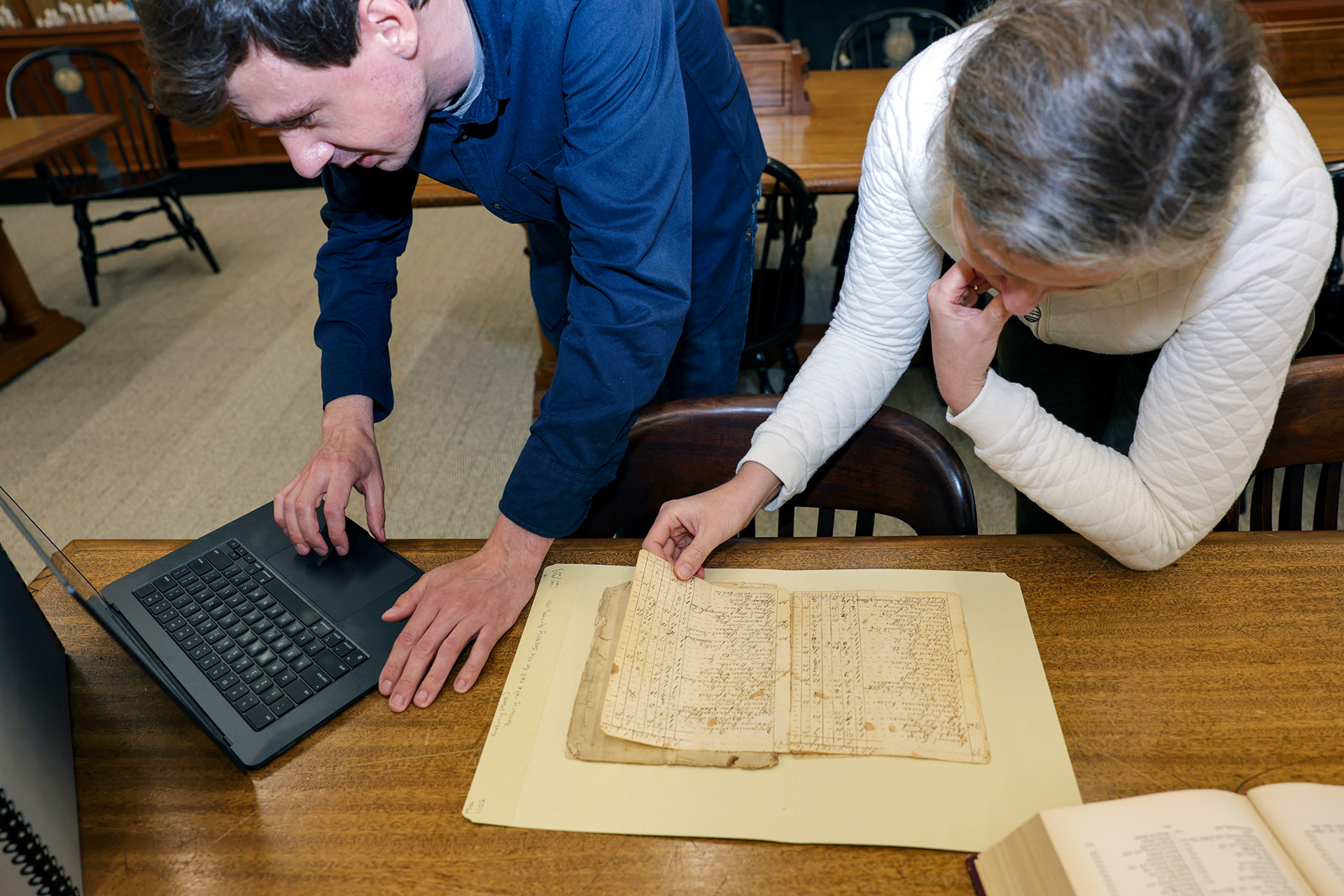
Researchers Gabriel Raeburn and Christine Bachman-Sanders review documents.
Photo courtesy of Claire Vail at American Ancestors
Campus & Community
Tracing Harvard’s ties to slavery: Recovering names and histories
Researchers delve into probate records, tax lists, and estate inventories to identify enslaved people
Second in a series about the ongoing work of American Ancestors and the Harvard & the Legacy of Slavery Initiative
When the Presidential Committee on Harvard & the Legacy of Slavery released its 2022 report, it identified 79 people who had been enslaved by Harvard leaders, faculty, and staff before the Civil War but noted the figure would likely rise as research continued.
After building a list of about 3,000 members of Harvard’s faculty, staff, and leadership who worked at the University when slavery was legal in the U.S., American Ancestors has turned to the next critical step: determining which individuals enslaved people and uncovering the names of those they enslaved.
The work reflects the Harvard & the Legacy of Slavery Initiative’s founding commitment to identify, engage, and support direct descendants of people enslaved by Harvard leaders, faculty, and staff.
To date, researchers have identified 1,314 formerly enslaved people connected to Harvard and 601 living descendants.
The process of identifying enslaved people is complicated. Institutions often didn’t keep robust records on them the way they did for free people. Instead, the records of the enslaved are often connected to those who owned them. To discover living descendants, researchers at American Ancestors, a genealogical nonprofit that has partnered with Harvard, examine the family histories of both enslavers and the people they enslaved.
“There’s an incredible interconnectedness between all of these families,” said the organization’s chief research officer, Lindsay Fulton, “not just between the enslaver family and the enslaved family, but also in the greater community of Harvard faculty, leadership, and staff. It’s a community of people.”
Understanding whether a certain member of Harvard’s community held enslaved people involves careful research. For each member of Harvard’s faculty, leadership, and staff, researchers go through a specified list of documents. These include probate records, land and property deeds, birth and death records, marriage records, town records, newspaper records, court records, tax records, church records, census data, and personal papers.
The group also uses targeted internet searches and an AI-assisted search tool to search quickly through large amounts of archival material.
A rigorous search for humans once considered property
Often, not every source proves fruitful. Some documents have disappeared. In other cases, information that would indicate whether someone held enslaved people is missing or excluded. Some families have well-preserved sets of personal papers; others have none at all.
Different sources vary in usefulness for free versus enslaved people — largely because the enslaved were considered property.
Harvard faculty, leadership, and staff are much more likely than enslaved people to have accessible birth, marriage, and death records. They are also easier to search in a database than enslaved people, in part because they are likelier to be recorded with a first and last name.
When identifying enslaved people in documents, researchers are often most successful looking through Colonial probate, church, vital, and tax records. Probate filings might note that enslaved people were bequeathed in wills and appraised by estate inventories. Enslaved people within a certain age range were considered taxable property, and so would appear in the tax records of their enslavers.
Church records are also useful, often recording baptisms, as well as the civil marriages of enslaved people, which Massachusetts began to allow in 1705. The First Church of Cambridge, for example, recorded the 1729 baptism of “Titus, an Indian manservant of Pres. Wadsworth” — one of four enslaved people who lived and worked in Harvard’s Wadsworth House.
Puritan churches also recorded the public confessions of churchgoers, which sometimes included enslaved people, who were often identified as property of their enslaver.
Court records are also useful for identifying enslaved people throughout the Colonial period and beyond. They appeared in various legal proceedings, including property disputes and criminal cases. In the second half of the 18th century, enslaved people increasingly sued for their own freedom, appearing in records alongside the person who enslaved them.
However, even when enslaved people are referred to in historical documents, they are not always easy to identify. Some probate records are brief, but in estate disputes, filings can stretch to several hundred pages — with the names of the enslaved mentioned only in passing. Names can also shift over time, with enslaved people sometimes being referred to only by first name, sometimes in association with their owner, and sometimes with a different first or last name.
In personal papers, those discovered to be enslavers often reference free and enslaved people without clear distinctions. Gabriel Raeburn, senior research project manager at American Ancestors, recalled reading someone’s letters that referenced family members alongside people they were enslaving. He knew one man was enslaved only because he had previously reviewed his bill of sale.
Researchers also point out that the term “slave” was often not used in official documents. Instead, enslaved people are often referred to as servants along with a racial descriptor. Raeburn adds, “The archives are created by the enslavers themselves for the most part,” and they often didn’t seem to believe it was worth recording the life events of those they enslaved.
The complexity of the research makes it crucial that American Ancestors researchers systematically study and record every source that could be associated with a member of faculty, staff, and leadership.
Building on collaborative work
Researchers at American Ancestors underscore that their efforts build on archival work by Harvard-affiliated researchers and exist among a broader landscape of organizations seeking to document American slavery. Those include the Universities Studying Slavery (USS) consortium, run out of the University of Virginia, as well as the Northeast Slavery Index, which indexes records and identifies enslaved people throughout the region.
Raeburn also pointed to research by organizations like the Boston Task Force on Reparations, Medford’s Royall House and Slave Quarters, the Longfellow House, and local churches and historical societies, whose work has helped document enslaved people in Massachusetts.
Kirt von Daacke, managing director of USS and an assistant dean and professor at the University of Virginia, emphasized the importance of schools working together as they research institutional slavery.
“[O]ne cannot really tell the history of slavery at a university without expanding the research lens to include the many communities beyond the university gates that the school was embedded in,” he said.
He thinks that the efforts universities have taken in the past 10 years to collaborate on best practices and share findings have produced “excellent results, even if they are all imperfect and incomplete.”
Fulton agrees.
“Standing on the shoulders of people who have done this before is really important to this particular work,” she said, “because we’re looking for records that are typically overlooked.”
As the work continues, researchers expect to identify many more enslaved people connected with the University. The team will continue to build on existing research — and leave a fuller picture of a long-obscured history.