Featured series

Arts & Culture
Tina Fey’s keys to a good joke: Snark, confidence, surprise
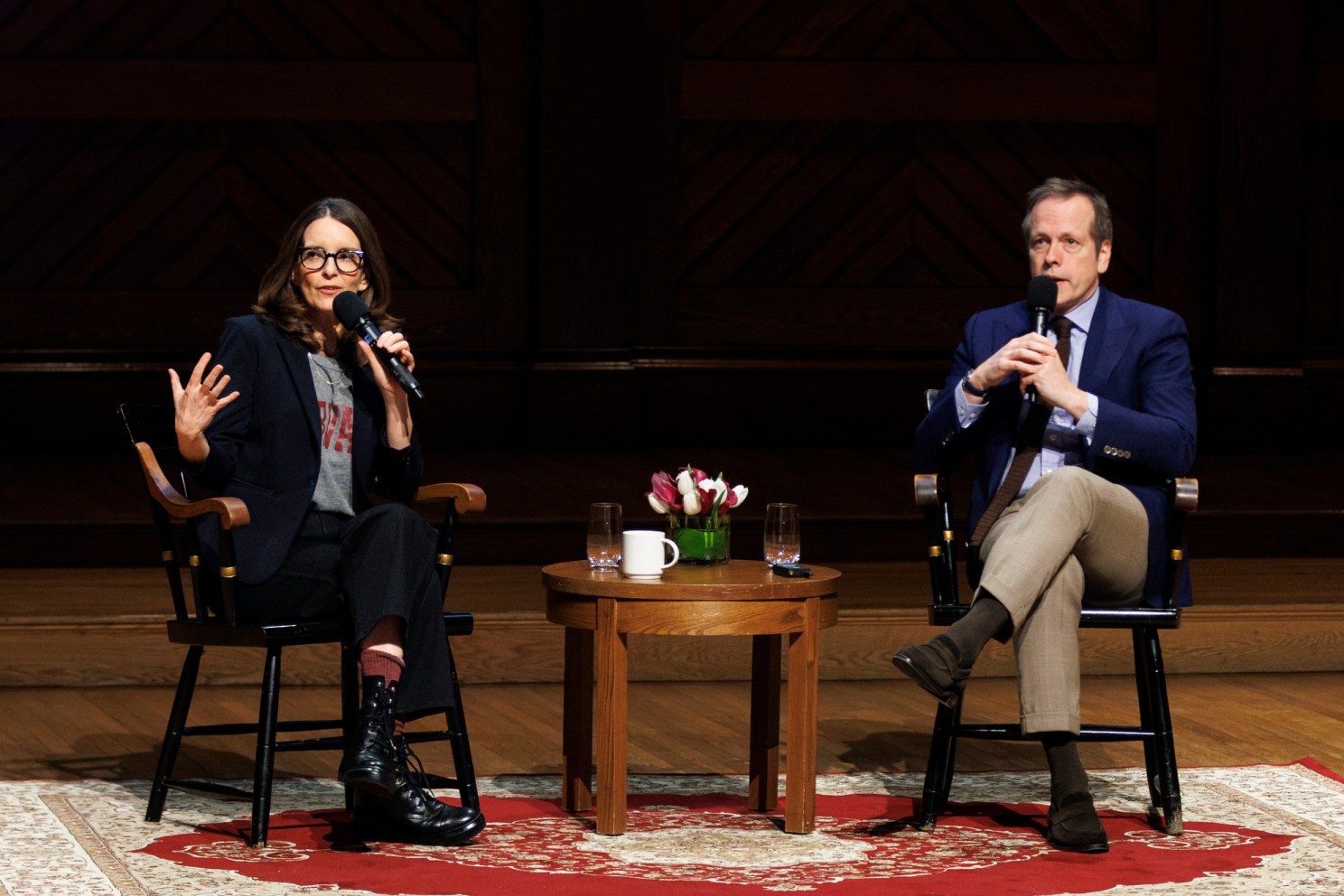
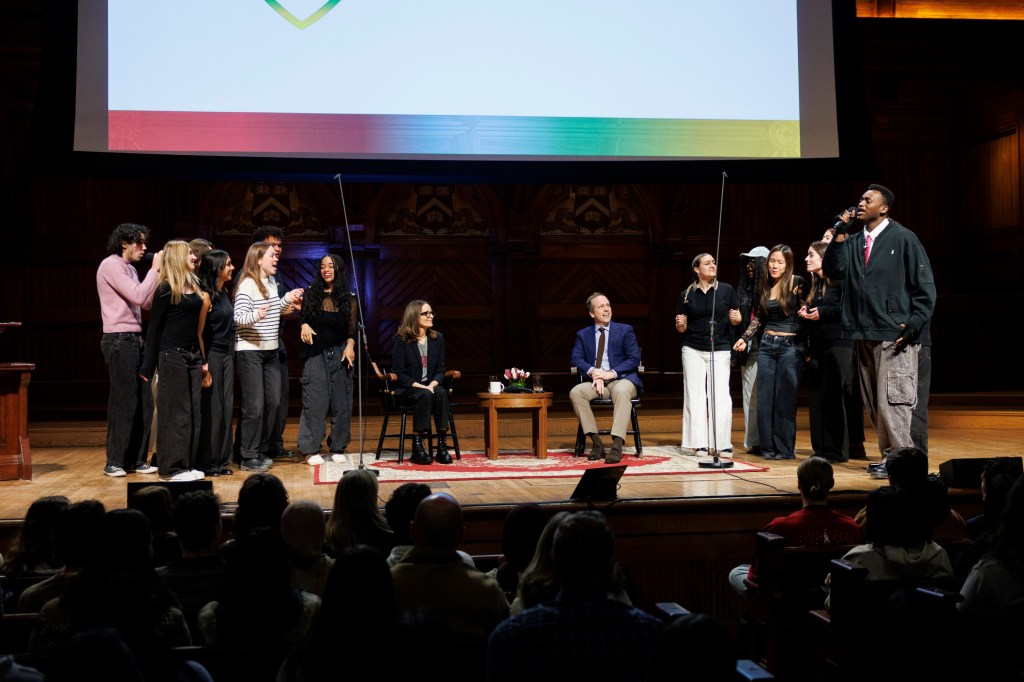
Tina Fey and Robert Carlock ’95 at Sanders Theatre.
Photos by Niles Singer/Harvard Staff Photographer
Comedian keeps Harvard crowd laughing with longtime co-writer Robert Carlock ’95
For Robert Carlock ’95 and Tina Fey, success in comedy requires a combination of “benign grandiosity and imp of the perverse.” In other words, it takes a little snark and a lot of confidence to survive such a competitive industry.
But when it comes to their decades-long creative collaboration, from “Saturday Night Live” to “30 Rock” and “Unbreakable Kimmy Schmidt,” both agreed the real secret is mutual respect.
“That recognition, very early, of like, ‘Oh, she is competitive and fierce and wants to win, I’ll see you on the ice,’ I didn’t see that in a lot of other comedy writers all the time,” Carlock told the audience that packed Sanders Theatre on Friday to hear the dynamic comedy duo speak about their creative process. “I think it’s kind of necessary. ‘We’re both going to work as hard as we can, and let’s see if we’re any good at this.’”
Carlock and Fey, whose latest collaboration, the sports sitcom “The Fall and Rise of Reggie Dinkins” premiered last month, kept the audience laughing while discussing their time on SNL, learning from failure, and how they work together to build a joke from the ground up. The sold-out event, hosted by the Office for the Arts at Harvard, marked the 50th anniversary of the Learning From Performers program, an initiative that brings professional artists to campus for events and workshops with students.
At first glance, the “Mean Girls” creator and “Bossypants” author appeared to be wearing a Harvard T-shirt underneath her blazer, until she revealed — to the audience’s delight — that it was actually the words “damar varnish.” The shirt, a tongue-in-cheek design by screenwriter Meredith Scardino, inspired the name of a “Kimmy Schmidt” character played by rapper Black Thought.
“Creating an expectation and subverting it is kind of what jokes are,” said Fey. “It’s taken me so long in doing this to learn jokes are just surprises. Most of the time, they are a surprise in some form.”
Carlock, who also wrote for “The Dana Carvey Show” and “Friends,” recalls Fey was an “intimidating” SNL writer to work alongside because she was so prolific in producing sketches that were consistently chosen at the weekly table read. This wasn’t easy, as each week there would be 40 to 50 sketches submitted by SNL writers and only room for about eight to air.
“I love that kind of healthy competition,” Fey said. “If you lose at the table, you lost fair and square because it’s a real proving ground.”
Fey added that competition she faced in her early days at SNL, and in the improvisational comedy group The Second City, was useful, preparing her to weather later rejections, like the first iteration of what would later become “30 Rock.”
“With both improv and ‘SNL,’ the biggest gift they give you is the constant failure,” Fey said, “and the feeling of, ‘OK, I failed so deeply, and I survived.’”
At the event, the comedians chatted with undergraduates Lollie McKenzie ’26, Hamza Masoud ’26, Aidan Kohn-Murphy ’26, and Priya Allen ’27, who took to the stage to ask questions about writing for different media and actors, and what projects most challenged them (for Fey it was “Bossypants,” for Carlock, his pieces in The New Yorker).
They were also serenaded with a surprise performance by the Harvard Opportunes performing the “Kimmy Schmidt” opening theme.
When McKenzie asked how college prepared them for careers in comedy, Carlock cited his time at The Harvard Lampoon, and simply being around friends on campus who were interested in the arts.
“If I were a student sitting in this audience right now (which I wouldn’t be, because it’s Friday night), I would swear up and down that I had no idea I was going to do this, even if I was a senior,” Carlock said. “To the extent that Harvard creates a community of wonderful weirdos of all kinds, it was absolutely instrumental.”
To explain their process of writing together, Carlock and Fey talked through one of their favorite jokes, which appeared in the Season 1 finale of “30 Rock.” In the scene, which is set in a hospital, recurring character Dr. Spaceman (played by Chris Parnell) enters the waiting area unexpectedly, covered in a shocking amount of blood, and explains that he was at a costume party, was attacked by the hostess’s dog, then stabbed the dog. Writing that joke was like “putting a hat on a hat,” according to Carlock, where he and Fey kept adding twists (Spaceman, the blood, the costume party, the dog) to heighten the absurdity.
“One thing that people say a lot is, ‘You must have so much fun. It must be so much fun just laughing all day,’” Carlock said. “This time it was.”
The writers also shared an example of a joke that didn’t make it to the air. Carlock had suggested a line for “Unbreakable Kimmy Schmidt: Kimmy vs. the Reverend” (2020) in which Titus is preparing to go to sleep and says, “Now, to quote the goose cobbler, ‘honk-shoe, honk-shoe, honk-shoe.”
Fey vetoed that one.
“You told me that no show with your name on it would ever have that joke in it,” Carlock reminded Fey.
“Sometimes I have to hold a boundary,” she said.
Many of their jokes are effective, Carlock explained, because they are carefully sandwiched between more serious moments that serve to build character relationships. In the hospital scene, for example, the Dr. Spaceman joke occurs before a heartfelt bedside conversation between Liz Lemon (Fey) and Jack Donaghy (Alec Baldwin), and after the audience learns Lemon is Donaghy’s emergency contact.
“The way audiences were able to tolerate that amount of jokes is that we did try to pay attention to the story spine, and we did try to make characters and leave room for people to care about those relationships,” Fey added.
“Make the real silly and make the silly real,” Carlock agreed. “And put hats on everything.”