Featured series

Arts & Culture
How Bad Bunny rocketed to global stardom
Photos via Getty Images; photo illustration by Liz Zonarich/Harvard Staff
Music scholar charts ‘remarkable’ rise that transcended language barriers and cultural stigma
Songs by Benito Antonio Martínez Ocasio, better known as Bad Bunny, were streamed nearly 20 billions times on Spotify in 2025, more than any other artist. The Puerto Rican superstar’s triumphant run continued Sunday — a week before he was set to headline the Super Bowl halftime show — when he won three Grammys including album of the year for “Debí Tirar Más Fotos (I Should Have Taken More Photos).” It was the first time an all-Spanish-language album has won the Recording Academy’s top award.
To contextualize the success of Bad Bunny — recently dubbed “probably the most important musician in the world right now” by The New Yorker’s Kelefa Sanneh — we spoke with Harvard scholar Alejandro L. Madrid, Walter W. Naumburg Professor of Music.
What are the musical origins of Bad Bunny?
Before Bad Bunny became a global music star, he was known as the “King of Latin Trap.” Trap is slang for houses where drugs are sold and it’s the name of a subgenre of urban hip-hop that originated in the American South, specifically in Georgia. Bad Bunny’s earliest songs were the Spanish version of trap; they were not very Latin-sounding even though they were sung in Spanish, and they speak of drugs, violence, and sexuality, just like American trap. In the beginning, his music was criticized because many Puerto Ricans didn’t want their culture and identity to be associated with trap, which was seen as something vulgar and lacking aesthetic values. But we must remember that other musical genres, such as danzón, maxixe, and mambo, were also labeled as vulgar when they first appeared.
I also think that we need to judge cultural manifestations according to the criteria of the cultures and the place and the time where they rise. We can’t judge reggaeton using the values of classical music. Bad Bunny’s musical style has changed since he started in 2016; though he started as a trap artist, what he does today is not trap. It is a fusion of trap, hip-hop, and elements from reggaeton, which is a type of hip-hop developed in Jamaica, Puerto Rico, and in the diaspora of Jamaicans and Puerto Ricans in the United States in the 1990s.
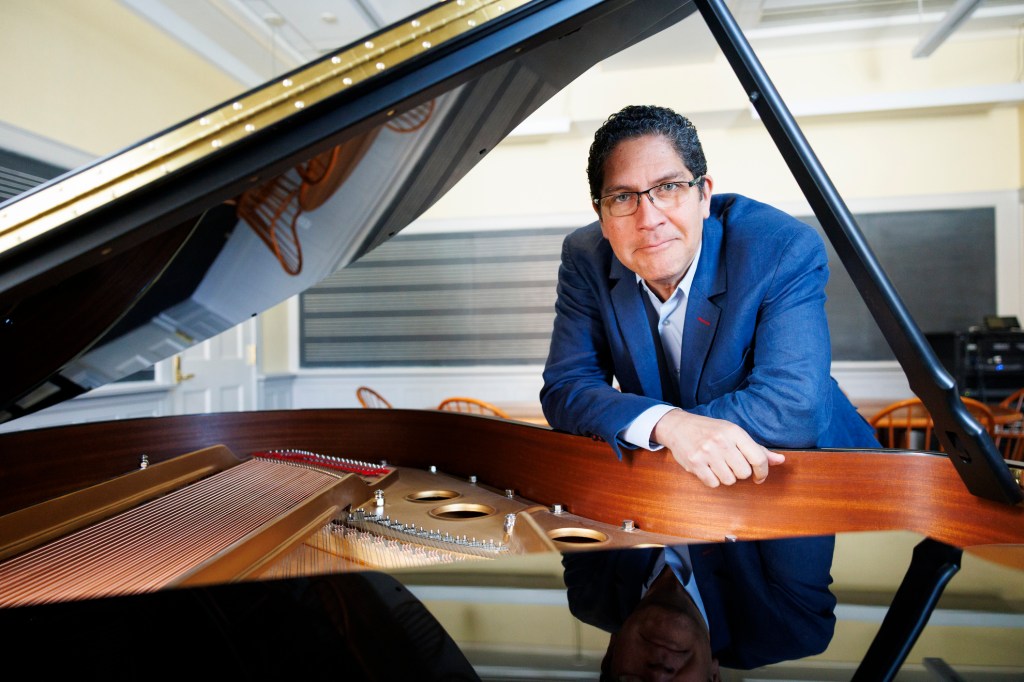
Alejandro L. Madrid.
Niles Singer/Harvard Staff Photographer
How did Bad Bunny evolve to become a global music star?
First, he comes up in the context of the rise of Latin music in the United States, which is connected to processes of migration and the development of a Latin music industry in Los Angeles and Miami in the 1990s. Between that decade and the 2000s, Shakira and Ricky Martin, who were big stars in Latin America with songs in Spanish, made the crossover into the American market singing in English. And in 2017, the song “Despacito” by Luis Fonsi with reggaeton star Daddy Yankee, and later with a remix featuring Justin Bieber, became the most streamed song of the year, not only in the U.S. but around the world. That’s the moment when Latin music became global, and Bad Bunny, who had released his first song in 2016, happened to be there at the right time. He was very savvy and started collaborations with Cardi B, J Balvin, Karol G, Drake, Rosalía, and other popular artists, as he was articulating different audiences and creating his own. By 2020, he was a star and was invited as a guest performer at the Super Bowl that was co-headlined by Jennifer Lopez and Shakira. What’s significant about his ascension to the global music stage is that he has achieved that in Spanish, and that is a remarkable feat.
“What’s significant about his ascension to the global music stage is that he has achieved that in Spanish, and that is a remarkable feat.”
Alejandro L. Madrid
How do you explain his global success given the fact that he only sings in Spanish?
Singing in Spanish would seem counterintuitive to become a global music star, right? How do we explain that? One of the main features of the neoliberal music market is that it thrives on difference. Take for example the very idea of world music. The industry is always on the lookout for the next exotic “other,” and Bad Bunny, the hypersexualized trap artist, was just that. It’s striking that he insists on singing in Spanish and using Puerto Rican slang that many people in Latin America don’t know, and it’s even more remarkable that fans all over the world embrace his music. I think the fact that he sings in Spanish also has to do with the larger context of Puerto Rican history. Some of the songs in his latest album dwell on the history of Puerto Rico as a U.S. colony, and he’s doing us a service because that history has been rendered invisible in the United States. There are still lots of people in this country that don’t know that Puerto Rico is part of the United States and that Puerto Ricans are U.S. citizens even though they speak Spanish.
There was some controversy over his selection as the Super Bowl halftime show performer precisely because he’s a Latin music star who sings in Spanish.
Yes, there was, but let’s not forget that Jennifer Lopez and Shakira performed at the Super Bowl halftime show in 2020, and there was the same backlash from mainstream America. People were saying, “How could Spanish-speaking people be the main performers in the quintessential American event?” Bad Bunny’s is one of the world’s biggest superstars, and what this selection shows is that the NFL recognizes the market opportunities in the U.S. Hispanic audience.
What’s your take on Bad Bunny’s latest album?
This album has changed the minds of many people about Bad Bunny, including me. When I first heard about him in 2017, I saw Bad Bunny as a good artist in the world of Spanish trap, but to me, he was just another reggaeton singer. In the last few years, I’ve been listening to more Bad Bunny because of my daughter, who is 11 years old and likes his music. I’ve seen Bad Bunny evolve musically over the last decade. He has matured musically, and with this last album, he has gone back to his roots. This album is a very Puerto Rican album; it sounds completely different from his previous ones. He’s connecting reggaeton and trap to Puerto Rican traditional musical genres such as plena, bomba, and salsa. Before this album, people would say that he couldn’t sing and lacked musical talents, but he’s proving everyone wrong. He shows he is a good musician; he sings, he raps, and he’s accompanied by Puerto Rican musicians who are icons, respected by both critics and fans, on the island. The album is a homage to Puerto Rico, and its culture and history. It’s also politically charged because some songs touch on issues of colonialism and gentrification, but it is mostly a celebration of Puerto Rican music and culture.
Will Bad Bunny have a musical legacy, or will his music be a fad?
I’m teaching a class on the musical traditions among the different Latino communities in the United States, and we’re listening to Bad Bunny and Rubén Blades, Ricky Martin, Selena, Celia Cruz, and Shakira, among many other artists. Bad Bunny is putting Puerto Rican music and culture on the global stage, something that others haven’t been able to do. In that sense, if he continues in that direction, keeping Spanish and Puerto Rican culture at the center of his musical career, there’s a chance that his musical legacy would last longer than those of others.