Featured series


Campus & Community
‘Talent can be a great hindrance … It’s really about endurance’
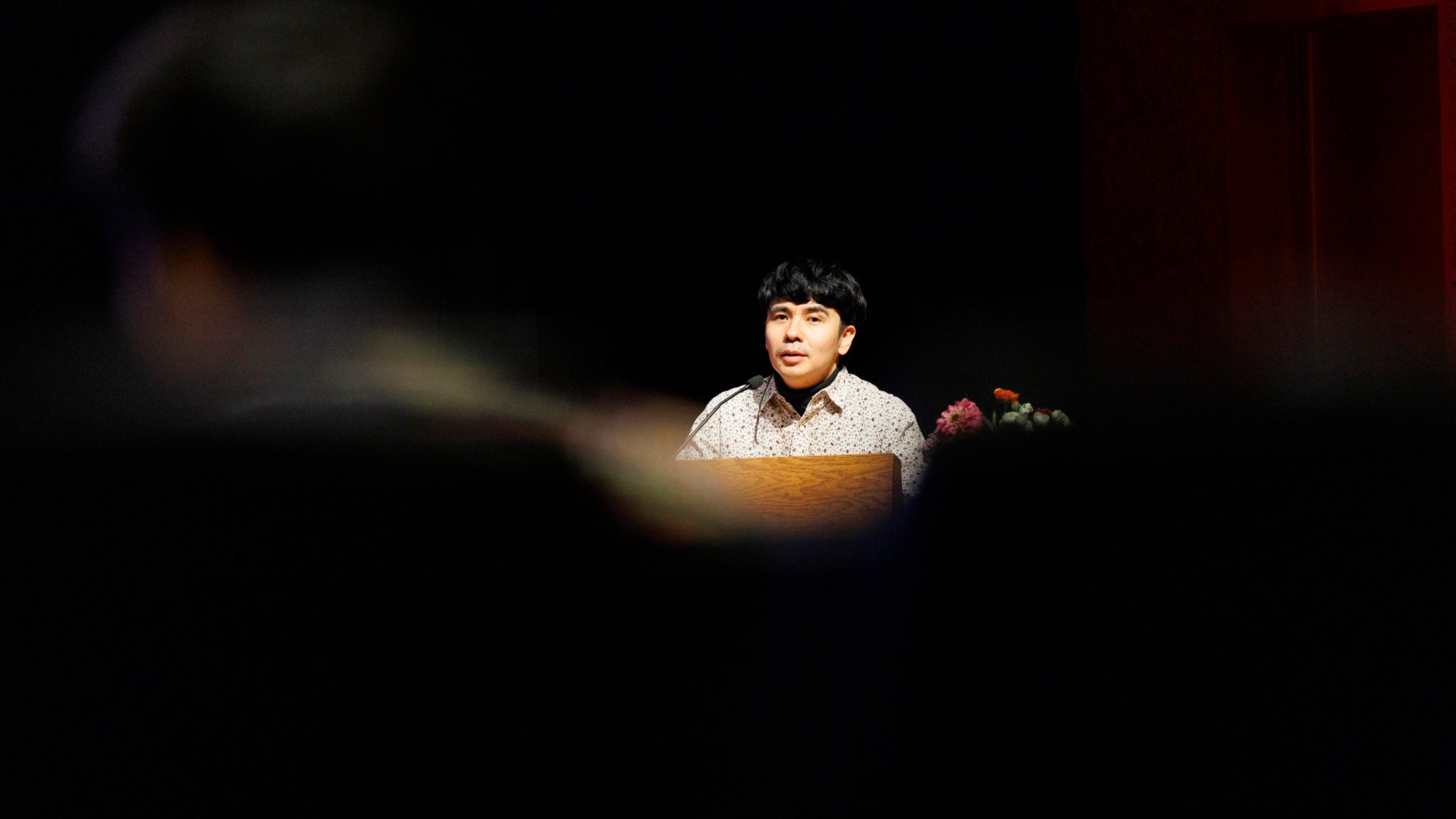
Ocean Vuong.
Photos by Stephanie Mitchell/Harvard Staff Photographer
MacArthur-winning poet, novelist Ocean Vuong offers advice to young writers at Eliot Memorial Reading
Many young writers think the first step is finding a voice.
Ocean Vuong shakes his head at this. Spending time searching for a distinctive style could limit your growth as an author, he says. Better to focus on developing and shaping it along the way.
“It makes sense that in our culture of gain and scarcity that [finding a voice] should be a hunt or search or possession, but I don’t think that’s true,” said Vuong, an award-winning poet, novelist, and the featured speaker at the recent annual Eliot Memorial Reading. “I don’t think one finds a voice … I think one develops it throughout one’s life … I’m still discovering mine.”
“I don’t think one finds a voice … I think one develops it throughout one’s life … I’m still discovering mine.”
Ocean Vuong
“We all have a thumbprint; it’s idiosyncratic to us,” he said at the event presented by the Woodberry Poetry Room and funded by the T.S. Eliot Foundation. “Language syntax, how you arrange your words; that’s the thumbprint of an inner life, and that could be replicated, shifted and grown inexhaustibly.”
The author of several poetry collections, Vuong wrote “On Earth We’re Briefly Gorgeous,” a New York Times best-selling book that has sold more than a million copies and has been translated to 40 languages since its publication in 2019.
A recipient of a MacArthur “Genius Grant,” Vuong was born in Vietnam and immigrated to the U.S. at age 2 as a refugee with his mother and other relatives. He grew up in Hartford, Connecticut, and teaches modern poetry and poetics in the M.F.A. program at NYU.
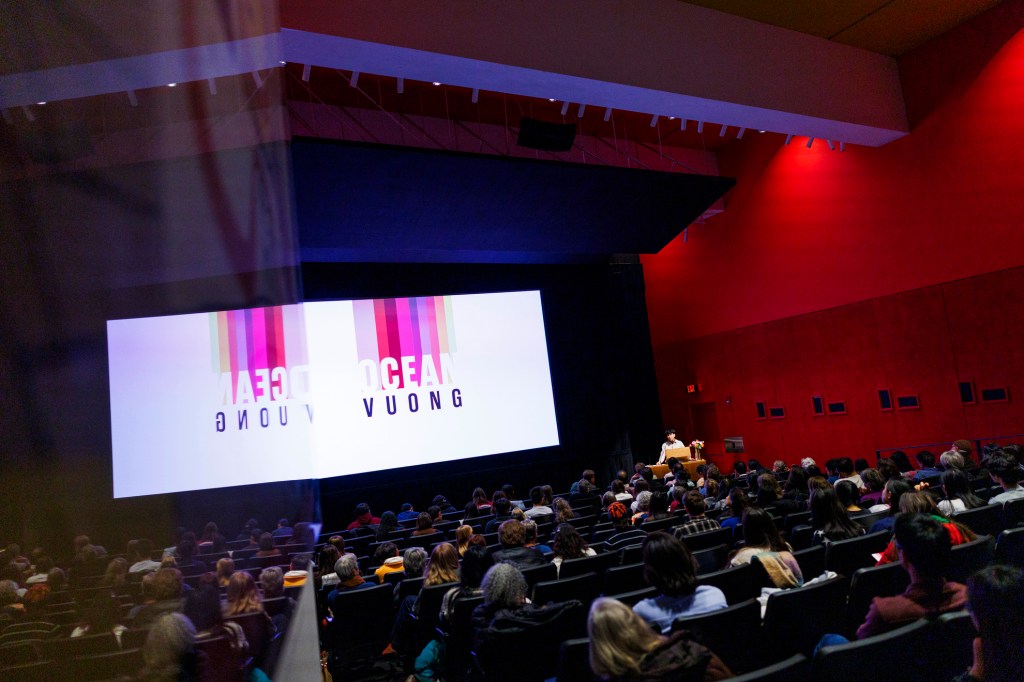
The event was dedicated to the poet, novelist, and activist Fanny Howe, who was to be this year’s speaker but fell ill and died in July. Christina Davis, Curator of Poetry of the Woodberry Poetry Room, reached out to Vuong, who agreed to fill in. Davis noted that six years ago Howe had replaced Vuong, who had to cancel because of his mother’s failing health.
“Could it be, I wonder, that this reading might be a chance for the kindness she [Howe] once bestowed on Ocean to experience a form of eternal return?” Davis told the audience. “It seemed so unlikely, given Ocean’s notoriously packed schedule … but all I had to do was speak three words: For Fanny Howe …”
After paying tribute to Howe, Vuong read several new poems of his own, among them one about his 12-year-old dog named Tofu, another about President Abraham Lincoln, and an ode to the last dinosaur.
In a Q&A period, Vuong shared pieces of advice to aspiring writers. He told them to work seriously on their craft because perseverance is more important than talent.
“Talent is real, but a lot of times, talent can be a great hindrance,” said Vuong. “It’s not a marker of a successful writer. It’s really about endurance … Because everything outside of your desk, outside of your home, conspires to destroy you.”
“It’s not a marker of a successful writer. It’s really about endurance … Because everything outside of your desk, outside of your home, conspires to destroy you.”
Ocean Vuong
Asked if he writes out of anger and how he manages to remain hopeful, Vuong said his Buddhist practice helps him manage his emotions and focus on writing not out of anger, but out of care, which he describes as the “afterlife of anger.”
Hope is a guiding principle in his work and life, he said.
“I’m angry often, but I’ve never written out of anger,” said Vuong. “Anger is not useful for me because I destroy myself as I use it. It’s a radioactive energy for me; it wounds as it’s being wielded, and it’s only a matter of time before it sputters out … To me, the most productive work comes out of care and then compassion.”