Featured series

Campus & Community
Michael McElroy, pioneering atmospheric scientist, dies at 86
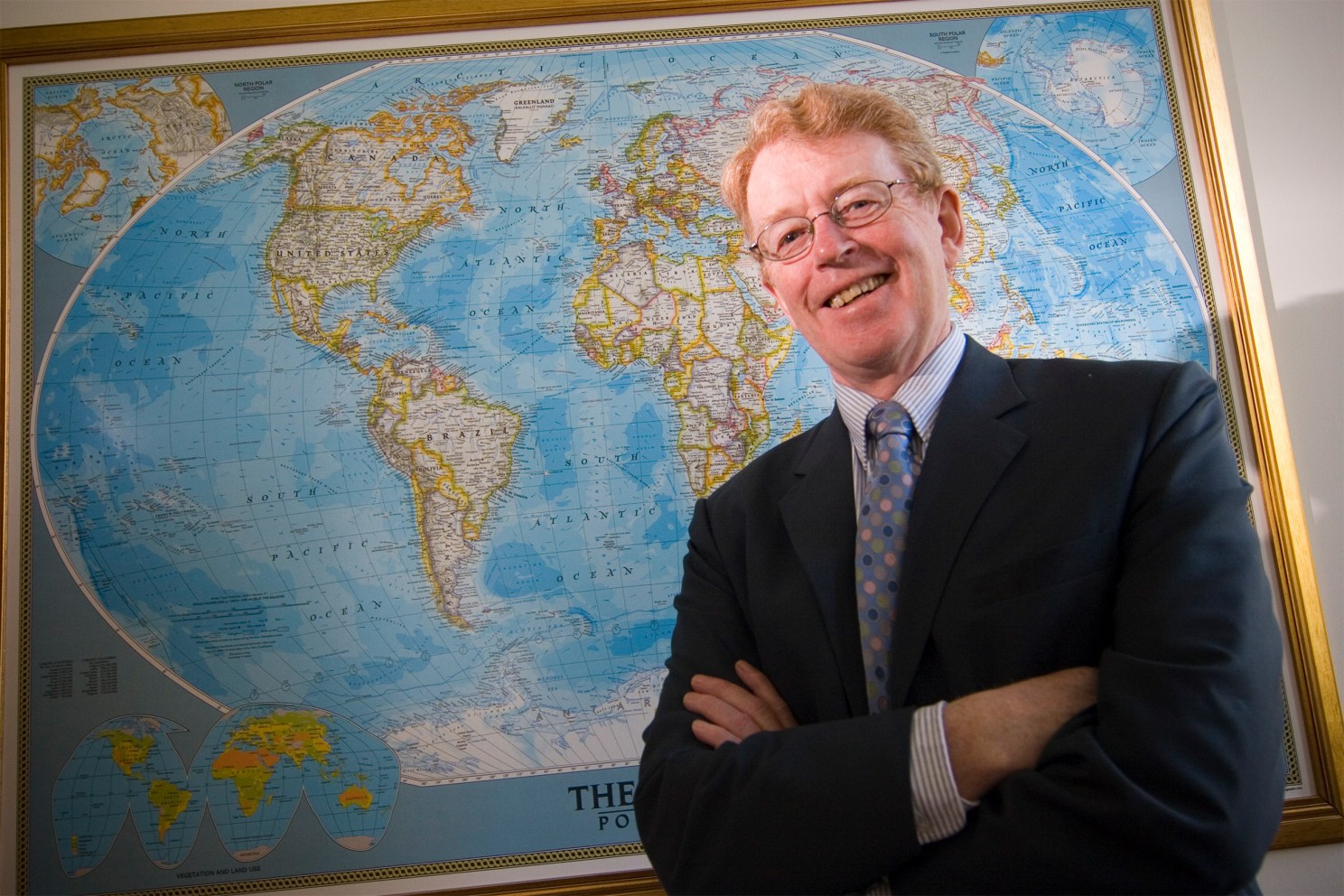
Michael McElroy.
Harvard file photo
Helped build foundation of climate and environmental studies at Harvard
Michael B. McElroy, the Gilbert Butler Professor of Environmental Studies in the Harvard John A. Paulson School of Engineering and Applied Sciences (SEAS) and chair of the Harvard-China Project on Energy, Economy, and Environment, died on Jan. 8 at the age of 86.
McElroy was a towering intellectual whose pioneering research shaped how we understand the atmospheric chemistry of more than half the planets in our solar system, including Earth. His groundbreaking work on human-induced stratospheric ozone depletion and climate change shaped the direction of international environmental agreements, notably the Montreal Protocol, and played a vital role in protecting our planet from harmful ultraviolet radiation. Later in his career, McElroy expanded his focus to energy science and decarbonization in the U.S. and countries such as China and India, where his work has influenced energy and climate policy.
At Harvard, McElroy was a driving force behind the University’s commitment to environmental and climate science. At a time when other universities were shuttering geology and Earth science departments, McElroy championed the creation of the Department of Earth and Planetary Sciences and became its founding chair in 1986. He helped establish the Environmental Science and Public Policy concentration in 1993; chaired the first University-wide Committee on the Environment; founded the Harvard-China Project on Energy, Economy, and Environment; and became the first faculty director of the Harvard University Center for the Environment (HUCE).
McElroy was known for his broad intellectual curiosity, his commitment to collaboration, his dedication to teaching and mentorship, and his serious and tireless drive to find solutions for the hardest problems facing our planet today.
“When I look back on my career, of course I am proud of the research, teaching, and the opportunity I’ve had to shape young minds,” McElroy said when he was awarded the William Bowie Medal from American Geophysical Union in 2024. “What also stands out are the collaborations I’ve had with colleagues across Harvard, China, and the world, and the enduring connections and friendships I’ve built. Ultimately, we are all in this fight against climate change together.”
An active catalyst
McElroy was born in County Cavan, Ireland, on May 18, 1939, and grew up in Belfast. He earned his Ph.D. in applied mathematics from Queens University in Belfast when he was just 23 years old. At Queens, McElroy studied under Alex Dalgarno, the renowned theoretical atomic and molecular astrophysicist (who would go on to become the chair of the Department of Astronomy at Harvard).
As NASA began launching satellites and interplanetary probes to observe the physics and chemistry of planets in our solar system, a new field of planetary science began to take form — with McElroy at the forefront.
In work that began at Queens and continued at the Kitt Peak National Observatory in Tucson, Arizona, McElroy developed a general theory to describe features of the upper atmospheres of Earth, Venus, Mars, and Mercury and demonstrated how reactions between carbon monoxide and oxygen are catalyzed in unexpected ways, preventing oxygen from accumulating in the atmosphere of Venus.
That early work earned McElroy the 1968 James B. Macelwane Medal from the American Geophysical Union (AGU), the highest honor for early career scientists in Earth and planetary sciences. It also caught the attention of faculty at Harvard, who were searching to fill the Abbott Lawrence Rotch Chair of Atmospheric Science. McElroy emerged as the frontrunner, with colleagues praising his work ethic, intellect, and catalytic potential. McElroy joined Harvard in 1970 at the age of 31, making him among the youngest tenured faculty at the University.
For the next 50 years, McElroy would, indeed, act as a catalytic figure at the University and beyond.
Global impact
In the 1970s, McElroy turned his focus to Earth’s atmosphere and became a leading voice on the threat certain human‑made chemicals posed to the stability of the ozone layer.
McElroy and his collaborators, including Steve Wofsy, the Abbott Lawrence Rotch Professor of Atmospheric and Environmental Science at SEAS, demonstrated how bromine and nitrous oxide played an important role in ozone depletion and found that even small amounts of halogens, such as chlorine, could lead to large losses of ozone. Their work described how the combination of bromine and chlorine worked together to speed up ozone loss, explaining how the Antarctic ozone hole got so big, so fast.
Their research led to a deeper understanding of ozone loss and helped inform the policies enacted by the Montreal Protocol, the landmark international treaty which phased out the production of ozone-depleting chemicals.
Over time, McElroy’s interests broadened. In 1993, he founded the Harvard-China Project to bring together the best minds from Harvard and China to understand and address challenges bridging climate, air quality, energy systems, economics, and policy.
Chris Nielsen, the executive director of the Harvard-China Project, recalled McElroy, in his late-60s, pouring over textbooks to teach himself the fundamentals of energy sciences.
“One of Mike’s remarkable features was his sheer intellectual curiosity, across the sciences but also well beyond them, to how the changing physical world intersects with societies, economies, and people living their lives,” said Nielsen.
That curiosity propelled the deeply collaborative and interdisciplinary ethos of the Harvard-China Project.
“Our goal was always collaboration,” said Nielsen. “We wanted to build a program that was collaborative in two respects — collaborative between Harvard and China and between different disciplines. It was never about studying problems from afar. It was about bringing people together to puzzle out complex challenges and innovative solutions to have an impact.”
In its more than 30 years, the Harvard-China Project has brought hundreds of students, postdoctoral fellows, and visiting scholars to Harvard to collaborate with students and researchers in climate and environmental sciences, engineering, public health, economics, urban planning and architecture, policy, and more. Its affiliated scholars have published hundreds of papers, most recently exploring everything from using municipal solid waste to produce jet fuel to balancing renewable power variation with flexible demands of electrified transportation and industry sectors. In recent years, the project increased its research in other countries, especially India, which was the focus of McElroy’s last co-authored book, published in 2025.
Nearly six decades after being awarded the Macelwane Medal for early career scientists, McElroy was awarded the AGU’s highest honor, the Bowie Medal. He is one of only a few scientists to win both.
“It is a testament to his sustained career and sustained passion that after 60 years, he arrived at the other peak of the mountain,” said Yuk L. Yung, professor of planetary science at California Institute of Technology and Jet Propulsion Laboratory senior research scientist, who was McElroy’s second Ph.D. student at Harvard.
In his commendation, James Hansen, of the Earth Institute at Columbia University, wrote of McElroy’s “unwavering commitment to fostering collaboration and cooperation.”
“Michael McElroy is a rare combination of scientist, scholar, educator, and visionary leader in science and its applications to human welfare and the natural world … As an inspirational educator, McElroy has guided and inspired countless young scientists by nurturing an inclusive and supportive environment that fosters collaboration, curiosity, and creativity. His inspirational leadership and far-reaching research contributions continue to guide both progress and policy in some of the most critical global challenges that we face today.”
McElroy is survived by his wife, Veronica; their two children, Brenda and Stephen; and grandchildren Zoe and Abigail.