How design of public housing can lift future prospects of children
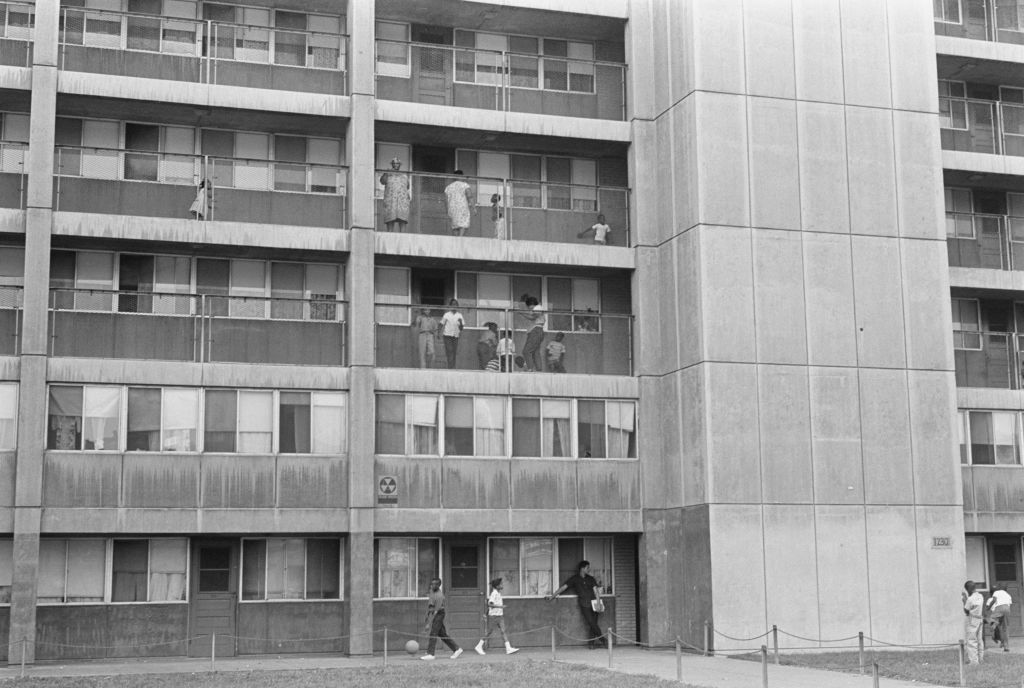
Cabrini-Green, a 70-acre low-income housing project in Chicago in 1966. The last of the buildings was torn down in 2011 and replaced with mixed-income townhouses and mid-rise apartment buildings.
Photo by Pix/Michael Ochs Archives/Getty Images
Christy DeSmith
Harvard Staff Writer
5 min read
New research builds upon previous work that focused on moving families from high-poverty areas, broadening social milieu of young
Public housing high-rises, common in the late 20th century, often siloed residents from surrounding communities.
“You had these big towers that were in the middle of large courtyards, spaced far away from other residents,” said Matthew Staiger, a research scientist with Harvard’s Opportunity Insights. “It was extremely obvious where the public housing started and ended.”
The HOPE VI project, launched in the 1990s by the U.S. Department of Housing and Urban Development (HUD), sought to replace these architectural islands with a mix of public and market-rate housing that fit more seamlessly with the urban grid.
According to new research, led by economists at Opportunities Insights, these changes had no effect on the income of adults in public housing. But the expanded social milieu offered children big returns in adulthood.
“We find that kids who moved into these revitalized units, and spent some portion of their childhoods there, ended up earning about 16 percent more,” explained Staiger, one of the paper’s seven co-authors. “We also see increases in college attendance as well as reduced incarceration rates for boys.”
The findings build upon more than a decade of big-data research connecting adult outcomes to childhood environment and social connections.
A landmark paper, published in 2016, documented the long-term impacts of HUD’s Moving to Opportunity program. Co-founded in the 1990s by Lawrence Katz, Elisabeth Allison Professor of Economics and Opportunity Insights research principal, the initiative helped more than 4,000 families relocate from high-poverty areas.
“A core finding from that earlier work is that a neighborhood’s influence is proportional to the amount of time spent there during childhood.”
Matthew Staiger
Katz’s early results showed few gains for enrolled parents. But the 2016 study, authored with Opportunity Insights co-founders Raj Chetty, William A. Ackman Professor of Economics, and Professor Nathaniel Hendren of MIT, found children saw higher rates of college attendance and increased earnings — especially if they moved to higher-opportunity neighborhoods before high school.
“A core finding from that earlier work is that a neighborhood’s influence is proportional to the amount of time spent there during childhood,” Staiger said.
But moving America’s millions of low-income families with school-age children would be impossible.
That inspired researchers to zoom in on HOPE VI, one of the largest neighborhood revitalization programs in U.S. history. The study represents Opportunities Insights’s first effort to investigate whether policy interventions can deliver economic mobility to the doorsteps of low-income households. Chetty and Katz are among the study’s co-authors, along with Rebecca Diamond, the Martin Feldstein Professor of Economics.
Between 1993 and 2010, HUD channeled more than $17 billion into replacing 262 large, highly distressed public-housing towers in dozens of American cities. Rising in their place were townhouses and mid-rise apartment buildings. The multidecade effort to reimagine Chicago’s notorious Cabrini-Green complex, for example, was infused with $50 million in HOPE VI financing.
The neighborhood-level successes of HOPE VI, which led to decreased crime and increased property values, have been well documented. But most prior research focused on the program’s major shortcoming. The original buildings were high-density, averaging 1,355 people per property. Far fewer residents secured units in the lower-density, mixed-income design of a HOPE VI development. According to one study, just 27.6 percent of displaced households returned upon project completion.
“I want to be clear that we’re not necessarily endorsing the program,” Staiger said. “Our focus was whether or not it’s possible to create higher-opportunity neighborhoods.”
Researchers tried to recreate the conditions of a randomized, controlled experiment by incorporating data on residents from 200 HOPE VI dwellings and 2,500 traditional public-housing sites. Decades of anonymized federal income tax returns were linked with HUD records on more than a million residents.
“We see a systematic pattern where each year a child spends in a HOPE VI project increases their income by almost 3 percent,” Staiger said. “What those estimates suggest is that if a child were to spend their entire childhood in one of these sites, that would increase their income at age 30 by about 50 percent.”
Prior Opportunities Insights research has identified peer interaction as a key driver of this kind of economic mobility. To understand how this played out with HOPE VI, the team examined 15 years of anonymized tax records on thousands of kids who grew up in market-rate units nearby.
Most of the program’s gains, the researchers found, flowed from HOPE VI developments situated in neighborhoods with a mix of income levels.
“We actually found no impact for HOPE VI projects that are located within broader areas of disadvantage,” Staiger said.
Also factored into the analysis were more direct measures of social interaction. Census data from 2010 and 2020 yielded information about patterns of cohabitation and marriage, with HOPE VI increasing the likelihood that kids in public housing would end up partnered with higher-income neighbors.
Data provided by Facebook didn’t point directly to public-housing residents. But researchers were able to match low-income students with their high schools. Results showed more connections with higher-income peers when the school was near a HOPE VI property.
The bottom line, Staiger said, is that “HOPE VI was a cost-effective way of increasing economic mobility.”
While the upfront government price tag was approximately $170,000 per unit, projections show an increase of $500,000 in future lifetime earnings for the children who grow up there. That means additional tax revenues have likely offset the original costs.
“A lot of low-income neighborhoods are located near more affluent areas,” noted Staiger, who hopes the results inspire fresh experimentation in policy circles. “We should be trying other interventions that foster this type of cross-class integration and ultimately expand economic opportunity.”

 Featured series