Featured series


Campus & Community
Gathering medieval French prayerbook, Kabuki in America, Sylvia Plath’s thoughts
Photos by Veasey Conway/Harvard Staff Photographer
New Houghton exhibits highlights breadth of new acquisitions — and of library’s collection
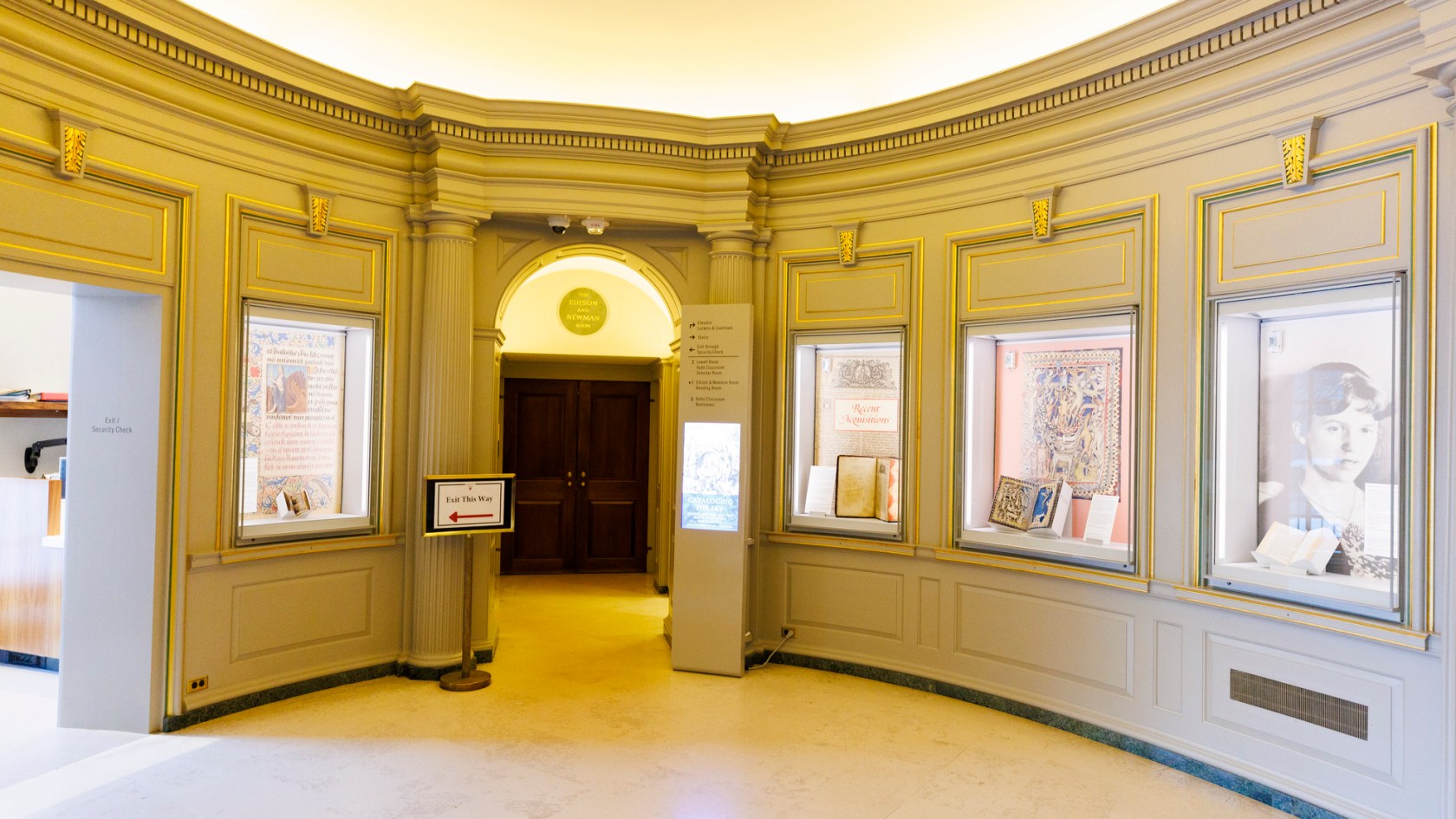
Harvard’s Houghton Library is home to more than half a million books, manuscripts, letters, photos and other ephemera spanning centuries and capturing swaths of human experience. And every year that collection grows even more vast.
To highlight some of those new acquisitions, Houghton’s curatorial staff have put together an exhibition in the library’s lobby featuring 10 of the items now in its collections.
“We acquire a huge amount of material in a given year,” said Matthew Wittmann, curator of the Harvard Theatre Collection at Houghton, who helped put the display together. “And so I think what’s really useful about these periodic exhibitions we do is that it gives visitors and students and faculty a concise way of understanding the broad range of materials we collect.”
The new acquisitions exhibit, on display through the end of April, includes a novel from Sylvia Plath’s bookshelf, religious texts, letters from Japanese internment camps, and more.
Ancient translation of the Bible and the Apocrypha from the Greek into Georgian
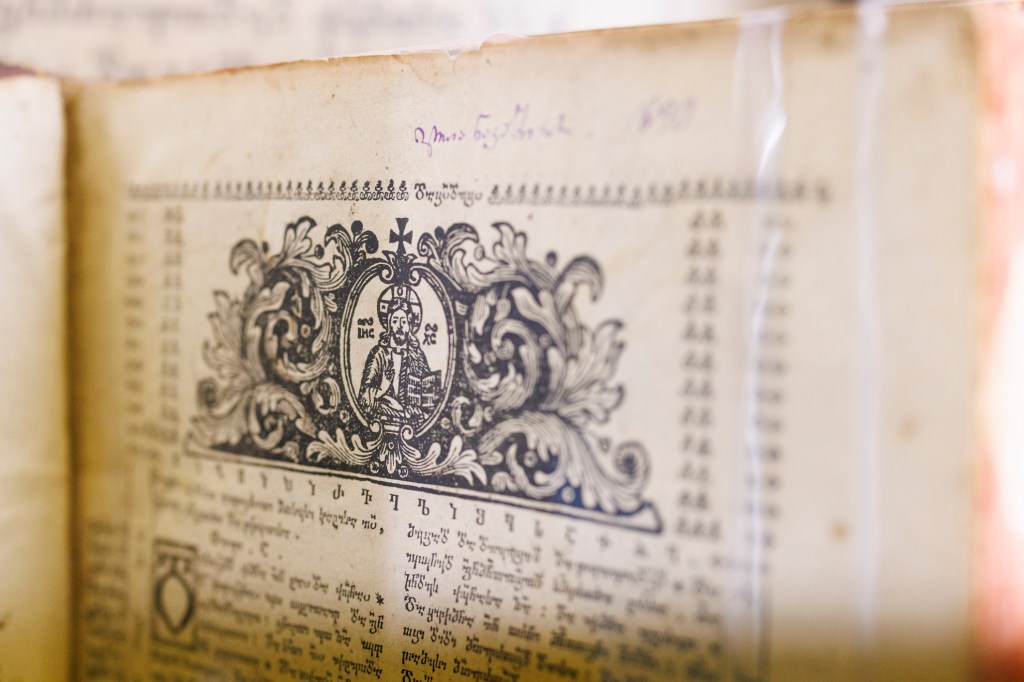
This is probably the rarest piece on display as part of the new acquisitions exhibit, according to curators.
The book was created as part of a program begun by Prince Bakar Batonishvili in the late 18th and early 19th centuries to promote the use of the language.
It is one of the few complete copies that survived Russia’s 19th-century annexation of part of the country and subsequent crackdown by Russian Orthodox religious authorities. Many of the Bibles were lost in an 1812 fire that destroyed Moscow during the Napoleonic invasion.
Curators note that this is not this Bible’s first time at a Harvard library. In 1920 it was placed on deposit by its then-owner, Professor Robert Pierpont Blake, and returned to his collection when he retired.
Sylvia Plath’s copy of Thomas Hardy’s “Far from the Madding Crowd”
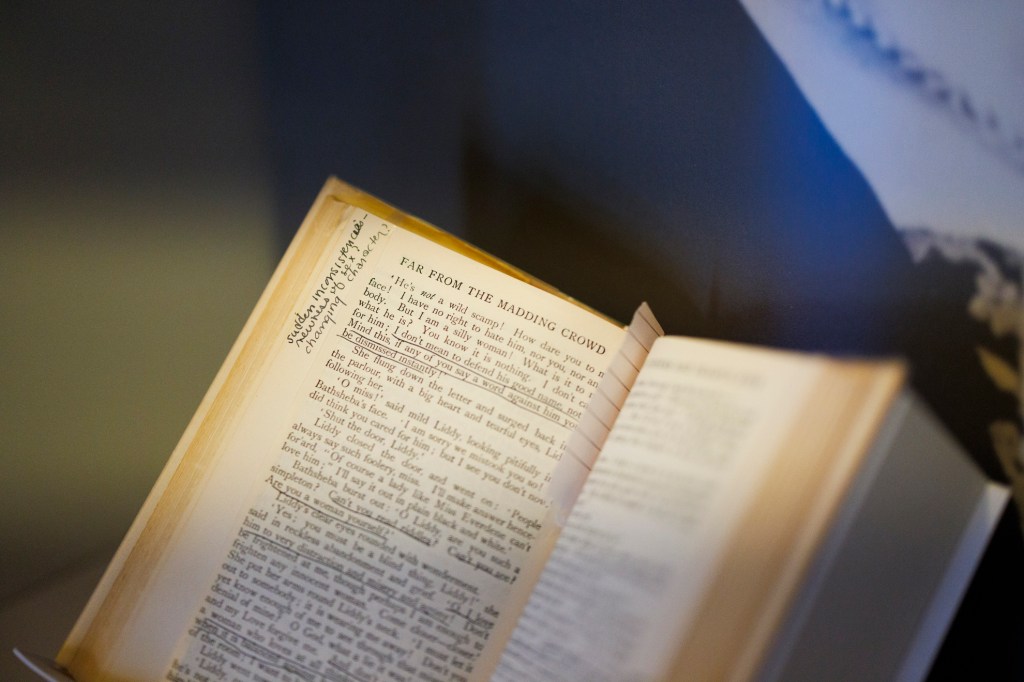
Sylvia Plath likely read this copy of “Far from the Madding Crowd” in 1957 or 1958 while she was teaching first-year English at her alma mater, Smith College. She didn’t assign the text to her students but was clearly impressed with it, writing in a July 1957 journal entry that she found Hardy to be a “moving, highly kindred mind.”
Plath underlined passages from more than half the pages of Hardy’s novel. One bit of marginalia reads: “Loving is misery for women always. I shall never forgive God for making me a woman and dearly am I beginning to pay for the honour of owning a pretty face.”
She also made this note: “Beginning to get glimpse of destiny” in the margin.
Plath, who suffered from depression, had a tumultuous marriage to the poet Ted Hughes and had two children. She committed suicide at the age of 30.
During her lifetime, she published only two books: “The Colossus,” a collection of poetry, and her best-selling semiautobiographical novel, “The Bell Jar.” Several more volumes were brought out posthumously, including the 1982 Pulitzer Prize-winning “The Collected Poems.”
Houghton Library has made several Plath acquisitions lately, including a rare first edition of “The Bell Jar” and her annotated reading list for sophomore English at Smith.
“El Indio”
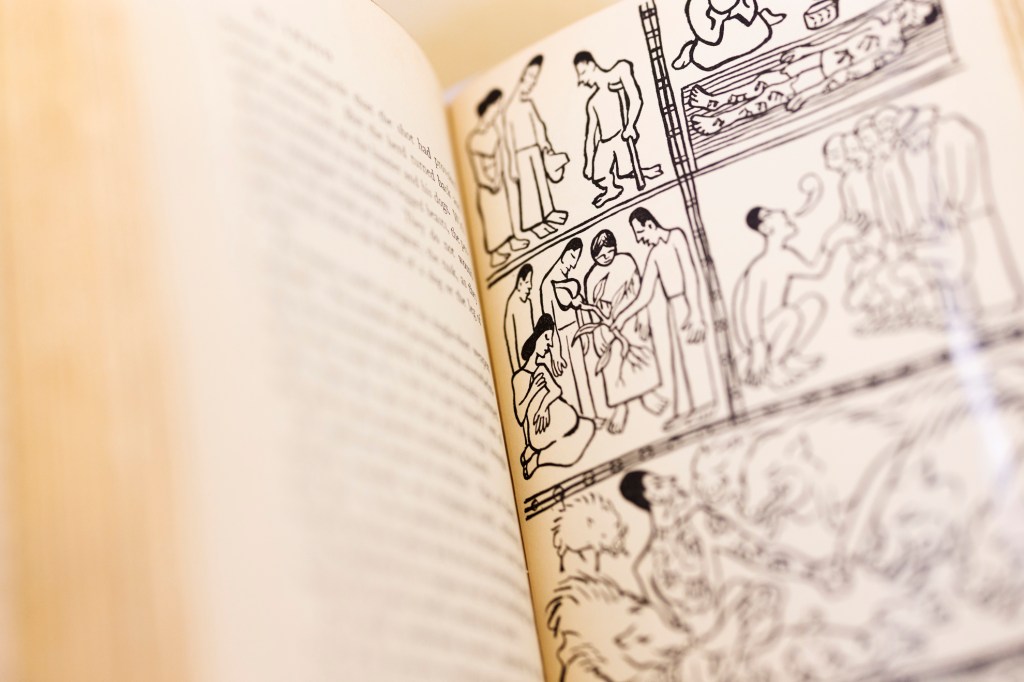
Diego Rivera is best known for his large-scale murals that helped shape the Mexican and international art scenes for more than three decades. But he also worked in commercial book illustration — an often-overlooked exploration of smaller-scale illustration.
Now in Houghton Library’s collection is an English translation of Mexican novelist Gregorio López y Fuentes’ “El Indio,” which features illustrations by Rivera.
“El Indio,” a critique ofcapitalist violence in early 20th-century Mexico, was the inaugural winner of the Premio Nacional de Literatura award in 1935.
Its story centers on a search for gold and the exploitation of Indigenous people, with Rivera’s illustrations depicting the violence and bravery of “El Indio’s” characters through simple bold linework.
Medieval French prayerbook
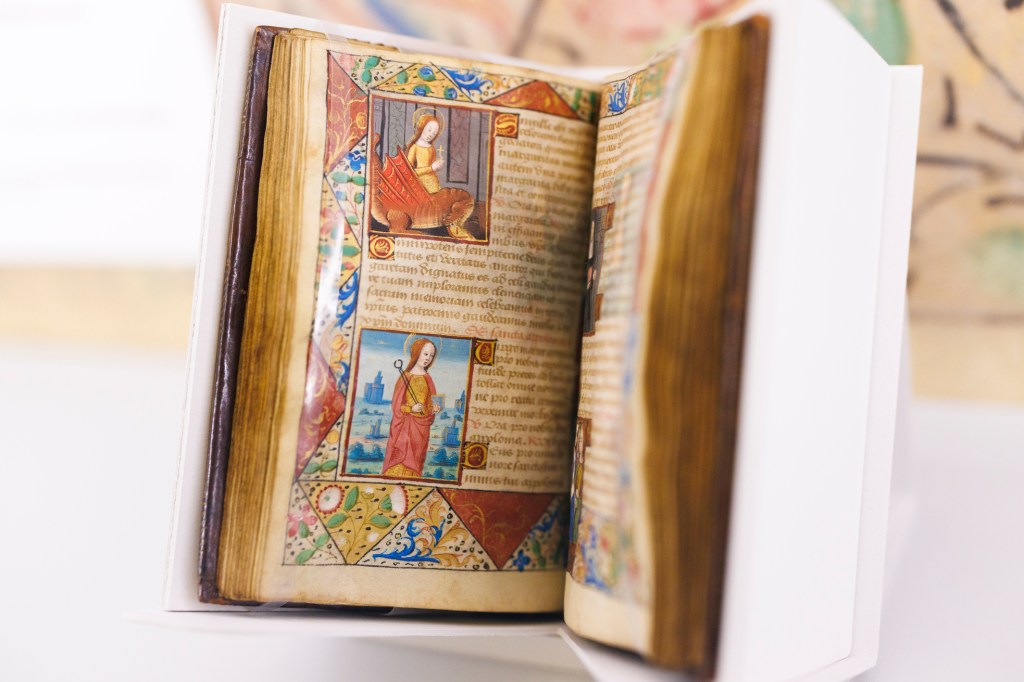
Created sometime between 1475 and 1500, this prayerbook serves as a snapshot of late medieval life for literate, middle-class women as well as a time capsule for a long line of French bourgeoisie.
The prayers explore recurring themes of pregnancy and motherhood, as it was likely made for Léonarde Bernachier, the wife of a notary from central France. Here is a passage:
“Fe(m)me grosse qui veult enfenter tienne la sur soy tantost e(n)fentera sans peril de son corps …” (“As soon as a pregnant woman who wants to give birth holds it [the prayer] on herself, she will give birth without danger to her body … ”)
The book, preserved as a family keepsake, records Bernachier family births and marriages through the end of the 18th century.
Devotional leaf featuring Saint Augustine with the eagle of Saint John and Saint Bridget
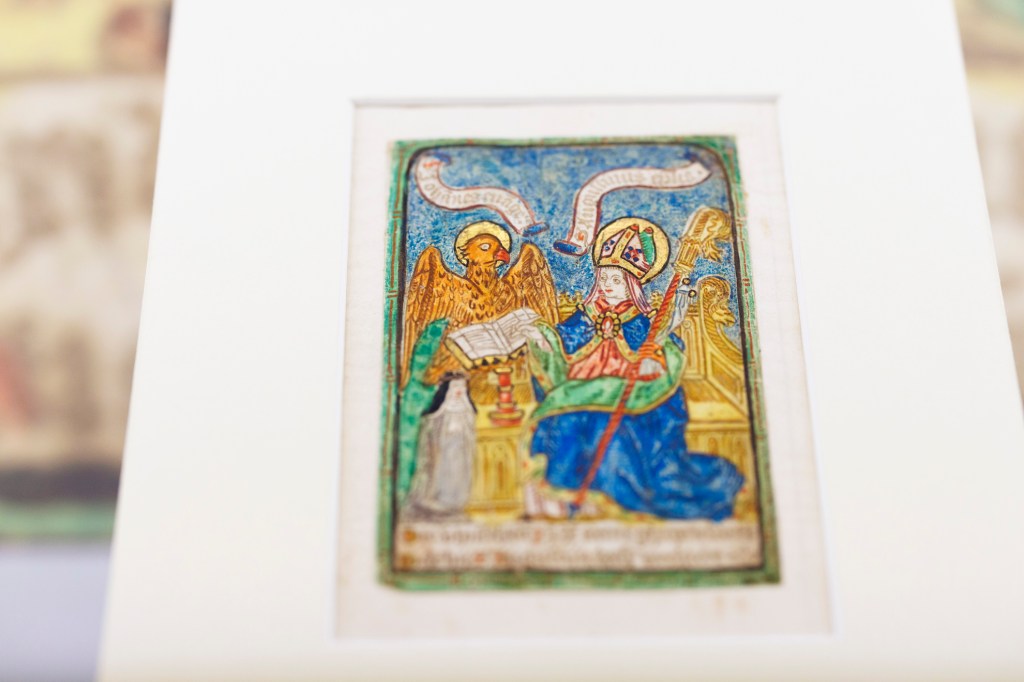
Devotional leaf featuring Saint Augustine with the Eagle of Saint John and Saint Bridget.
Veasey Conway/Harvard Staff Photographer
Devotional illustrations like this were commonly sold to pilgrims visiting holy sites during the incunable period (1450–1500) as a way to generate income for religious communities.
According to Kelly Bullard, assistant curator of printing and graphic arts at Houghton, “The presence of this feminine saint likely points to the leaf’s place of production: a women’s religious house, where manuscript and early print production commingled to create printed, hand-colored, and illuminated religious souvenirs.”
The accompanying legend reads: “Die verholentheiden zyn den arent ghoopenbaert wele hy St. Augustin heeft verclaert,” (“The hidden things are the hope of the eagle which St. Augustine has declared.”) The banderoles (ribbon scrolls) read: “S. Johan(n)es eva(n)ge(lista)” and “S. Augustinius ep(iscop)us.”
‘Haute Volée’
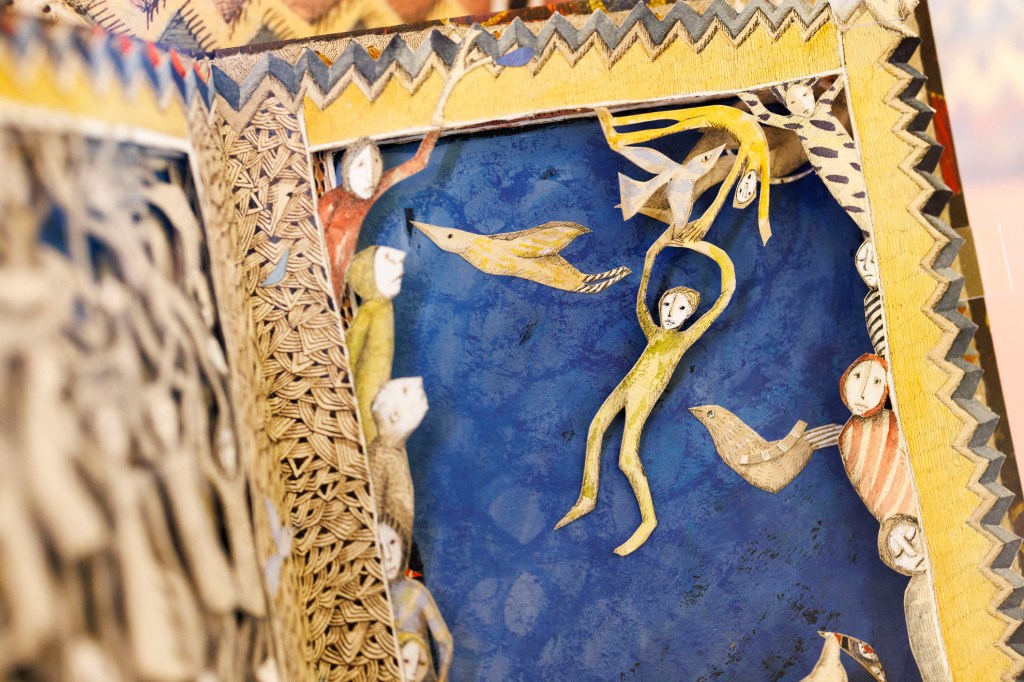
Diane de Bournazel is a painter, printmaker, and book illustrator from France who uses drawing, painting, paper cutting, and collage to create what she calls “poetry without words.”
Houghton recently acquired a copy of her 2022 artist’s book “Haute Volée” — which translates roughly into “High Flying” or “High Class.” The imagery includes distinctive human and nonhuman figures alongside folkloric patterns and bold color blocks.
Molly Schwartzburg, the Philip Hofer Curator of Printing and Graphic Arts, said she hopes viewers “find the messages they seek in its cryptic imagery.”
Memories of San Francisco’s Chinese theaters
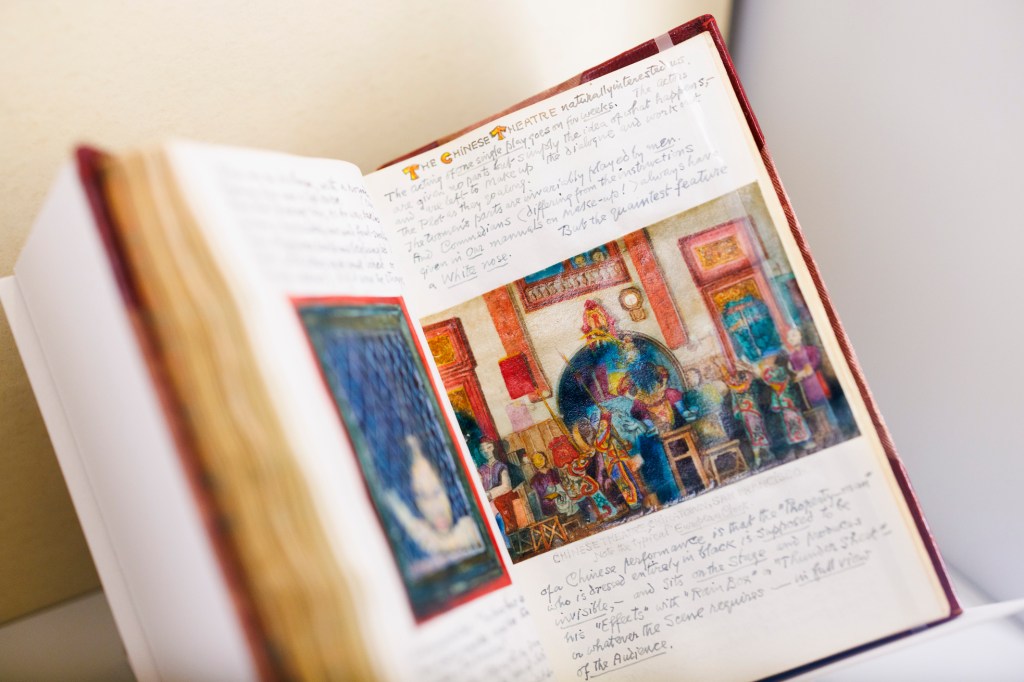
British actor Leonard Shepherd did three tours of the United States between 1904 and 1909, during which he kept two volumes of journals.
These journals included not only handwritten accounts but also striking photographs and vivid watercolor sketches, some of which provide valuable documentation of San Francisco’s Chinese theaters, which began to rise up in the 19th century.
Chinese theaters in San Francisco, home to the nation’s first Chinatown district, were enjoyed largely by the immigrant community, with Shepherd being the rare tourist to take part. His journals provide valuable historical insight into the operation of the theaters before their destruction in a 1906 earthquake and fire that razed much of the city.
Record of influential Kabuki actors and spring program at the Kabuki-za theatre in Meiji
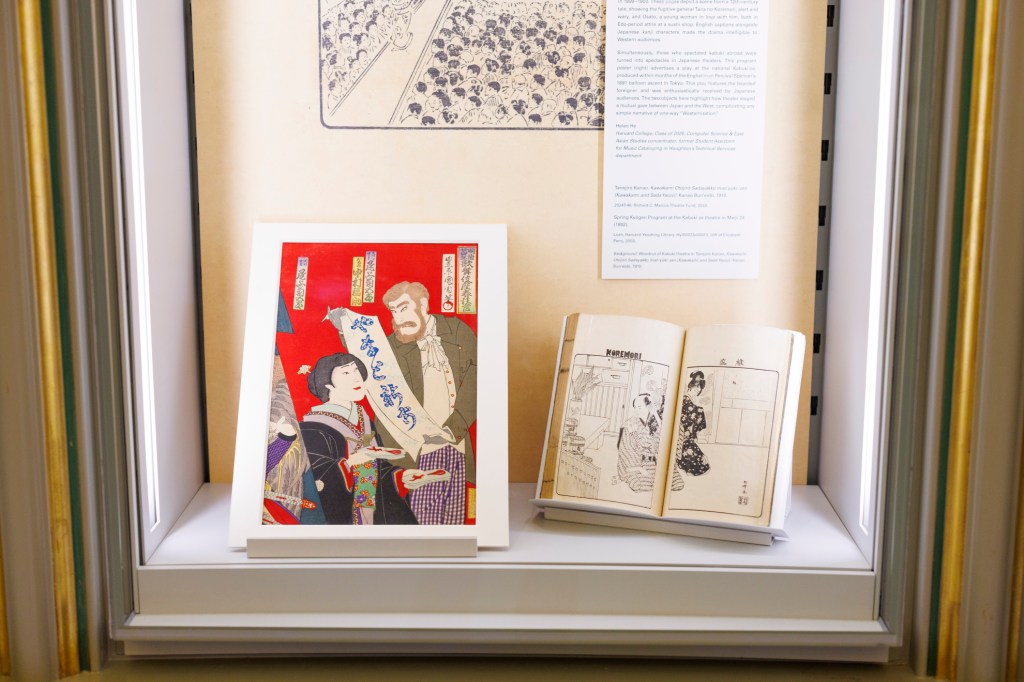
Among the new acquisitions are records of Kawakami Otojirō and Sadayakko’s first tour of the West from 1899 to 1900.
An illustrated version of Kawakami and Sadayakko’s performance includes English captions in an attempt to help Western audiences understand the highly stylized drama, which includes music but no dialogue.
Also on display is a program poster from Japan’s national Kabuki-za Theatre, on loan from Harvard-Yenching Library, promoting the theater’s spring 1892 show.
Princess White Deer chromolithograph poster
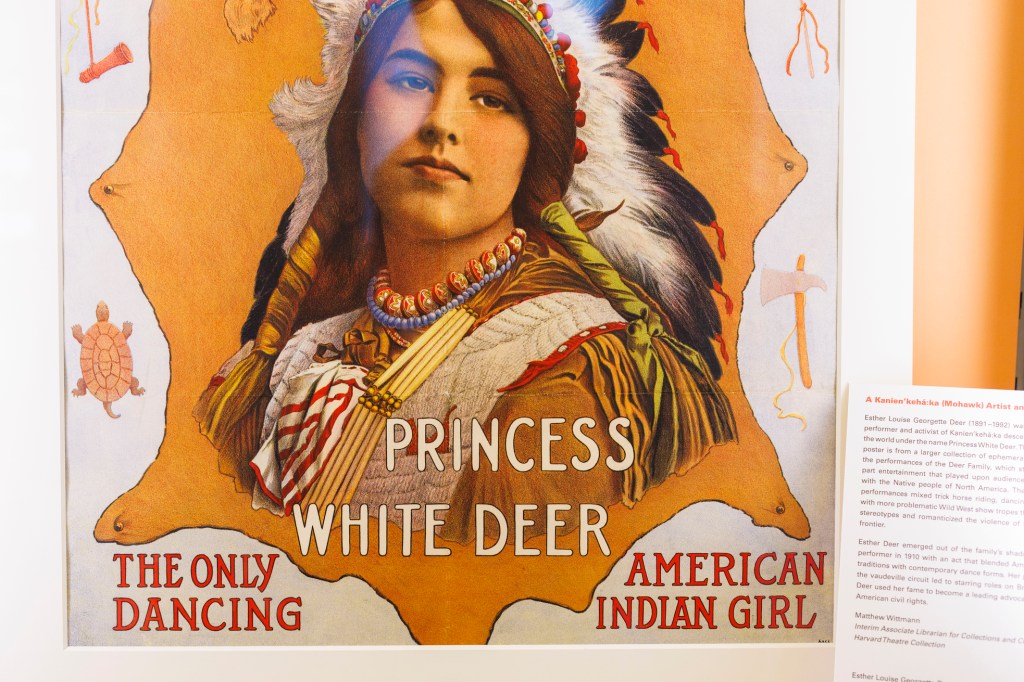
Known as Princess White Deer, Esther Louise Georgette Deer (1891–1992) was a performer and activist of Kanien’kehá:ka descent who rose to fame in popular 19th-century Wild West shows.
The poster on display in Houghton’s exhibit is part of a larger collection of ephemera documenting the performances of the Deer family, who became known for their shows that mixed trick horse riding, dancing, and songs with romanticized tableaux depicting Native people on the American frontier.
Esther Deer would go on to reject the aspects of the Deer family performances in her solo career — creating an act that blended Native American traditions with contemporary dance forms.
She would also go on to have starring roles in the Ziegfeld Follies and on Broadway, in turn using her cross-cultural fame to become a leading advocate for Native American civil rights.
Uenishi family wartime papers
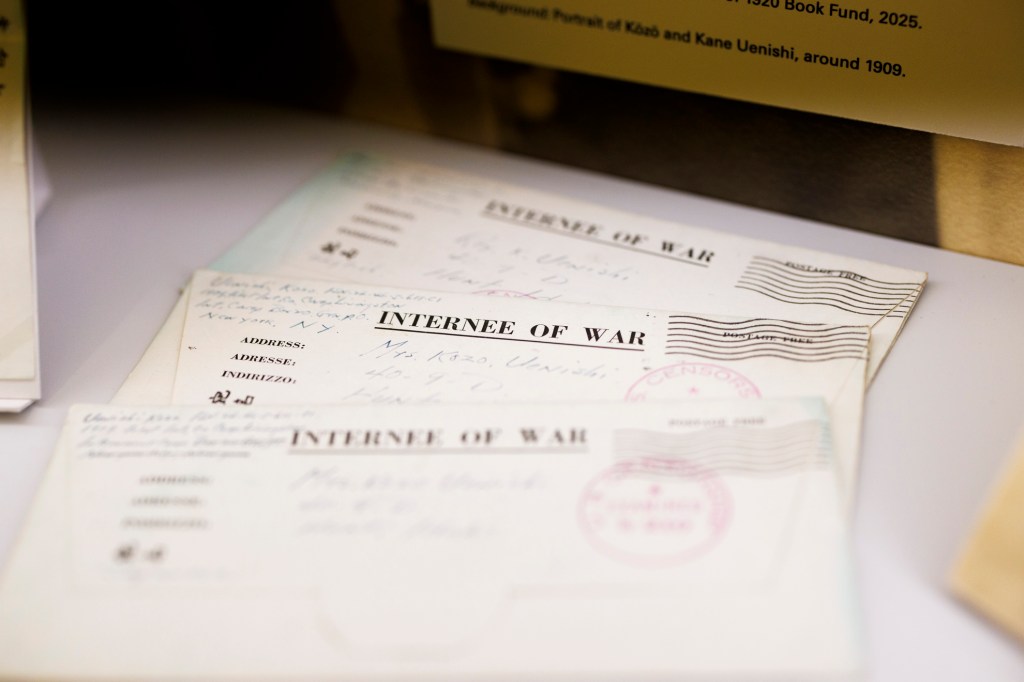
Mariagnes Aya Uenishi Medrud (1925-2016) was a Colorado schoolteacher and community leader who spent several years in U.S. concentration camps in Washington and Idaho.
Her papers help shed light on the experience of Japanese Americans during World War II, including that of Medrud’s mother, Kane, and sister Hope and brother Roy, who were imprisoned alongside her.
Houghton has also acquired letters written by Medrud’s father, Kōzo, a community leader who was arrested by the FBI as an enemy of the state and held in a series of prison camps separate from the rest of the family.
The acquisitions include four letters from Kōzo to his wife and another in English to Roy in which he “assures him all is well, not to worry and to continue to improve himself,” according to Mitch Nakaue, interim associate librarian for scholarly and public programs.
Medrud and her parents successfully reunited after petitioning the government for two years to release them. She became an outspoken antiwar activist later in life.