Featured series

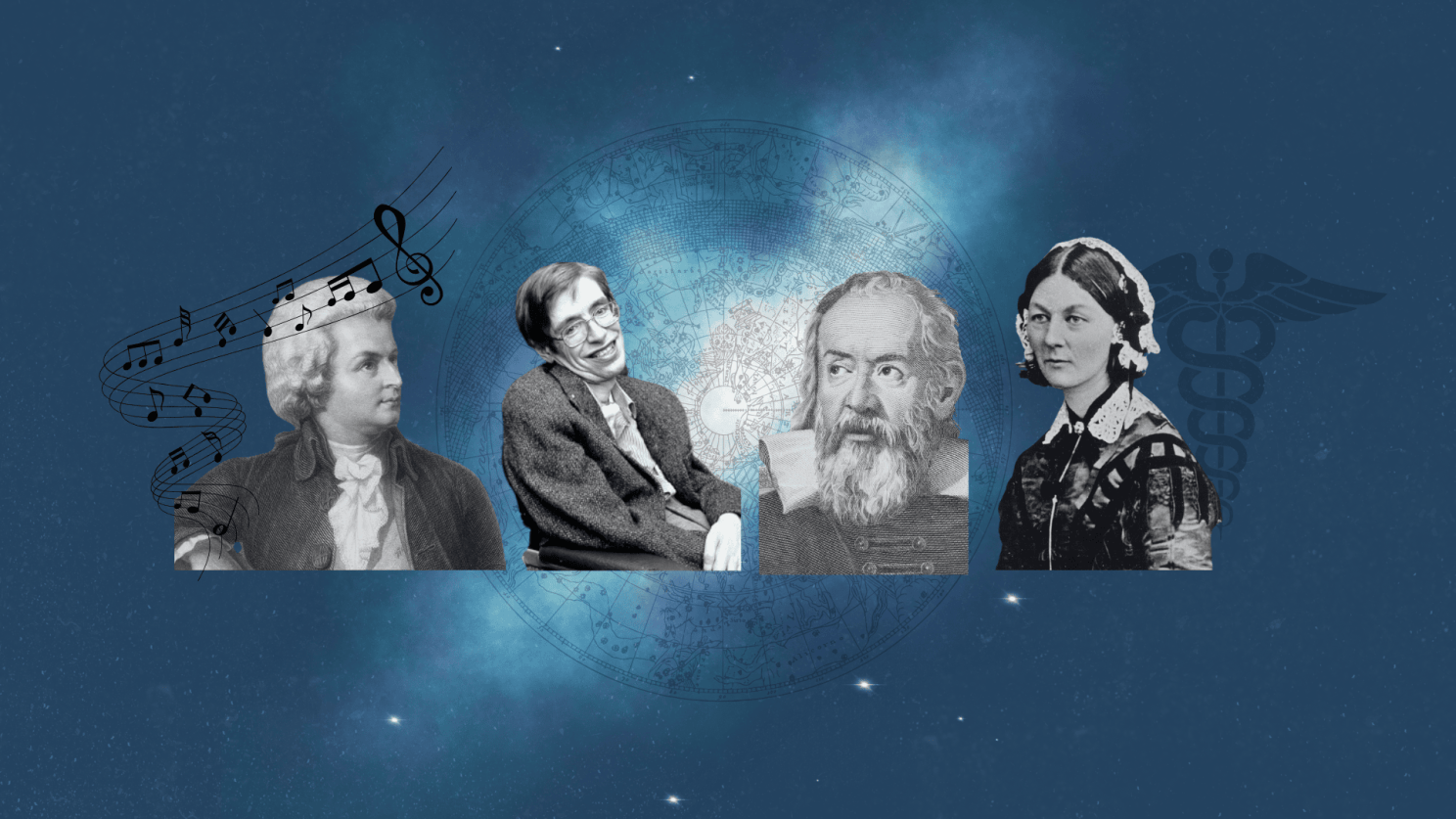
Illustration by Liz Zonarich/Harvard Staff
Arts & Culture
Dramatizing genius
Pop culture portrayals tend to favor the lone mastermind. These faculty faves are more realistic.
To be a genius requires extraordinary intellect and talent, but also hard work and persistence. And although the mythology of genius can be problematic because it reduces the collective work that goes into developing scientific breakthroughs to extraordinary individual accomplishments, portrayals of genius in film and literature succeed in dazzling popular audiences. The Gazette asked faculty — including two historians of science, a physicist, and a professor of medicine — to share their favorite portrayals of brilliance and breakthroughs in film and literature. The interviews have been edited for length and clarity.

Gabriela Soto Laveaga.
Harvard file photo
‘Science is not about a lone genius but rather about collaboration’
Gabriela Soto Laveaga
Professor of the History of Science, Antonio Madero Professor for the Study of Mexico
I would highlight “The Edge of All We Know” (2020) produced by our own Professor Peter Galison, my colleague and a genuine genius himself.
The film documents the quest to take a picture of a black hole, something that had never been done before. In order to achieve this, across the globe groups of physicists worked with computer scientists and others to attempt to image the unknown and — until then — invisible. Featured prominently is physicist Stephen Hawking, and though he may be the most well-known scientist at the time, it is clear that science is not about a lone genius but rather about collaboration among scientists both junior and senior, and of all genders, nationalities, and ages. It is an extraordinary film about the thrill of discovery, about the beauty of how to do science, and the excitement of creating new ways of thinking. Though it is about what was needed to better understand the universe — observatories, satellites, computers, and hundreds of people on every continent, to name just a few — at its core it is an ode to the joy of producing knowledge and humans’ ability to communicate and pursue truth.

Howard Georgi with Bandit.
Harvard file photo
‘Most of the geniuses I know would not be such interesting subjects’
Howard Georgi
Mallinckrodt Professor of Physics, Emeritus
My favorite by far is Mozart in “Amadeus.” I like it because there is at least an attempt to show his genius — but also because it is such a clear example of the genre. A musical genius is a familiar notion, and most people have some idea of what this means (though not always the same because it is different for performers and composers). My favorite scene is Mozart picking apart and improving one of Salieri’s pieces and I think most viewers will have some sense of what this means.
What makes it interesting is not his genius but the flawed and very unusual human being in whom the genius resides. Theoretical physicists Richard Feynman and Stephen Hawking show up in similar (though I think less successful) portrayals. Most viewers will have absolutely no idea what scientific genius means, and the portrayals usually focus on other things (like Hawking’s medical issues).
Most of the geniuses I know would not be such interesting subjects. The obvious example is Edward Witten, who is arguably the greatest living theoretical physicist. Ed doesn’t play bongo drums or have a debilitating disease. In fact, he seems like a pretty normal guy until he starts talking about string theory and mathematics and making connections that seem magical even to other outstanding physicists. The point is that to understand how extraordinary his thinking is, you have to be outstanding yourself — like Salieri to his Mozart.
Hannah Marcus.
Stephanie Mitchell/Harvard Staff Photographer
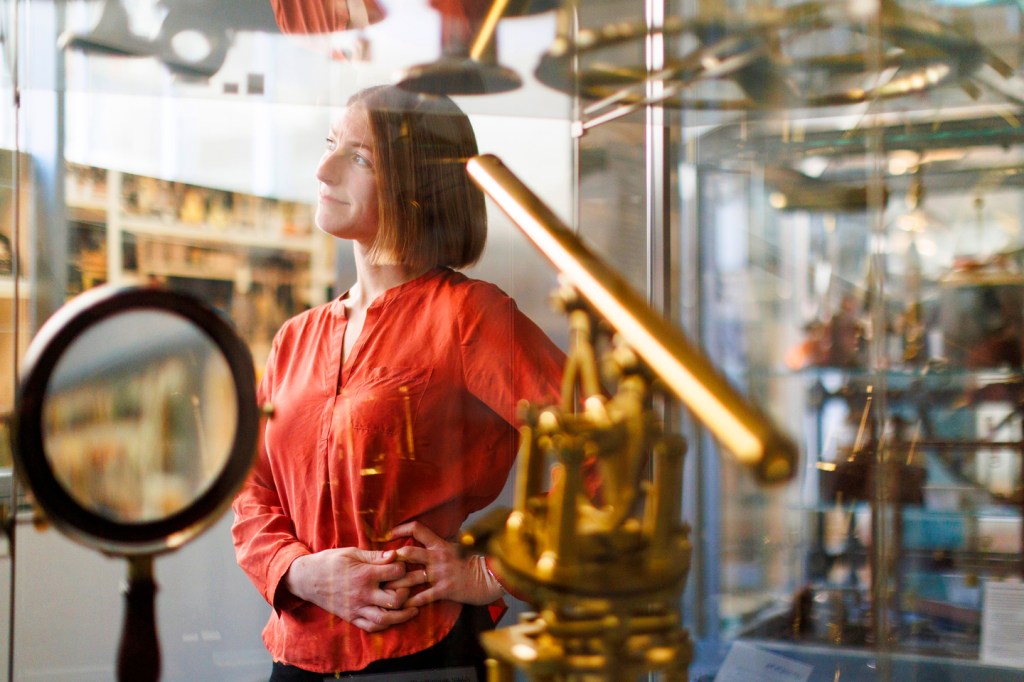
I am a scholar of Galileo (among other things), and I’m teaching a class devoted to his life and work right now. I propose the following as a model of genius and an endorsement of a creative process that follows detours. I think it’s an important reminder about how genius can require pursuing questions that arise even if they were not your original purpose.
I offer an excerpt from a literary and scientific work, the “Two New Sciences,” published by Galileo in 1638 from house arrest after his condemnation by the Roman Inquisition for advocating for the truth of the moving Earth. In it, the characters in his dialogue (named for two of his dearest friends who had long since died) discuss the following:
Salviati: “To solve the problems which you raise it will be necessary to make a digression into subjects which have little bearing upon our present purpose.”
Sagredo: “But if, by digressions, we can reach new truth, what harm is there in making one now, so that we may not lose this knowledge, remembering that such an opportunity, once omitted, may not return … Indeed, who knows but that we may thus frequently discover something more interesting and beautiful than the solution originally sought?”

Phuong Pham.
Niles Singer/Harvard Staff Photographer
Revolutionizing humanitarian and public health
Phuong Pham
Associate Professor at Harvard Medical School and Harvard T.H. Chan School of Public Health
My favorite portrayal of a genius is the television movie “Florence Nightingale” (1985), which dramatizes Nightingale’s early years, her decision to pursue nursing despite family opposition, and her groundbreaking work during the Crimean War, highlighting both her humanitarian spirit and pioneering efforts in public health and hospital care reform.
Nightingale revolutionized both the humanitarian response and the public health fields through her work as a nurse caring for soldiers during and after the Crimean War (1853-1856). She advocated for the care of wounded soldiers regardless of which side they fought for. She introduced two core humanitarian principles: humanity and neutrality. The principle of humanity “calls for the prevention and alleviation of human suffering wherever it is found,” while neutrality requires that “humanitarian actors must not take sides in conflicts or show preference for any particular political, racial, national, or religious group.”
In terms of public health, Nightingale introduced sanitation and hygiene practices and pioneered the use of statistics to advocate for public health interventions. After the war, she used data, analysis, and powerful visualization to demonstrate the impact of sanitation on health, collaborating with statisticians like William Farr to identify systemic causes of disease in hospitals and among soldiers. She advocated for improved ventilation, hand hygiene, sewage management, and reduced crowding. These core ideas have shaped modern public health, hospital design, and public health prevention control policy.