Featured series

Nation & World
A start in bridging divisiveness: Rein in social media
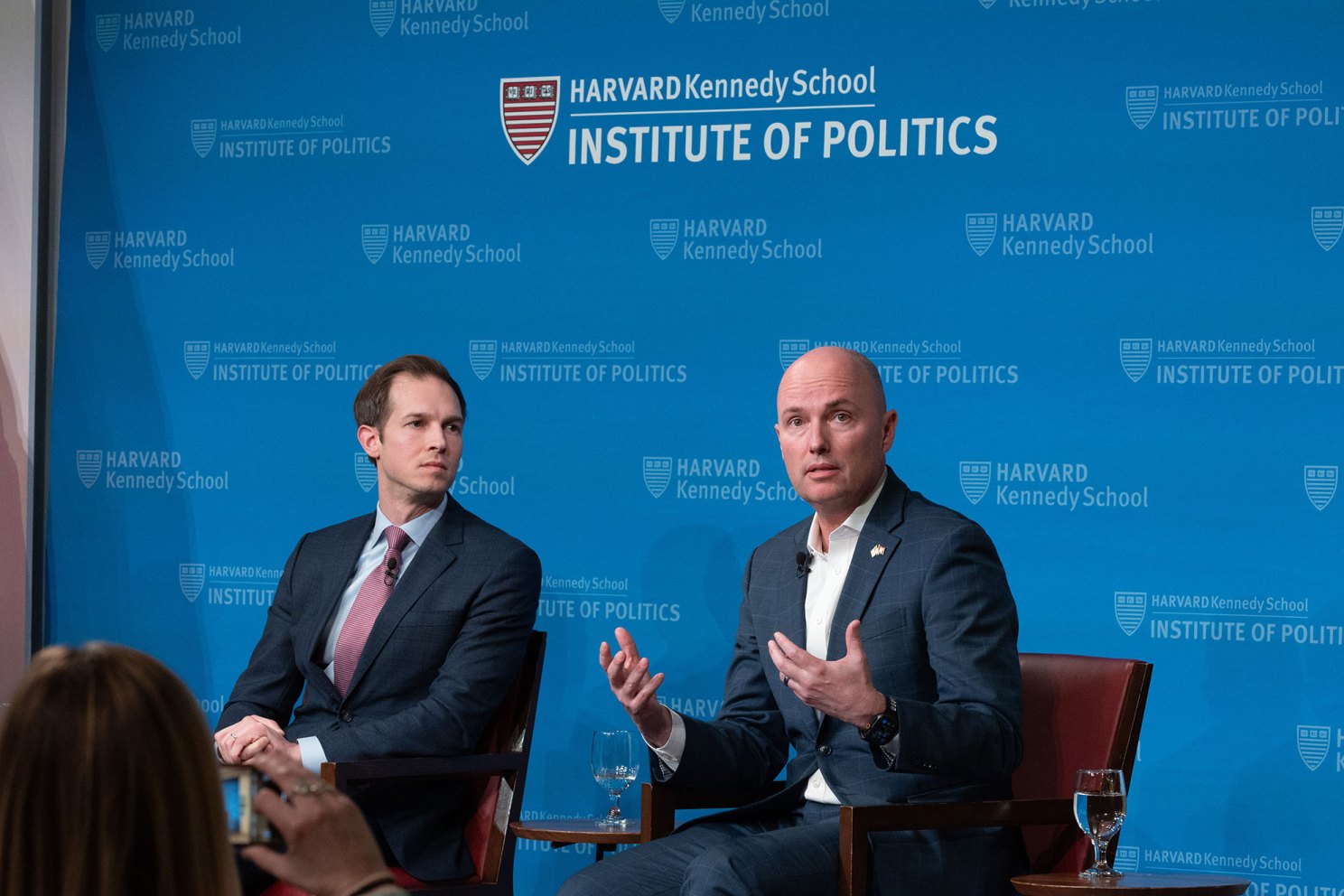
U.S. Rep. Jake Auchincloss (left) and Utah Gov. Spencer Cox.
Photo by Martha Stewart
Republican Utah governor, Democrat U.S. congressman find common cause
One is the Republican leader of conservative Utah; the other a Democratic congressman from liberal Massachusetts. They differ on many issues.
But Gov. Spencer Cox and U.S. Rep. Jake Auchincloss ’10 agree that social media and AI must be regulated if the country ever hopes to turn down the heat on political polarization and violence.
“An acceptance of violence and extremism, and the dehumanization that is integrated with that viewpoint, comes when you stop thinking that you have a shared future with other people,” Auchincloss said during a discussion on the topic Wednesday evening at Harvard Kennedy School.
Instead of bringing people together, social media algorithms attuned to political identity “just tear us apart,” Cox said. “We don’t have any real friends, but we can hate the same people together on social media and so that becomes our tribe.”
Cox came to national attention last fall in the wake of the fatal shooting of conservative activist Charlie Kirk at Utah State University. Cox spoke then of the role social media plays in fostering divisiveness in the country and of the need to rein it in — a view shared by Auchincloss.
“I think the reason that that sense of a shared future is deteriorating is that our sense of a shared reality is deteriorating,” in large part because of social media, Auchincloss said at the event. “And without a sense of a shared reality, it’s hard to have a sense of a shared future, and it’s hard to have a sense of common humanity.”
The forum was moderated by Nancy Gibbs, Lombard Director of the Shorenstein Center, and the Edward R. Murrow Professor of the Practice of Press, Politics, and Public Policy. It opened with remarks by Massachusetts Governor Maura T. Healey ’92 and Kennedy School Dean Jeremy M. Weinstein.
Cox noted that social media is not the only reason for our political divisions.
The loss of trust in institutions and gradual decline in civic participation and activities like Rotary Club and bowling leagues, as chronicled in Kennedy School Professor Robert Putnam’s landmark 2000 book, “Bowling Alone,” has left many Americans lonely and vulnerable to the mirage of community that social media appears to offer.
Citing the growing evidence of social media’s developmental and emotional harm, particularly to children and young adults, both Cox and Auchincloss are pushing for greater oversight at the federal and state level.
Utah has been out front nationally in terms of regulation.
In 2024, the state passed a law requiring tech firms to verify user ages or even get parental consent before minors can access platforms.
Last year, Cox signed a bill outlawing the use of generative AI to create fake content in order to deceive consumers in Utah. The state is also embroiled in several lawsuits involving Meta, TikTok, and Snapchat, arguing that their products expose children to various harms.
Auchincloss has proposed what he called a kind of social media “temperance” — not banning platforms but limiting access in the same way alcohol is restricted. He has also urged Congress to hold tech companies liable for the spread of AI-generated deepfakes.
Asked how the country can get beyond seeing those with different political viewpoints as enemies, Cox and Auchincloss said the parties will only change when voters start punishing officials who seek to divide Americans and support candidates who work across the aisle.
“We’ve got to find ways to reward the ‘boring stuff’ where we actually accomplish things instead of just the people who are really good at making you mad,” said Cox. “If that’s the incentive structure, we’re going to keep getting the performative instead of the substantive.”
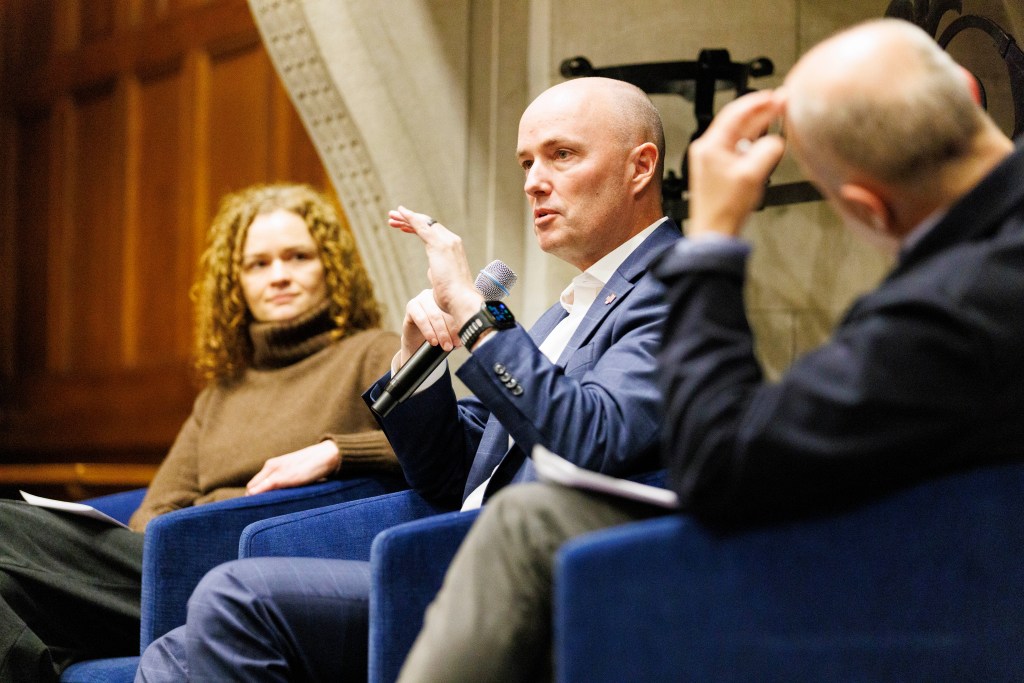
Cox during a panel discussion with Michelle Sanchez and James Wood.
Veasey Conway/Harvard Staff Photographer
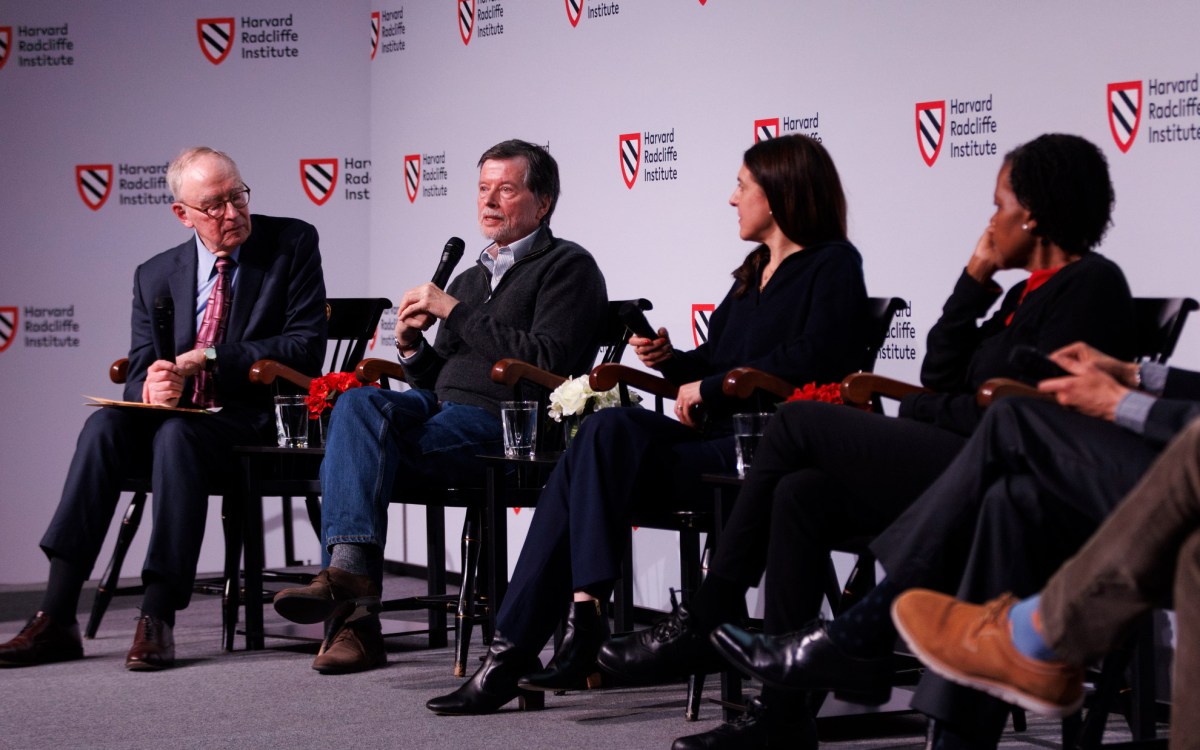
Earlier in the day, Cox joined Michelle Sanchez, a theology professor at Harvard Divinity School, to discuss religion in American life today during a panel at the Barker Center sponsored by the FAS Division of Arts & Humanities’ Public Culture Project. James Wood, Professor of the Practice of Literary Criticism, moderated the discussion
Cox and Sanchez discussed whether religious beliefs and practices should be private or play a role in U.S. politics, whether religion is necessary for leading a moral life, and how religion contributes to community-building.
They agreed that organized religion presents an important opportunity for Americans to meet and share community space with others who are different from them, people with whom they might not have anything in common save a shared faith.