Featured series

Arts & Culture
Writing like it’s a ‘game of telephone’
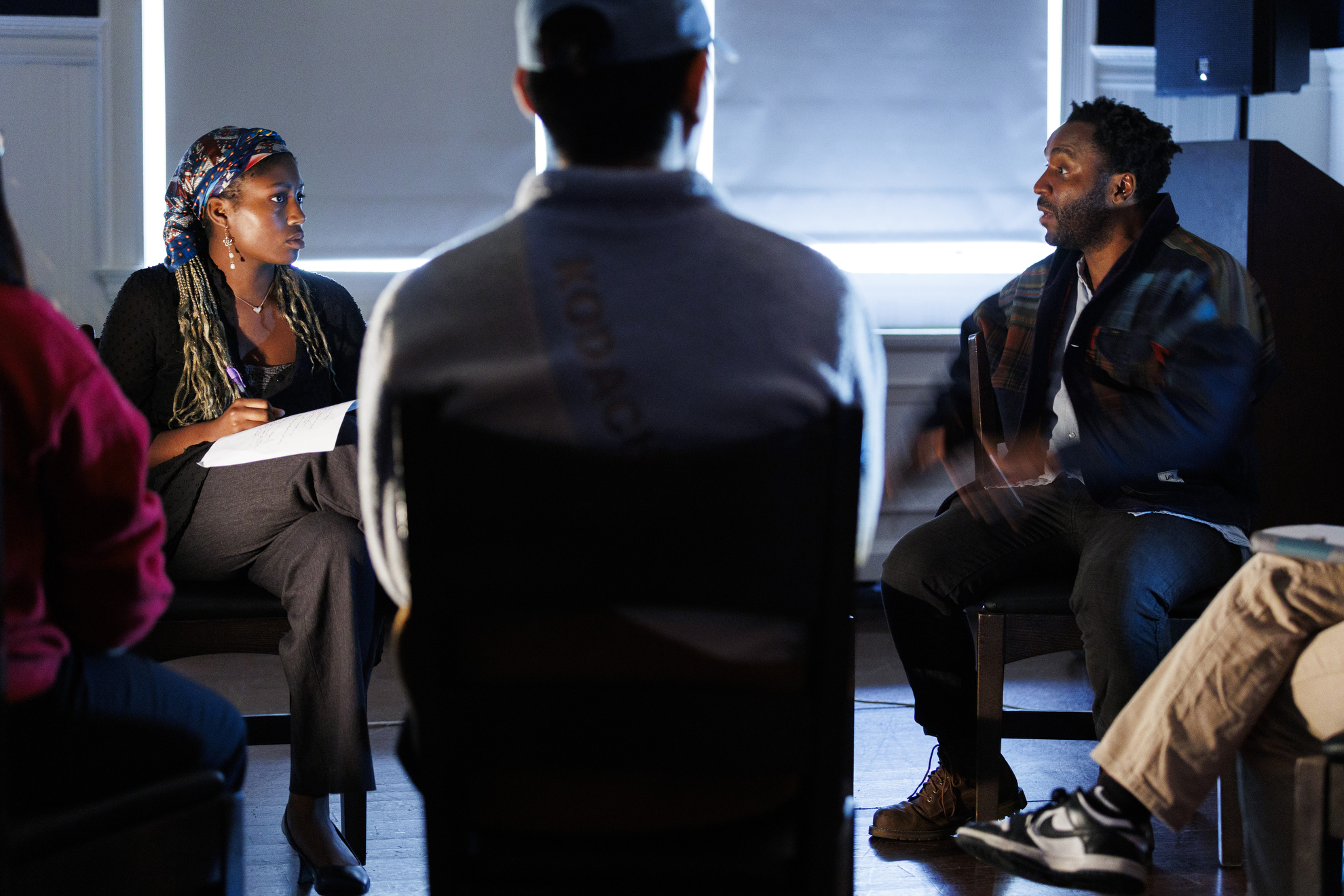
Aiyanna Ojukwu ’26 (left) and Phillip Howze.
Stephanie Mitchell/Harvard Staff Photographer
Students workshop TV script ideas in course designed as writers room ‘bootcamp’
In a seminar room in Farkas Hall, senior Aiyanna Ojukwu stood before a rolling whiteboard lined with index cards, each representing a plot point from her TV pilot episode. The story, as she explained to classmates grouped around a nearby table, follows a high school senior whose life takes a turn after an heirloom — a watch her parents gave her — goes missing.
“I think my original idea was it’s a windable watch, and if it gets off time then something bad will happen,” Ojukwu explained. “But if you can think of something better, this heirloom doesn’t need to be a watch. It just needs to be something that can be lost.”
Senior Solomey Alemseged had an idea: “Maybe it doesn’t tell time, but it tells something else.”
Ojukwu liked the proposal. “Maybe it shows how out of line you are, like a compass,” she mused.
“A moral compass,” senior Inseo Yeo added.
The creative volley continued for the College students enrolled in TDM 166H: “TV Writers Room,” who took turns workshopping their projects with the group.
Associate senior lecturer Phillip Howze has been teaching the advanced writing workshop in the Theater, Dance & Media program for the past three years. The technical skills needed for TV writing are different than for plays or film, he said.
“I’m a curious person and thus I’ve worked in a variety of fields. Relatedly, a TV writers room is really about bringing a whole spectrum of experience, personal experiences, ideologies, scholarships, and the multivalent aspects of your personhood, to bear on the story that you are writing collectively with a group of people,” said Howze. “To make a television show is to work incredibly collaboratively, and to risk failure really boldly, over and over again in a serialized, recurrent way. It’s like any creative practice. In order to do it, you need to practice the muscle.”
“A TV writers room is really about bringing a whole spectrum of experience, personal experiences, ideologies, scholarships, and the multivalent aspects of your personhood, to bear on the story that you are writing collectively with a group of people.”
Phillip Howze
Howze, a playwright and screenwriter who has written for shows such as the Netflix series “Mindhunter” and National Geographic’s “Genius: Aretha,” says a TV writers room is a unique environment: a temporary assembly of people who meet daily to craft a story together, where the narrative is ongoing rather than being neatly contained like a movie.
In a professional writers room, Howze explained, the showrunner, or creator, typically brings in an idea that others build upon. There’s usually a “blueskying,” or brainstorming phase. Then writers hone the story until it fits the framework of an episode. He describes his course, a two-hour-and-45-minute seminar that meets once a week, as a “bootcamp” that mimics this process.
Ojukwu, who is concentrating in neuroscience and in Art, Film & Visual Studies with a focus on film production, described the collaboration as a “game of telephone,” where one person has an idea, the next person expands on it, and a third person writes even more.
“Everyone has been doing individual work, but there’s always the thought of ‘my community has chipped in,’” Ojukwu said. “I took this class because I was kind of sick of individualism tied to creativity. As if the only way you can truly be a ‘good creative’ is if you did it yourself with no help. That was kind of exhausting to me. I found that, outside of classes, I had a better time making stuff if it was with other people.”
“I took this class because I was kind of sick of individualism tied to creativity.”
Aiyanna Ojukwu
The course “prioritizes community and collaboration in a way that I’ve never seen anywhere,” added Alemseged, who is concentrating in history of science and Art, Film & Visual Studies. “But there is this preservation of self-reflection and voice while pursuing that. There’s also this passion, like a fire being lit under everyone’s seat. Everyone is very eager to share and to collaborate.”
Outside of class, students write original work each week: scenes, character monologues, episode synopses, and elevator pitches. They often swap in class and take each other’s work home to expand on the ideas. They also watch shows as homework assignments and write responses. The coursework includes several shows primarily created by women and artists of color alongside the creative seeds that inspired them, such as Issa Rae’s web series “The Misadventures of Awkward Black Girl,” which later became the hit HBO show “Insecure;” Phoebe Waller-Bridge’s one-woman play “Fleabag” and its BBC TV adaptation; and the “Homecoming” thriller podcast and its Amazon Prime television version starring Julia Roberts.
Sharing work with peers can be daunting. Howze encourages students to present their writing to the class without disclaimers, and to practice letting go of ego, habits that will aid them in the professional writers room.
“The course really puts forward, to encourage and inspire students, that your lived experience and your unique perspective is not only of use to your own story, it could potentially be of use to Issa Rae, plus anyone else who you might wind up working next to in the context of a writers room,” Howze said.
Claire Liu, a senior concentrating in Theater, Dance & Media and economics, did her first Harvard internship in a writers room: a virtual position for The CW’s “Nancy Drew” show.
“I’m hoping to work in entertainment as a writer, director, and performer, mostly in film and TV,” said Liu. “It’s definitely something that I want to continue after graduation.”
Howze also brings in guest speakers from the television industry. Recently it was Monet Hurst-Mendoza, who was a writer/producer for Seasons 21-24 of NBC’s “Law and Order: SVU.” She watched the students simulate a writers room, working together on Ojukwu’s time-travel pilot, as well as others, including a dream sequence involving a Los Angeles cult and a family of dinosaurs that survived the meteor strike.
Howze hopes students will come away with more confidence and conviction in their creative selves than they had at the start of the semester.
“By the end of the class, I hope students leave prepared to go into a writers room skillfully, but really any collaborative creative space, with a healthy balance of conviction and grace. Not only do we nourish their talents as emerging artists, we also tend to the need for more good citizens of the art world,” Howze said.