What’s working, not on front lines of AI in classroom
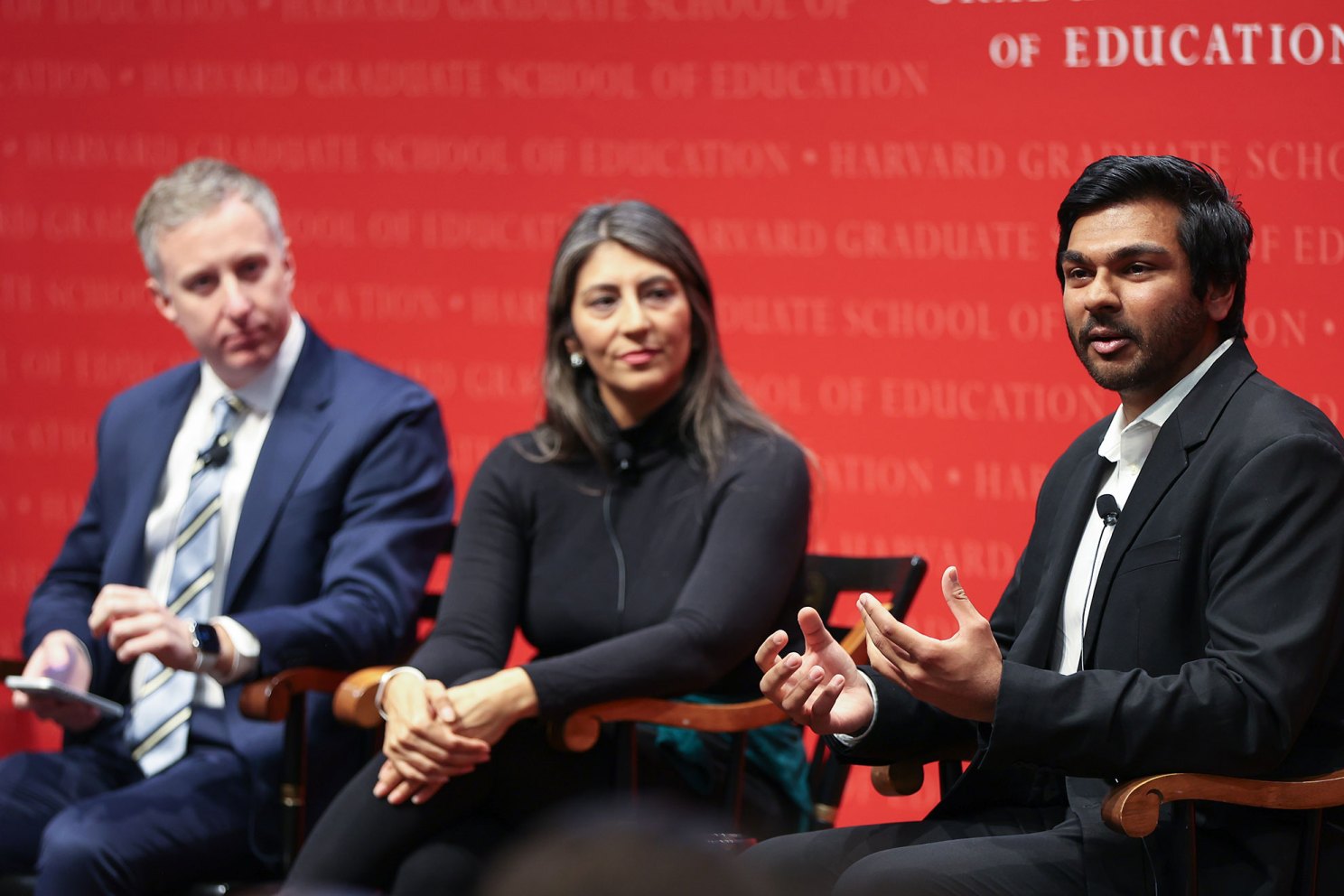
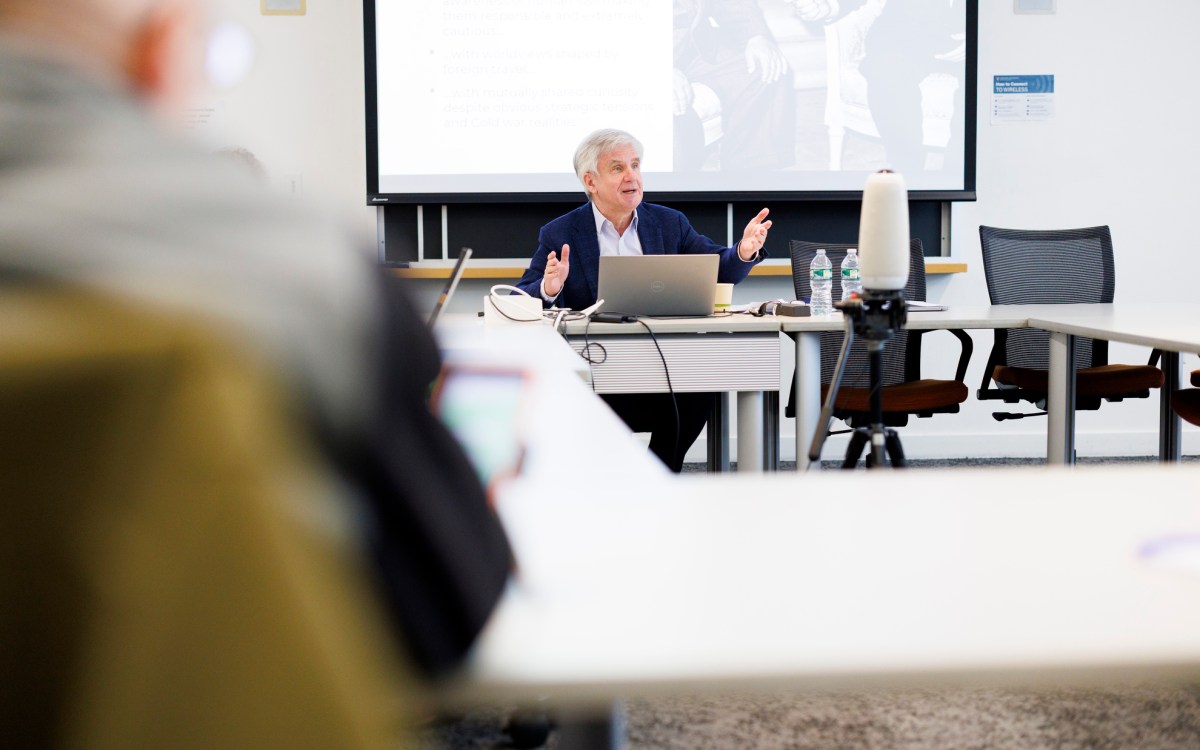
Keith Parker (from left), Yenda Prado, and Kedaar Sridhar.
Jill Anderson/HGSE
Anna Lamb
Harvard Staff Writer
5 min read
Tech, education experts share new initiatives on learner profiles, making STEM more accessible, ‘microschool’ experiments
As AI becomes more accessible to students, educators and school leaders are scrambling to figure out how best to integrate the technologies rather than fight against them.
To share the innovative ways in which they’re bringing AI into the classroom, Harvard’s Graduate School of Education brought together an education researcher, a tech entrepreneur, and a school superintendent to discuss what’s working, what’s not, and what we still don’t know about utilizing AI’s capabilities.
“I think it is important to recognize the moment we’re in. We are in a space that is emerging,” said Yenda Prado, research analyst at the education nonprofit Digital Promise.
Her organization’s work has centered around closing learning gaps for students performing below grade level, living in poverty or rural communities, learning multiple languages or in special education programs, and students of color.
“We’re very much interested in developing learner profiles. So what does the learner profile of an English language learner look like? What does the learning profile of a student with a learning disability look like? And how can we use those profiles to train learning agents to deliver instruction that is tailored to the specific need of a specific student?”
Kedaar Sridhar, the 2025 Harvard Education Entrepreneurship Fellow and co-founder of the startup M7E AI, said his company has developed a platform using AI to make STEM learning more accessible for some of the more vulnerable student populations.
“What I’m building is not student-facing, but it helps the ecosystem where you’re helping reduce teacher burden and improve the classroom experience,” he said.
M7E uses an AI platform to analyze math curricula, which is often wordy and sometimes confusing. The program is then able to simplify the language to make problems more straightforward, clearer, and easier to understand.
“We remove unnecessary or irrelevant struggle and focus on the productive struggle,” he said. “The desirable difficulties that come with actually building up a student’s core of knowledge, where they’re able to question and make decisions, and even be able to question what an AI might be able to output.”
“Once we understand the things that AI can and can’t do, we can start thinking about the types of tasks that AI could and should not be doing.”
Yenda Prado
Keith Parker, superintendent of the Elizabeth City-Pasquotank Public Schools in North Carolina, is using a “microschool” as a hub of AI experimentation in the classroom. Parker has been a voice for innovation since economic downturn in his region led to a shortage in resources and teaching staff.
“Economically, over the past 50 years, this part of the state has been challenged, and so my career is focused on building up systems and structures in public education,” he said.
To try out new classroom strategies, Parker and his leadership team started a district microschool — 25 fifth and sixth graders managed by three teachers who are free to develop their own curricula. Parker said he has plans to expand the microschool to grade 8.
“There will be no way three adults can teach 60 kids across grades five through eight and differentiate exactly what all those kids need,” he said. “So our great experiment here is — not only can AI be a supplemental tutor, but can AI also be a primary means of direct instruction to kids for some portion of the day.”
So far, Parker said that the focus for his teachers has been sharing how to create prompts that allow students to elicit what they really want to know from AI systems.
“Because the way you prompt and the way you engage with it can produce an entirely different response from the model,” he said. For instance, students in English class can generate character guides for the novels they’re reading or even prompt chatbots to take on the persona of characters for a student Q&A.
But, he said, every day sees new ways to use the tech. “We’re in the midst of a massive revolution in K-12 education,” Parker said.
According to Prado, the first step toward reimagining K-12 education will be further research into successful strategies and the student benchmarks they produce.
“We need to have educators involved in the actual co-design of these technologies,” she said. “That looks like researchers going into the school communities, developers going into the school communities, and engaging and testing things out and seeing what sticks and what doesn’t, and going through these rapid iterations of design.”
And, she added, that will help students and educators understand the capabilities of AI, what it’s good at, and what is better without it.
“Once we understand the things that AI can and can’t do, we can start thinking about the types of tasks that AI could and should not be doing, and how we support our school communities to develop the necessary AI literacy to feel empowered to make their own choices about how they use or not use AI,” she said.
Current trends ‘not sustainable,’ says Fed chair, whose conversation with Harvard undergrads also touched on inflation, impact of war, independent decision-making

 Featured series