Featured series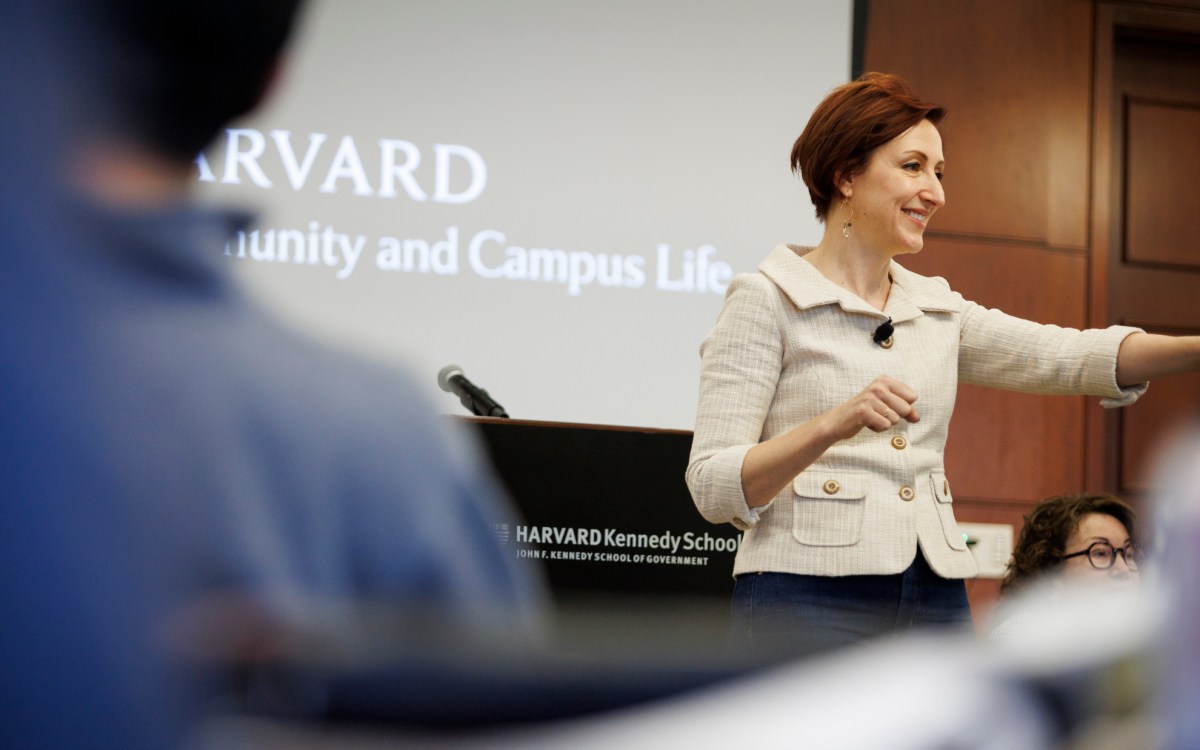
Campus & Community
‘Our students are seeking not just to coexist, but to understand’
Harvard file photo
8 projects win Building Bridges grants to spark constructive dialogue on campus
Eight student-led projects that aim to break down campus divisions — through talks, film screenings, and art installations — won funding from the 2025-26 President’s Building Bridges Fund.
The presidential initiative, which seeks to build community across faiths, cultures, and backgrounds, received three times as many applications and is funding twice as many projects as it did in its inaugural round last year. Grantees, led by students from the College and six graduate Schools, were awarded up to $5,000 and will launch projects during winter and spring 2026.
“There is interest across the University in creating new opportunities to deepen connections, build understanding, and strengthen relationships,” said Harvard President Alan M. Garber. “The threefold increase in Building Bridges applications this year demonstrates students’ eagerness to take risks and to learn from one another. It is an exciting and promising sign of renewal within our community, and I am honored to support an excellent slate of projects.”
Last year, student project leaders took a variety of approaches to fostering respectful dialogue among their peers on challenging issues. This year is no different. Projects will delve into a diverse set of topics, including exploration of the rural-urban divide, progressive-conservative values, Black and Jewish solidarity, and shared identity through art.
“Our students continue to show that building community across difference is not an abstract aspiration but a daily practice they are eager to pursue,” said Sherri Ann Charleston, chief community and campus life officer at Harvard, whose office administers the program. “From the Law School to the College, our students are seeking not just to coexist, but to understand. These selected projects capture that spirit perfectly, utilizing everything from the arts to structured policy debate to weave a stronger, resilient community at Harvard.”
Summaries of the projects:
Harvard Rurality Forum (Harvard College)
The Harvard Rurality Forum is a one‑day event aimed at convening Harvard affiliates, invited guests, and partner organizations on campus to examine the rural-urban divide. By placing rural perspectives alongside those shaped by the Boston metropolitan area, the forum aims to highlight differences in culture, economics, and daily realities while creating space for genuine understanding. Through conversations on issues such as agriculture, healthcare, and education, attendees will challenge assumptions, explore policy impacts, and develop the skills needed to engage constructively across cultural lines.
The Black-Jewish Pluralism Project (Harvard Divinity School)
This semester‑long dialogue series brings together students, faculty, and staff from across Harvard for monthly, cross‑school conversations on Black-Jewish solidarity in a polarized time. Each gathering will blend theological reflection, historical context, and ethical discussion to help participants examine their assumptions and move beyond performative allyship. The series will conclude with a collective ritual centered on moral responsibility and repair. Its purpose is to cultivate empathy, humility, and a shared commitment to justice across lines of faith, race, and ideology.
Civil Society at the Cinema: Finding Common Ground Through Film (Harvard Kennedy School)
Civil Society at the Cinema is a series of free film screenings and roundtable conversations held at the Brattle Theatre in Harvard Square. The program will bring together Harvard students, faculty, filmmakers, and community members to engage with works that probe challenging questions about the human experience. By including directors and speakers from varied backgrounds, the series aims to model how thoughtful disagreement can coexist with empathy, intellectual rigor, and a shared commitment to understanding one another.
Breaking Bread, Building Bridges (Harvard Law School)
Breaking Bread, Building Bridges is a six‑session dialogue series designed to bring conservative Christian and progressive leftist students at Harvard Law School into structured, meaningful conversations about urgent social, ethical, and political issues. The series aims to foster empathy, understanding, and honest moral inquiry between communities often perceived to be in conflict. Rather than seeking agreement, the project aims to humanize disagreement by showing how differing moral frameworks can still share commitments to dignity, justice, and the common good.
From Dissent to Dialogue: Conservative and Progressive Legal Dialogue (Harvard Law School)
The Federalist Society and the American Constitution Society at the Law School will co‑host a series of lunch talks, bringing members of the Law School community together for conversations that bridge ideological divides. The series aims to create a shared space for thoughtful, good‑faith engagement, encouraging students to question assumptions and learn from contrasting perspectives. By moving beyond siloed programming and placing speakers in direct dialogue with one another, the series will let students engage with high‑profile guests while modeling respectful disagreement and strengthening the culture of open inquiry at the Law School.
Across the Aisle (Harvard Business School)
Across the Aisle will provide structured, empathetic spaces for Harvard Business School students to explore differing political and social perspectives. Through facilitated dialogues, story circles, and community dinners held on campus throughout the semester, participants will practice curiosity and reflective inquiry to build trust across ideological lines. Led by the Business School’s Democrats, Liberals, & Progressives Club, the Conservative Club, and the Government & Public Policy Club, the project invites students to engage with one another openly rather than through debate or persuasion. By encouraging students to examine their values, communicate across disagreement, and question assumptions, Across the Aisle aims to strengthen leadership skills essential for navigating complexity.
Gathering Under the Crest (Harvard Graduate School of Design)
Gathering Under the Crest is a campus installation of light, triangular pavilions designed to provide participatory communal spaces for the Harvard community. Placed on campus, the 13 pavilions represent each of Harvard’s Schools, sharing a common form with subtle variations that reflect the diversity within the Harvard community. Students from every School will help shape their pavilion, contributing ideas that give each structure its distinct character. By offering welcoming places for people to gather, the project invites the community to see itself both literally and figuratively within a broader whole.
Whose Genes? (Harvard Kenneth C. Griffin Graduate School of Arts and Sciences)
Whose Genes? is an online map and conversation space that aims to explore how the Harvard community understands genes and what they can and cannot tell us about identity. Built from 50 interviews with faculty experts, collected questions from the broader Harvard community, and a public panel featuring four scholars with contrasting views, the project will make diverse perspectives on genetics and inheritance accessible in one place. The project aims to deepen public understanding of genetics, challenge deterministic assumptions, and encourage thoughtful engagement with questions about identity, biology, and difference.
Proposals were evaluated based on the potential to bring students together along one or more of the following dimensions:
- Building meaningful relationships among affinity groups whose interests or perspectives on important issues may diverge;
- Advancing intellectual excellence by listening deeply, navigating tension constructively, and fostering cooperation across differences to solve common problems;
- Acting against discrimination, bullying, harassment, and hate;
- And fostering dialogue and engagement across differences on campus about interfaith or intercultural issues, or a combination of both.
The President’s Building Bridges Fund was established as a result of the preliminary recommendations from both the Presidential Task Force on Combating Antisemitism and Anti-Israeli Bias and the Presidential Task Force on Combating Anti-Muslim, Anti-Arab, and Anti-Palestinian Bias, which emphasized the need to provide more opportunities for building community across campus. Students who led and participated in projects last year learned skills necessary to engage in difficult conversations and said they appreciated the additional opportunities to engage with peers with different points of view outside of the classroom.
“True pluralism is not a given; it is an achievement that requires the intentional construction of bridges where there are none,” said Diana Eck, a member of the Presidential Task Force on Combating Anti-Muslim, Anti-Arab, and Anti-Palestinian Bias, professor of comparative religion and Indian studies, emerita, and Frederic Wertham Research Professor of Law and Psychiatry in Society. “These students have accepted the challenge to move beyond their comfort zones, designing initiatives that replace silence with conversation and assumption with inquiry. By fostering spaces where distinct religious, cultural, and political identities can interact constructively, these grantees are doing the essential work of the University.”