Featured series


Health
Nighttime exposure to light may raise cardiovascular risk by up to 50%
New research suggests that it disrupts biological clock
Exposure to light at night raises cardiovascular disease risk by up to 50 percent over sleeping in the dark, new research shows. But scientists say the effect isn’t from lack of sleep, but from disruption of the body’s master biological clock, the circadian rhythm.
Angus Burns, a postdoctoral fellow at Harvard Medical School and Brigham and Women’s Hospital, said the work highlights the potency of our circadian rhythm, which not only regulates sleep, but also independently affects nearly every organ in the body, changing how they function when we nod off.
For those experiencing the brightest nights, the research showed increased risk of between 30 percent and 50 percent for heart attack, stroke, heart failure, atrial fibrillation, and coronary artery disease.
“The reason it’s exciting is it adds light exposure as a novel risk factor for cardiovascular disease, and that’s something you can recommend to patients quite easily,” Burns said. “I think it should be added to guidelines about reducing risk for these cardiovascular outcomes.”
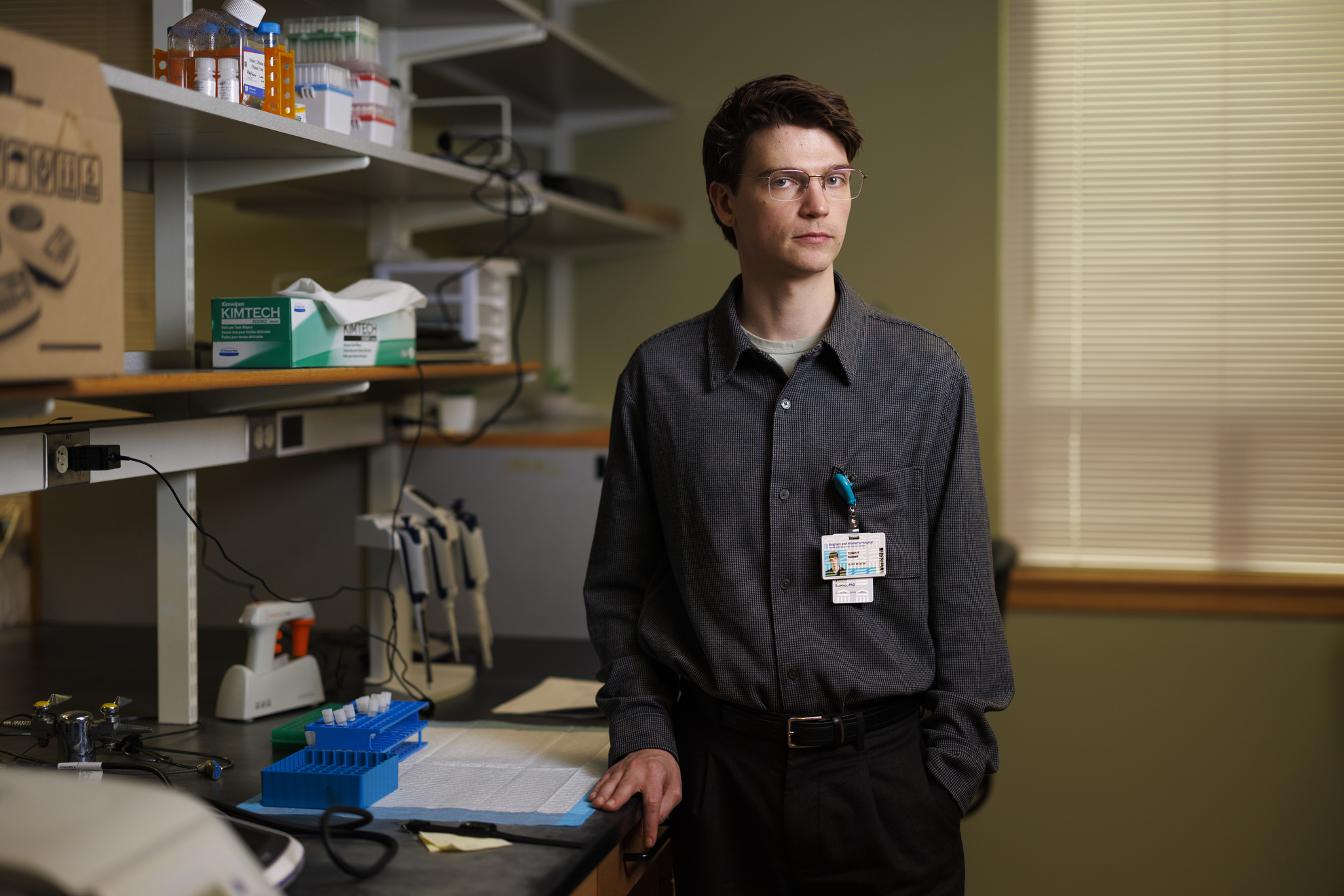
Angus Burns.
Veasey Conway/Harvard Staff Photographer
Burns and colleagues almost missed the chance to conduct the study.
Burns was intrigued when he learned of the UK Biobank database, which used biosensor-loaded wristwatches to track more than 100,000 participants, night and day, for a week. The resulting database is the largest known of physiological information related to participants’ sleep and wake habits.
But even though the schematics said the devices contained light sensors, the data downloaded from the watches didn’t include exposure to nighttime light sources.
So Burns reached out to the engineer who designed the watches, who told him the light exposure data was there, but had to be extracted separately.
“We find that sleep regularity, which captures circadian disruption, is a stronger predictor of mortality than sleep duration.”
Daniel Windred
The data did include light intensity but unfortunately provided no information about sources, such as streetlights, cellphone screens, nightlights, and television.
The resulting study analyzes data from 88,905 participants. In an article posted to JAMA Network Open in October, Burns, co-first author Daniel Windred from Australia’s Flinders University, and colleagues compared data on nighttime light exposure to health outcomes over the next 9½ years, using information from electronic medical records.
The researchers spent several years figuring out the best way to analyze the enormous data trove that resulted. The effort has been fruitful, and earlier publications linked light exposure patterns to higher risks of premature mortality, Type 2 diabetes, and psychiatric disorders, including depression, anxiety, schizophrenia, and bipolar disorder.
“I think the general public are certainly beginning to appreciate the health impacts of lack of sleep, but appreciation for the health impacts of disrupting circadian rhythm falls behind,” Windred said. “Much of our recent work shows that markers and determinants of circadian disruption, like bright night light exposure, are strong predictors of poor health outcomes. For example, we find that sleep regularity, which captures circadian disruption, is a stronger predictor of mortality than sleep duration.”
The current research highlights the sensitivity of the body’s circadian clock to disruption. Our bodies reach peak sensitivity to light stimulus between midnight and 6 a.m. Exposure in that period, particularly to bright light, causes your body clock to begin to reset, sending signals throughout the body, Burns said.
The study found a dose-response relationship between nighttime light exposure and cardiovascular disease risk.
For heart attack, for example, compared with those in the darkest 50th percentile, those who experienced some nighttime light — in the 51st to 70th percentile — had a 20 percent increased risk of heart attack.
Those who experienced more light, in the 71st to 90th percentile, had a 27 percent increased risk.
And those who experienced the most nighttime light, in the 91st to 100th percentile, had a 47 percent higher risk.
“There are various risk factors that predict cardiovascular disease, including smoking, alcohol, diet, physical activity, and sleep,” Windred said. “It was interesting to find that night light exposure predicted cardiovascular disease risks independently of these known risk factors. Light exposure appears to be an additional dimension of our lifestyle that we should be paying close attention to for optimal health.”
Modern life can work against a well-functioning circadian clock, Burns said.
Today, not only are our nights not as dark as in the past, but for many of us our days are not as bright. We evolved outdoors where sunlight sends a strong daytime signal that helps set our circadian clocks. Today, we spend 90 percent of our time indoors under weak artificial light.
Though we may perceive that as adequate for our chores, office light gives off 200 to 400 lux — a measure of illumination — while the sun generates 10,000 lux even on a cloudy day.
The result, Burns said, can be a weak circadian signal, resulting in things like feeling sluggish during the day yet too awake at night to sleep at a reasonable hour.
“There’s strong evolutionary pressure for a period of activity and a period of quiescence for your whole body,” Burns said. “Unfortunately, modern life is a challenge to that biology, as I’m sure most people really appreciate.”
Research was funded by the National Institutes of Health and the Australian Research Council.