Featured series


Campus & Community
New institute to strengthen fundamental physics research, collaboration
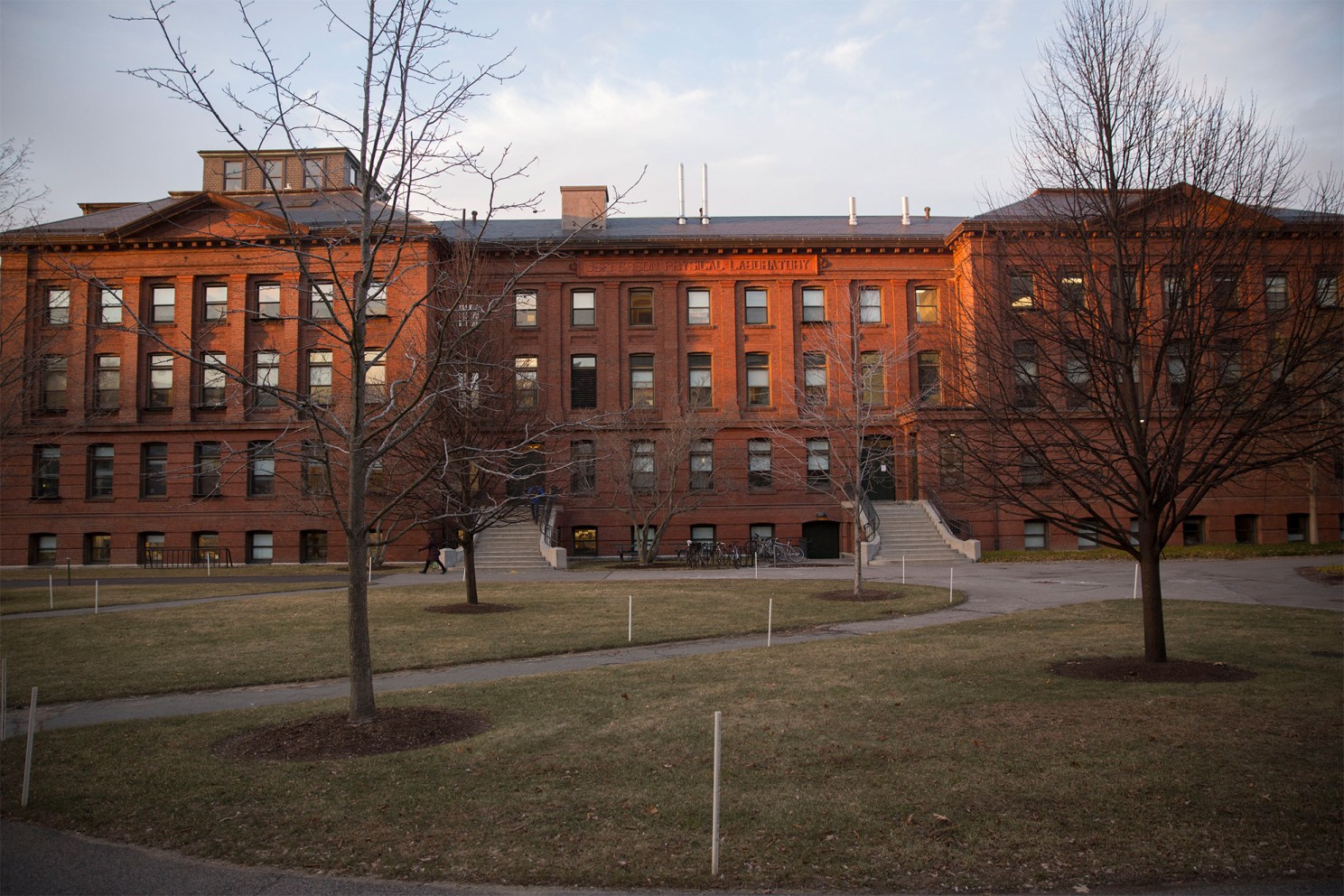
The Jefferson Physical Laboratory at Harvard.
Harvard file photo
Leinweber Institute for Theoretical Physics made possible by $20 million gift from the Leinweber Foundation
Harvard University on Thursday announced the creation of the Leinweber Institute for Theoretical Physics at Harvard, a new initiative focused on strengthening fundamental physics research and connecting physicists across the United States.
Made possible by a $20 million gift from the Leinweber Foundation, the institute, housed in the Department of Physics in the Faculty of Arts and Sciences’ Division of Science, will be a hub uniting researchers across the University with those at other leading research institutions to explore the theoretical principles of the physical world.
“Expanding opportunities for collaboration accelerates scientific progress,” said Harvard President Alan Garber. “This new institute will strengthen relationships among researchers within our community and across institutions who are working to deepen our understanding of the universe. We eagerly anticipate their discoveries, and we are grateful to Larry Leinweber and the Leinweber Foundation for their support of fundamental research.”
A growing network
With the creation of the Leinweber Institute, Harvard joins a growing national network of theoretical physics centers supported by a total investment of more than $150 million by the Leinweber Foundation. The institute will collaborate closely with peers working at California Institute of Technology; the Institute of Advanced Study; the Massachusetts Institute of Technology; Stanford University; the University of California, Berkeley; the University of Chicago; and the University of Michigan, with each site contributing complementary strengths and shared research fellowship programs.
Underpinning the effort is the idea that theoretical physics progresses most rapidly when scholars from diverse specialties share ideas, tools, and perspectives. The institute’s programs will support scholar visits, thematic workshops, and collaborative projects, creating new opportunities for partnership between Harvard theorists and visitors from around the world.
“The foundation’s vision is to build a national ecosystem to support theoretical physics — a network of institutes that support one another, challenge one another, and accelerate discovery in ways no single institution could do alone,” said Larry Leinweber, founder and president of the Leinweber Foundation. “Harvard is an essential part of that vision. Its history of excellence and its culture of rigorous, creative inquiry make it an ideal participant in the vision. I am especially proud that this gift will help launch and sustain young scientists whose ideas will shape the future of the field.”
Investing in the future
The gift also establishes the Leinweber Physics Fellows program to support emerging scholars in theoretical physics. A postdoctoral fellowship will enable fellows to pursue independent research under the general supervision of Harvard faculty affiliated with the institute, while faculty and graduate student research will be aided by awards for institute faculty and fellowships to Ph.D. students, attracting top scientists to the field and building a pipeline for innovation and discovery.
“Investing in science is an investment in people — students, postdocs, and faculty whose curiosity and dedication drive every breakthrough,” said Hopi Hoekstra, Edgerley Family Dean of the FAS. “This remarkable gift strengthens our ability to support scholars at every stage of their careers and gives them the resources and freedom to pursue bold ideas. We are deeply thankful to the Leinweber Foundation.”
The Leinweber Institute’s work will span high energy theory — including particle physics, string theory, and quantum gravity — cosmology, and aspects of condensed matter theory that illuminate basic laws of nature. The institute will also support theoretical studies that propose or analyze novel experiments or observations aimed at revealing new facets of fundamental physics.
The institute will be led by incoming faculty director Matthew Reece, a professor of physics in the FAS whose work in particle physics, cosmology, and quantum gravity seeks to uncover physics beyond the Standard Model by connecting fundamental theory to observations and experiments. He has developed new ideas about dark matter, the early universe, and the unexplained features of the Standard Model, and has worked extensively on how data from the Large Hadron Collider, future colliders, and astrophysical measurements can test these ideas.
“It is a great privilege to help launch an institute dedicated to fundamental theoretical physics, at a time when the central questions of the field are as profound and challenging as ever,” said Reece. “The Leinweber Foundation’s generous gift will sustain and strengthen Harvard’s long tradition of training and mentoring great theoretical physicists. I’m delighted by this new opportunity to bring some of the world’s best young theorists to Harvard and to give them complete freedom to pursue their scientific interests. I’m excited to see the new ideas and discoveries that will emerge from collaborations fostered within our institute and with the broader Leinweber Network.”
Building on strength
Harvard’s theoretical physicists have long been central to many of the field’s most influential advances. Drawing on close collaborations across physics, astronomy, mathematics, and engineering, researchers at Harvard have helped deepen our understanding of the most fundamental laws of nature — ranging from particle physics and cosmology to quantum field theory and gravity — and continue to shape the direction of theoretical research worldwide.
“Harvard’s Department of Physics has pushed the boundaries of knowledge in many directions over many decades,” said Cumrun Vafa, the Timken University Professor and Physics Department chair. “The generous gift from the Leinweber Foundation enables us not only to enhance our efforts in undertaking theoretical research in fundamental physics at a critical time when there are tremendous financial pressures, but also to better connect us with a network of peer institutions to promote a young cohort of students and researchers, which will impact the future of the field for decades to come.”