Featured series
Campus & Community
5 from Harvard named Marshall Scholars
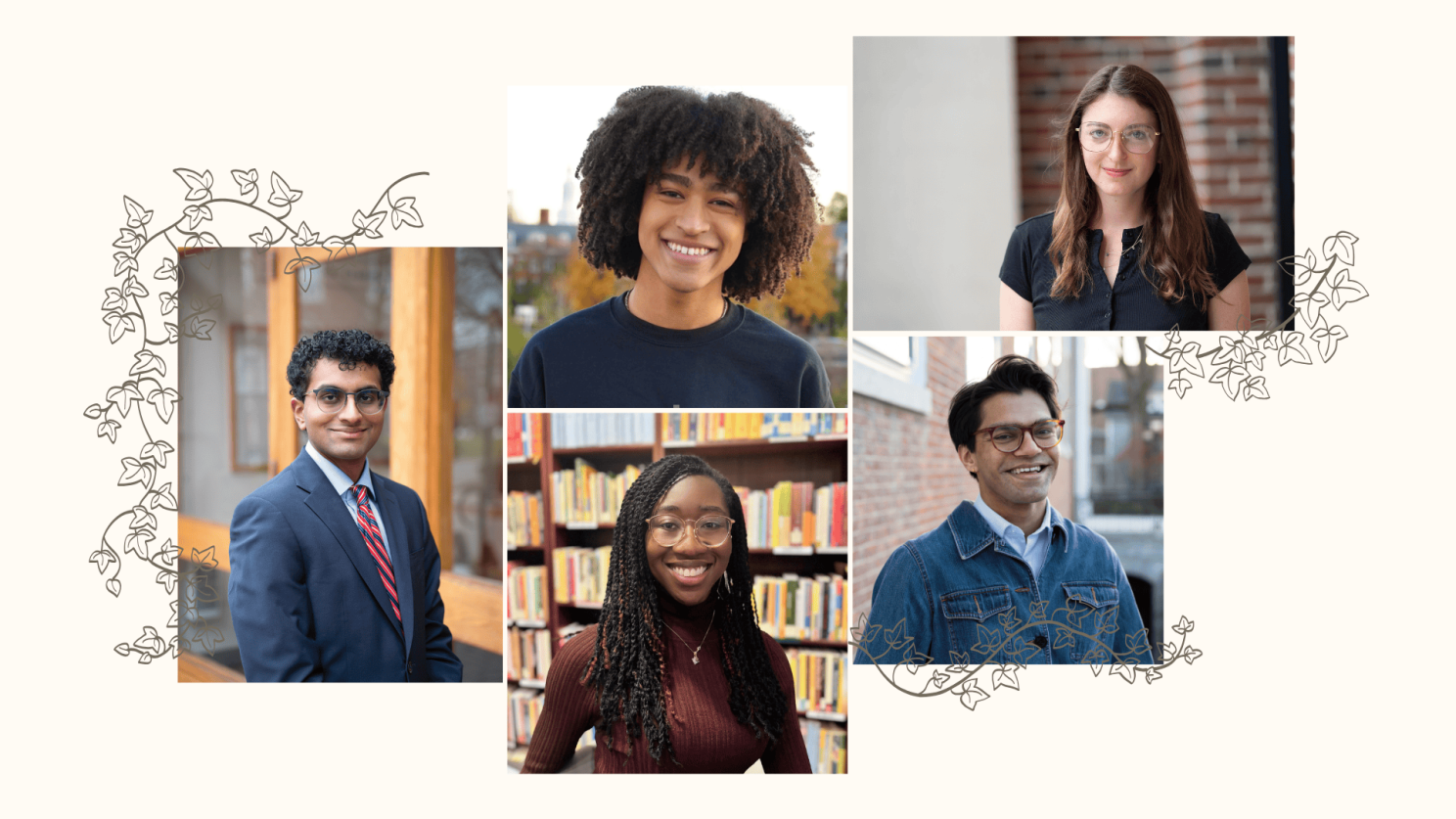
Ashwin Sivakumar (clockwise from lower left), Tenzin Gund-Morrow, Hannah Duane, Kashish Bastola, and Edith Siyanbade.
Photo illustration by Liz Zonarich/Harvard Staff
Awards for 4 students, 1 alumna — more than any other institution — support graduate studies in the United Kingdom
Harvard is home to more 2026 Marshall Scholars than any other institution.
The annual scholarship, launched by the British Parliament in the 1950s as an expression of gratitude for U.S. support following World War II, enables a group of American college graduates to continue their studies in the United Kingdom. Forty-three students were chosen this year from more than 1,000 applicants. Representing Harvard College are Kashish Bastola ’26, Hannah Duane ’26, Tenzin Gund-Morrow ’26, Ashwin Sivakumar ’26, and Edith Siyanbade ’24.
Kashish Bastola, a history concentrator from McKinney, Texas, with a language citation in Nepali, has particular interest in studying the U.S. Gulf South and the Himalaya. His senior thesis brings to light a Cold War-era CIA operation to aid the Tibetan resistance on U.S. college campuses and military bases. He dedicated much of his time as an undergraduate to research and mentorship at the Radcliffe Institute as well as the Phillips Brooks House Association, and currently serves on the city of Cambridge’s American Freedmen Commission. Bastola plans to spend the next two years studying military history at the University of Oxford.
Hannah Duane, a joint concentrator in social studies and philosophy, grew up in San Francisco and began her undergraduate studies at Deep Springs College in California. Since transferring to Harvard, she has been a member of the Intellectual Vitality initiative and worked as a research assistant for the Task Force on Combating Antisemitism. Her senior thesis explores political theorist Hannah Arendt’s theory of world alienation. Duane plans to continue studying Arendt, author of “The Origins of Totalitarianism” (1951), at the University of Oxford.
Tenzin Gund-Morrow, of New York City, is a social studies concentrator with a secondary in government. He was a White House intern during the Biden administration and served for the past year as president of the Institute of Politics at Harvard Kennedy School, Harvard’s largest student organization. Gund-Morrow will study toward a master’s in public policy at Oxford before pursuing another advanced degree in regional and urban planning studies at the London School of Economics and Political Science. His long-term plans entail returning to New York to work on prison diversion programs.
Ashwin Sivakumar is an integrative biology concentrator whose West Coast childhood instilled a deep love for the outdoors. He serves on the advisory board for the Pasadena Audubon Society and the student board of the Harvard Museums of Science and Culture. Sivakumar, who hopes to work as a curator one day, intends to study genetics at the University of Cambridge.
Edith “Tomi” Siyanbade concentrated in molecular and cellular biology with a secondary in global health and health policy and a language citation in French. Her work on global health has covered biotechnology, vaccine design, education, and health infrastructure. She developed a point-of-care diagnostic tool for Lassa fever, a viral illness endemic to West Africa, for her senior thesis. Since receiving her bachelor’s degree, she has advised biotechnology and pharmaceutical companies on molecular diagnostics and commercialization strategies. She plans to pursue a doctoral degree in clinical medicine at the University of Oxford.
This report was sourced with materials provided by the Marshall Scholarships.