MemChurch Prison Ministry: Lessons Beyond the Walls
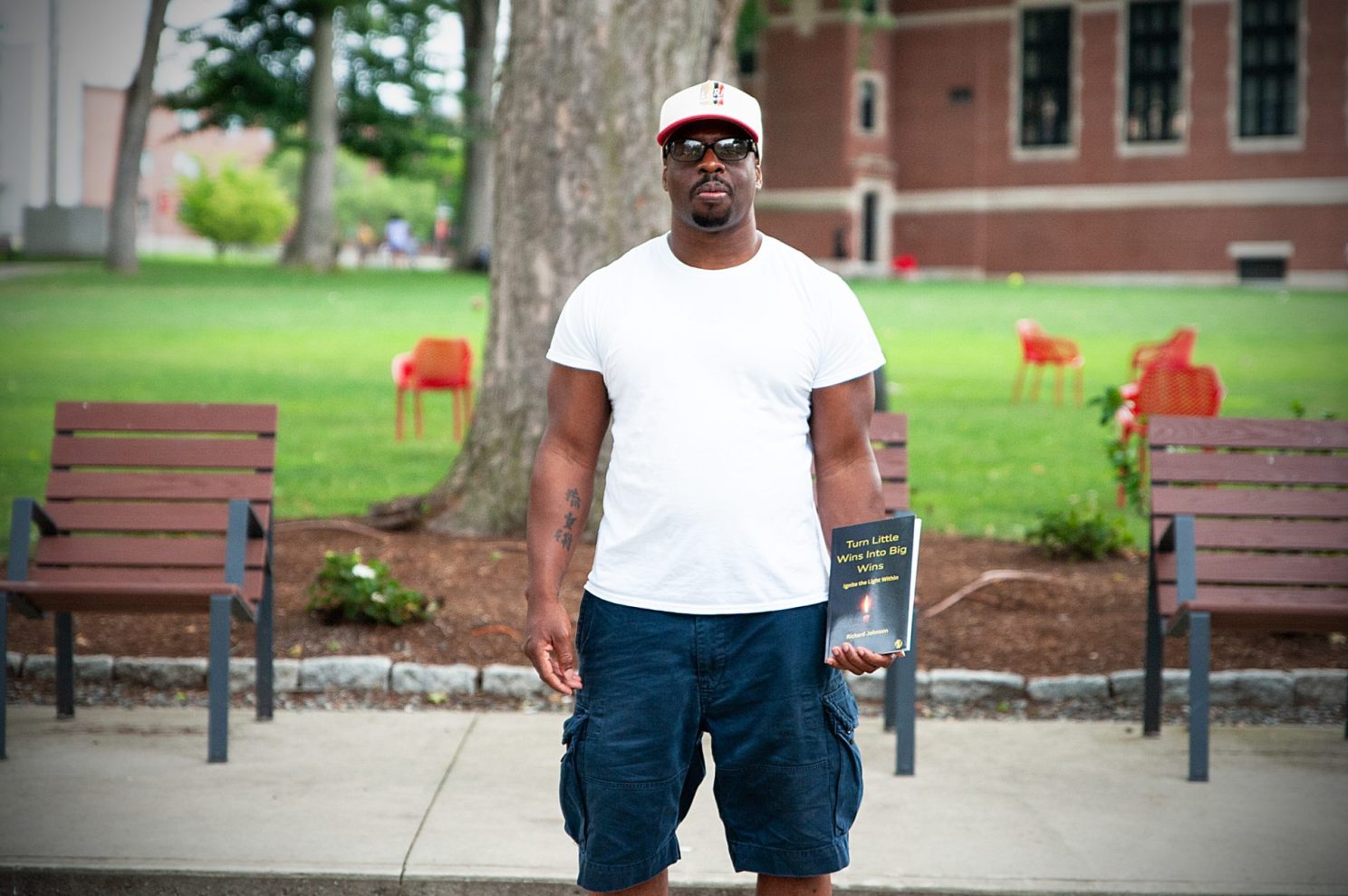
Richard Johnson holds a copy of his book, “Turn Little Wins Into Big Wins: Ignite the Light Within You,” at Clark University in Worcester. Johnson is a student in Clark University’s Liberal Arts for Returning Citizens program.
The Massachusetts Correctional Institution at Shirley is a medium-security prison housing over a thousand inmates behind tall fences topped with razor wire. There, Megumi Abe and other Memorial Church volunteers mentor people society often overlooks, including Carlos, 26, who has served more than five years of a lengthy prison sentence.
“I’ve been so impressed with his resilience and his ability to approach a terrible situation with so much grace and optimism, and to really try to make the most of everything that comes his way,” said Abe. “It’s given me a deeper, more personal understanding of the injustice of the system.”
The church participates in two programs serving people who are incarcerated or recently released. Partakers pairs volunteer teams with incarcerated students pursuing bachelor’s degrees, while Clark University’s Liberal Arts for Returning Citizens (LARC) program offers formerly incarcerated students tuition-free college courses. The Rev. Matthew Ichihashi Potts, Plummer Professor of Christian Morals in the Faculty of Divinity and Pusey Minister in the church, mentors through Partakers and teaches through LARC. He sees this work as part of the Gospel’s call to visit prisoners and as part of his scholarship on forgiveness.
“In the gospels, Jesus says to visit the prisoner,” said Potts. “As I was thinking about what I wanted to do with my work on forgiveness, including its practical, pastoral, and political applicability, I thought I should invite the church into that work in a broader way.”
Over the past three years, two teams from the Memorial Church have participated in the program. The current team, which includes Potts, Abe, and Merryn Fraser, a Postdoctoral Fellow in Immunology and Infectious Diseases at the Harvard T.H. Chan School of Public Health and a regular MemChurch congregant, visits the Massachusetts Correctional Institution at Shirley to meet with Carlos about once a month.
Because incarcerated students have limited internet access, visits focus on classes, projects, research materials, and life outside prison. Mentors complete a thorough check-in and adhere to a strict dress code before meeting students face-to-face for several hours. Fraser said the experience challenges assumptions about incarcerated people and the criminal justice system.
“The first time, it’s definitely an intimidating experience to walk up to that building,” Fraser said. “It really does get you to challenge your own assumptions and implicit biases, or the way that you’ve been conditioned to think about people in these situations. And this is part of why I say we learn more than we can teach our students, because it really gets us to think about the reality of the legal or criminal justice system, to challenge our own assumptions, and to share that information with others.”
Clark University sociology professor Shelly Tenenbaum helped launch LARC in 2022. The program serves people seeking to begin or resume their education after prison. Classes include art, music, history, sociology, political science, economics, chemistry, financial literacy, artificial intelligence, and digital literacy. Although LARC does not grant degrees, its students earn transferable college credit and receive university identification cards and access to campus resources. The program also helps students rebuild employment, academic, and everyday skills they may have lost after years in prison.
“It’s a tuition-free college program for people who have been out of prison,” said Tenenbaum. “Our students need those foundational academic and life skills. We have people who got out of prison after 25 years. They’ve never seen a smartphone.”
Richard Johnson entered LARC after serving four years for drug-related charges. He said his life transformed from drug dealer to author, real estate professional, family man, and man of faith. While incarcerated, he wrote two books and worked as a prison librarian.
“The same way I funneled all my energy into being a prolific drug dealer, now I funnel my energy into doing something that is positive,” Johnson said. “LARC gave me the confidence that I knew how to study and that I could do it.”
The lessons from these programs flow both ways. Potts and the other volunteers say that they learn at least as much from their students as they teach them.
“I think we provide some dignity, encouragement, and a connection to the outside world,” Potts said. “I’ve come to care about these folks, and they feel like they care about me, and that’s enough. That is its own reward.”
The Memorial Church is seeking new volunteers for the Partakers program. Interested individuals can contact puseyminister@harvard.edu for more information.

 Featured series